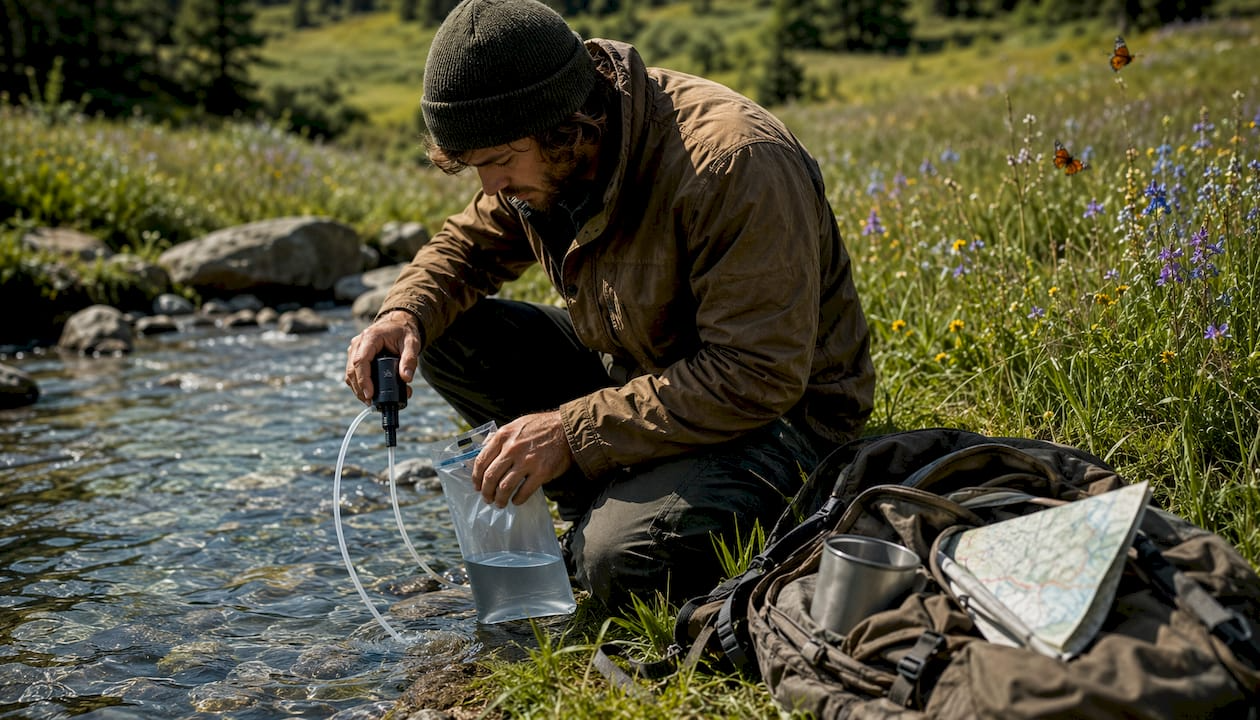
TL;DR:
- Treat all unknown water in the backcountry to prevent waterborne illnesses during outdoor trips.
- Effective purification methods, including filters, boiling, and chemical treatment, target specific contaminants.
Always treat or verify unknown water before drinking in the backcountry. That single habit prevents most waterborne illnesses campers encounter on the trail. Point-of-use filtration can reduce childhood diarrhea by approximately 52%, according to an umbrella review. For campers, the stakes are just as real.
Before you drink from any natural source, run through this quick checklist:
- Health (microbes): bacteria, viruses, and protozoa are present in most surface water
- Chemical risk: agricultural runoff, mining drainage, and industrial discharge can reach remote streams
- Taste and odor: purification removes compounds that make water unpleasant to drink
- Immune-suppressed travelers: anyone on immunosuppressants or with a compromised immune system faces higher risk from even low-level contamination
- Hydration consistency: treated water keeps you drinking steadily, which directly affects performance and safety
Pro Tip: Carry iodine or chlorine dioxide tablets as a backup on every trip. They weigh almost nothing, cost under $10, and can save you if your primary filter fails or freezes.
Why water purification matters for campers and hikers
Safe hydration is the foundation of every successful backcountry trip. When you are moving hard through the wilderness, your water intake goes up, and so does your exposure to types of golf hydration solutions for peak performance whatever is in the source. Drinking untreated water is not a calculated risk worth taking.
Public-health evidence backs this up. The umbrella review that examined point-of-use filtration found it had the strongest evidence among all field-applicable methods for reducing diarrhea, stronger than chlorination or solar disinfection. Community studies on membrane-filtered water showed large declines in reported diarrhea cases after introduction, which translates directly to fewer sick days and faster recovery.
For immune-suppressed campers, the risk is sharper. Acibadem Hospitals Group notes that purified water is a safety-first measure for anyone with compromised immunity, where even low pathogen loads can cause serious illness. The practical outcomes for all campers are straightforward:
- Fewer gastrointestinal episodes mid-trip
- Better physical performance from consistent hydration
- Reduced need for emergency evacuation due to waterborne illness
- Lower medical costs after returning home
Good outdoor water filtration is not optional gear. It is core kit.
What's actually in untreated trail water
Natural water looks clean. That appearance tells you almost nothing about safety. Purification targets parasites, bacteria, viruses, heavy metals, pesticides, and industrial chemicals, all of which can be present in water that looks perfectly clear.
Common contaminants and their practical risks for campers:
- Giardia lamblia (protozoan): causes giardiasis, with cramping and diarrhea starting 1–3 weeks after exposure; common in mountain streams
- Cryptosporidium (protozoan): highly chlorine-resistant; causes watery diarrhea within days; found in water contaminated by animal feces
- E. coli and Salmonella (bacteria): rapid onset, severe gastrointestinal symptoms; present wherever animal or human waste reaches water
- Norovirus and Hepatitis A (viruses): standard mechanical filters do not remove viruses; require chemical treatment or UV
- Heavy metals (arsenic, lead): no taste or odor; chronic exposure causes organ damage; common near mining areas
- Agricultural chemicals (nitrates, pesticides): can reach streams through runoff; boiling and standard filters do not remove them
- Algal toxins (cyanotoxins): produced by blue-green algae blooms; can cause liver damage; boiling makes them worse by releasing more toxin
Taste, smell, and clarity are unreliable safety indicators. Water from a pristine-looking alpine stream can carry Cryptosporidium. Murky water from a slow meadow pond might carry fewer pathogens than a clear stream downstream from a cattle pasture.
Pro Tip: If you see upstream agricultural fields, mining operations, or industrial sites, do not rely on any standard field purification method. Avoid that source entirely and find a spring or headwater source well above any human activity.
Field-ready purification methods and what each one removes
No single method covers every risk. Match your method to the contaminants most likely in your source water.
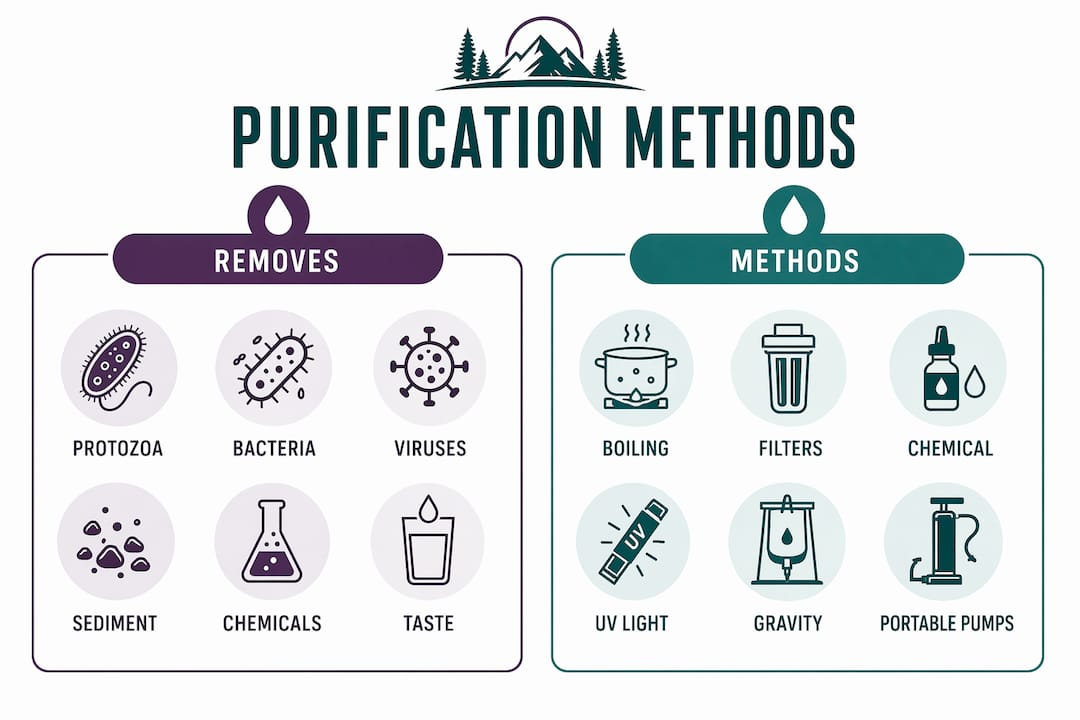
| Method | Protozoa | Bacteria | Viruses | Sediment | Chemicals/Metals | Taste/Odor |
|---|---|---|---|---|---|---|
| Boiling | ✓ | ✓ | ✓ | ✗ | ✗ | ✗ |
| Mechanical filter (1 micron or smaller) | ✓ | ✓ | ✗ | ✓ | ✗ | Partial |
| Chemical (chlorine dioxide) | ✓ | ✓ | ✓ | ✗ | ✗ | ✗ |
| UV pen | ✓ | ✓ | ✓ | ✗ | ✗ | ✗ |
| Reverse osmosis | ✓ | ✓ | ✓ | ✓ | ✓ | ✓ |
| Solar disinfection (SODIS) | ✓ | ✓ | Partial | ✗ | ✗ | ✗ |
Quick pros and cons:
- Boiling: reliable, zero consumables, but does not remove chemicals or heavy metals, and requires fuel
- Mechanical filters: fast flow, no chemicals, but miss viruses; freeze damage is a real risk in winter
- Chemical tablets: ultralight backup, effective against viruses, but slow (30–240 minutes depending on temp and turbidity)
- UV pens: fast and effective, but require low turbidity and a charged battery
- SODIS: free and chemical-free, but needs 6+ hours of direct sunlight and clear plastic bottles
Pro Tip: Pre-filter cloudy water through a bandana or coffee filter before using UV or chemical treatment. Turbidity scatters UV light and shields microbes from disinfectants, reducing effectiveness significantly.
How to choose the right purification method for your trip
Choose by source risk first, then filter by weight, speed, and environment. Here is a practical decision checklist:
- Source type: spring or headwater = lower biological risk; pond, slow river, or downstream of pasture = higher risk
- Turbidity: cloudy water requires pre-filtering before UV or chemical treatment
- Group size: gravity filters and squeeze filters handle high volume better than pump filters for large groups
- Trip length and weight budget: tablets weigh grams; pump filters weigh 3–5 oz; UV pens need batteries
- Freezing temperatures: mechanical filters can crack if water freezes inside; carry chemical backup in winter
- Chemical suspicion: if upstream activity suggests pesticides or heavy metals, avoid the source or use reverse osmosis
Recommended pairings for common scenarios:
- Weekend backpacking (2–3 days, mountain stream): hollow-fiber squeeze filter + chlorine dioxide tablets as backup
- International or high-risk travel: UV pen + pre-filter + chemical backup
- Winter camping: chemical tablets as primary (no freeze risk) + boiling for hot drinks
- Large group base camp: gravity filter bag + chemical treatment for virus coverage
Check that any filter you buy meets NSF/ANSI Standard 53 or 58 for the contaminants it claims to remove. Manufacturer claims vary widely, and certification is the only reliable verification.
Step-by-step field procedures for common methods
Treat water correctly every time. Skipping a step is where contamination happens.
- Collect water from the fastest-moving, clearest section of the source. Avoid stagnant edges.
- Pre-filter turbid water through a bandana, coffee filter, or fine-mesh bag into a clean container. Let sediment settle for 30 minutes if needed.
- Boiling: bring water to a rolling boil for 1 minute (3 minutes above 6,500 feet elevation). Cool in a sealed container before drinking.
- Mechanical filter: follow manufacturer instructions; backflush after every 1–2 liters in silty water to maintain flow rate.
- Chemical tablets (chlorine dioxide): add the correct dose per liter, shake, and wait the full contact time, typically 30 minutes for clear water and up to 4 hours for cold or turbid water.
- UV pen: pre-filter first, then stir the pen in 1 liter of clear water for the manufacturer's specified time (usually 60–90 seconds). Do not use in turbid water.
- SODIS: fill a clear PET bottle, lay it on a reflective surface in direct sunlight for 6 hours minimum (2 days if overcast).
Once water is treated, store it in a clean, sealed container. Keep purified water away from your hands, dirty gear, and untreated water. A hydration pack with a sealed reservoir is one of the cleanest ways to carry and drink treated water on the trail.
Pro Tip: Verify treatment by checking timing, turbidity control, and smell. Properly treated water with chlorine dioxide will have a faint chlorine smell. If your UV pen's indicator light did not stay on for the full cycle, repeat the treatment.
When purification methods aren't enough
If you suspect chemical contamination or algal toxins, do not treat and drink. Standard field methods will not protect you.
Red flags to watch for:
- Unusual water color (orange, green, or oily sheen)
- Strong chemical or petroleum odor
- Visible algal mats or blue-green scum on the surface
- Upstream industrial facilities, mining operations, or heavy agricultural use
- Dead fish or animals near the water source
- Known contaminated well water or posted advisories
Boiling water with algal toxins concentrates those toxins rather than destroying them. UV and standard filters do not remove dissolved chemicals or heavy metals. The safest response is to avoid the source entirely.
Actions to take: find a spring or headwater source well above any suspected contamination, carry pre-bottled water as a backup for the final leg of a trip, or locate a tested municipal supply. Chronic exposure to heavy metals and pesticides carries different risks than acute infection, including long-term organ damage with no immediate symptoms.
What to expect: typical costs and time in the field
Treatments trade off cost, time, and weight. Here is what to budget:
- Chemical tablets (iodine or chlorine dioxide): $5–$15 for a 30-tablet pack; 30 minutes to 4 hours contact time depending on conditions; effective for dozens of liters
- Squeeze or gravity filters: $25–$60 for entry-level hollow-fiber models; flow rate of 0.5–1.5 liters per minute; filter lifespan of 100,000+ liters with proper maintenance
- Pump filters: $50–$120; 1–2 liters per minute; require periodic backflushing and cartridge replacement
- UV pens (SteriPen-style): $50–$100; treat 1 liter in 60–90 seconds; batteries last 50–100 treatments per charge; replacement bulbs available
- Reverse osmosis (base camp units): $150–$400+; slow output; heavy; reserved for chemical-risk situations
For a group of four on a 5-day trip, plan for roughly 3–4 liters per person per day. A gravity filter handles that volume efficiently. A UV pen works well for solo travel where speed matters. Factor in replacement filter cartridges and spare batteries before the trip, not during.
Key Takeaways
Treat every unknown water source in the backcountry: match your method to the contaminant risk, carry a backup, pre-filter turbid water, and protect purified water from recontamination.
| Point | Details |
|---|---|
| Always treat unknown water | Biological and chemical hazards are present in most natural sources, regardless of appearance. |
| Match method to risk | Mechanical filters miss viruses; UV fails in turbid water; no single method covers chemical contamination. |
| Filtration has the strongest evidence | POU filtration reduced childhood diarrhea by approximately 52% in the umbrella review, outperforming other field methods. |
| Know the red flags | Algal blooms, chemical odors, and upstream industrial activity mean avoid the source, not treat it. |
| Lifecampadventure kit recommendation | A hollow-fiber squeeze filter plus chemical tablet backup covers most 2–6 day backcountry trips reliably. |
A practical take on what most campers get wrong
Most campers who get sick in the backcountry were not careless. They just underestimated one thing: the gap between a water source looking safe and actually being safe. Clear, cold, fast-moving mountain water is the most trusted source on the trail, and it is also where Giardia thrives.
The conventional wisdom says "just boil it." Boiling is reliable for microbes, but it leaves chemicals and heavy metals untouched, and it costs fuel you may not have on a long trip. A hollow-fiber filter is faster, lighter, and handles most biological risks in one pass. Add a small pack of chlorine dioxide tablets for virus coverage, and you have a light and affordable two-method system.
For immune-suppressed campers or anyone traveling with young children, the calculus is even simpler: purified water is non-negotiable, not a precaution. The hydration strategies that keep you performing well on the trail start with water you can actually trust.
The one thing most guides skip: protect your treated water as carefully as you treated it. A clean filter and a dirty water bottle cancel each other out.
Your next step: build a trip-ready water kit
Lifecampadventure carries the survival essentials that make building a reliable water kit straightforward, whether you are heading out for a weekend or planning a longer backcountry route. The gear is selected for weight, durability, and real-field performance, not just shelf appeal.
A solid starter kit for most 2–6 day trips includes a hollow-fiber squeeze filter, a small pack of chlorine dioxide tablets, and a collapsible clean-water container. For longer or higher-risk travel, upgrade to a UV pen and a pre-filter bag. Browse the essential camping gear collection to find the right combination for your next trip, and check the outdoor survival checklist to make sure water treatment is not the only box you have covered.
Useful sources
These sources back the claims in this article and are worth reading directly if you want to go deeper.
- CDC: About choosing home water filters — pore size, certification standards, and what different filter types remove
- CDC: How water treatment works — boiling effectiveness and limitations
- CDC: About home water treatment systems — UV systems and turbidity guidance
- Umbrella review: point-of-use filtration and diarrhea outcomes (PubMed, 2025) — the 52% diarrhea reduction finding
- Umbrella review: unsafe drinking water and human health (PMC) — comparative evidence strength across POU methods
- Nature: community membrane filtration and diarrhea reduction — real-world community outcomes
- Acibadem Hospitals Group: purified water explained — immune-suppressed travelers and safety-first guidance
- Britannica: water purification overview — contaminant classes and purification targets
- Lifecampadventure: how to purify water outdoors — step-by-step field techniques and method comparisons
This article is general information for outdoor planning purposes. For medical advice, especially if you are immunocompromised or managing a health condition, consult a qualified healthcare provider and check current CDC or local health authority guidance for your specific destination.
