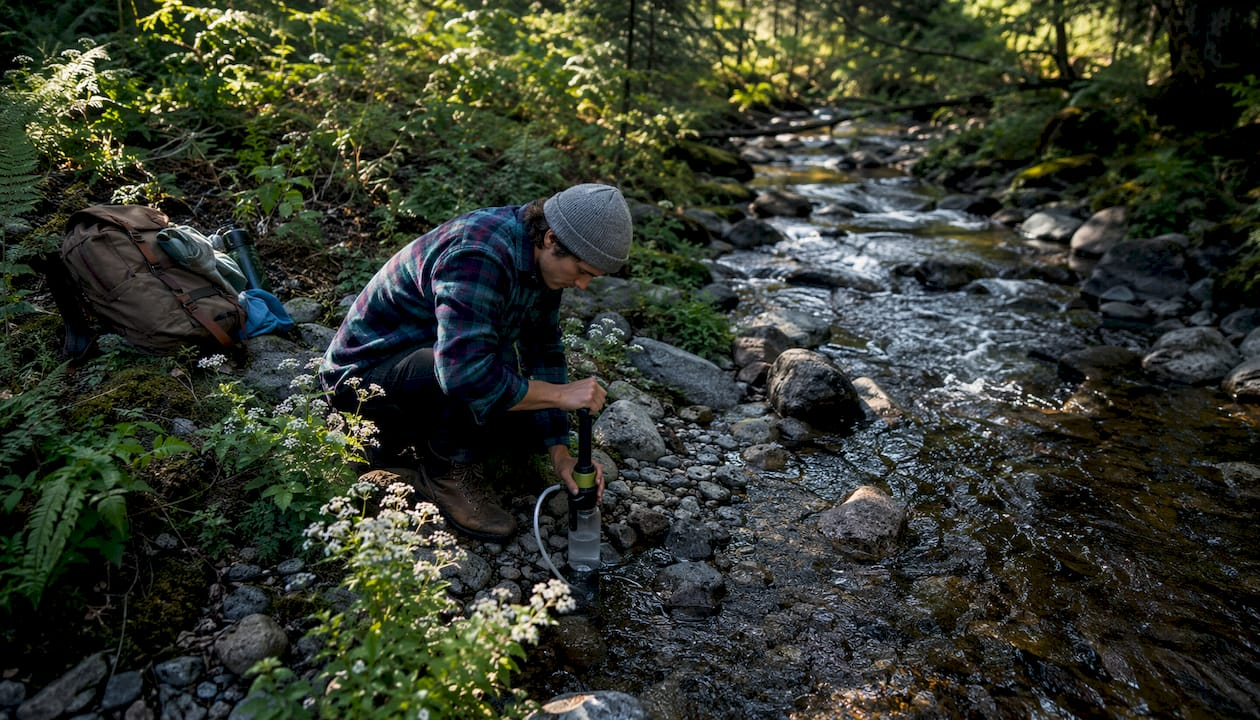
Yes, outdoor enthusiasts should carry a portable water filter on every backcountry trip. An umbrella review of point-of-use filtration trials covering 15,582 participants found a pooled risk ratio of 0.48, meaning filtration cuts diarrheal risk by nearly half. That single figure makes the case. Carry a portable filtration system matched to your trip length and water sources, and you dramatically reduce one of the most common ways a backcountry trip goes sideways.
- Filtration removes bacteria and protozoa (Giardia, Cryptosporidium) reliably when the filter is rated for them.
- Most portable filters do not remove viruses or dissolved chemicals without an added purification step.
- Clear water is not safe water. Invisible pathogens can exist in the most pristine-looking mountain stream.
52% reduction in diarrheal risk from point-of-use filtration (RR = 0.48, 95% CI: 0.39–0.58) — one of the strongest protective effects documented across water-treatment interventions.
Why water filters work: mechanisms, pore size, and what labels mean
Filtration physically strains contaminants out of water. CDC guidance explains that effectiveness depends on pore size and filter type, and that product labels must be checked to confirm which contaminants a given filter targets.
Pore size is the number that matters most. Standard microfiltration (0.1–0.2 micron) removes bacteria and protozoa but lets viruses pass through. Ultrafiltration goes smaller and catches most bacteria and some viruses. Reverse osmosis removes nearly everything, including dissolved chemicals, but it is too slow and heavy for backcountry use. Carbon adsorption, used in many bottle filters, targets taste, odor, and some chemicals, but it does not strain out pathogens on its own.
Certifications from NSF International or the Water Quality Association (WQA) tell you a filter has been independently tested against specific contaminants. A label that says "removes 99.9999% of bacteria" (6-log reduction) means something verifiable. One that says "improves taste" does not guarantee pathogen removal. Read the label as a contract, not marketing copy.
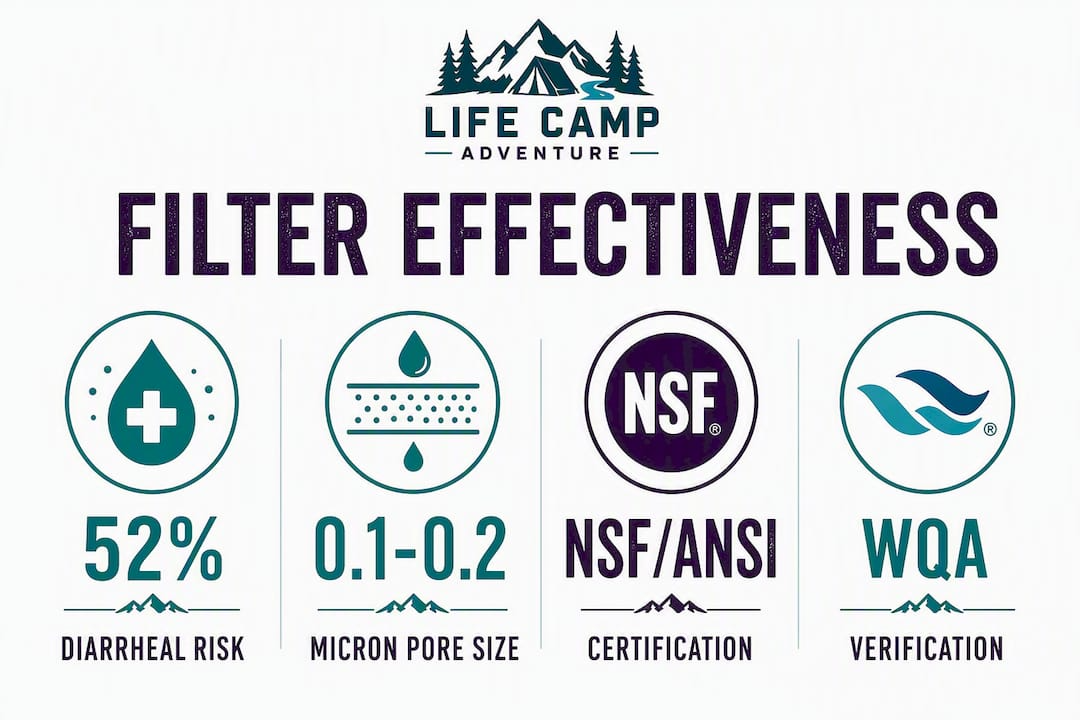
Pro Tip: Look for NSF/ANSI 58 or NSF/ANSI 53 certification on any filter you plan to use in the backcountry. These standards confirm third-party testing, not just manufacturer claims.
What portable filters reliably remove and where they fall short
Filters rated at 0.2 microns or finer reliably remove Giardia, Cryptosporidium, and most bacteria including E. coli. Sediment and particulates are captured at even coarser pore sizes. That covers the most common backcountry threats in U.S. wilderness water sources.
- Removed reliably: Giardia, Cryptosporidium, E. coli, sediment, most bacteria
- Not removed by most portable filters: viruses (norovirus, hepatitis A), dissolved chemicals, PFAS, nitrates, heavy metals
- Situation-specific gaps: wildfire ash contaminants, agricultural runoff chemicals, and mine drainage require avoidance or specialized treatment, not standard filtration
Which portable filter type fits your trip?
CDC's overview of home water treatment systems distinguishes microfiltration, ultrafiltration, and reverse osmosis by what each removes. Those same categories map directly to portable backcountry options.
| Filter Type | What It Removes | Best Use Case |
|---|---|---|
| Straw filter | Bacteria, protozoa | Solo day hikes, ultralight travel |
| Pump filter | Bacteria, protozoa, sediment | Solo or small group, varied sources |
| Gravity filter | Bacteria, protozoa, sediment | Base camps, groups of 3+ |
| Bottle filter | Bacteria, protozoa, some chemicals | Day trips, urban travel, light packing |
| Hollow-fiber squeeze | Bacteria, protozoa | Backpacking, fast and light |
| UV pen | Viruses, bacteria, protozoa (inactivation) | Low-turbidity sources, virus risk areas |
| Chemical tablets | Viruses, bacteria, protozoa (inactivation) | Emergency backup, lightweight redundancy |
Key trade-offs worth knowing before you buy:
- Straw filters are the lightest option but require you to drink directly from the source, limiting versatility.
- Gravity filters have the slowest flow rate per minute but need no pumping, making them ideal for camp use while you set up shelter.
- UV pens work fast on clear water but fail in turbid conditions and depend on battery life. Pair them with a portable power bank on longer trips.
- Hollow-fiber squeeze filters hit the best balance of weight, flow rate, and pathogen removal for most backpacking scenarios.
How to choose the right filter for your trip
Pick the least-complex system that reliably removes the hazards you expect to encounter. Adding complexity adds weight and failure points.
- Identify target contaminants. Domestic wilderness travel typically means bacteria and protozoa. International travel or areas with known viral contamination require a purification step too.
- Check pore size and certification. Confirm NSF or WQA certification for the specific contaminants on your list.
- Match weight to trip type. Day hikes tolerate heavier options; multi-day backpacking demands sub-3-ounce filters.
- Calculate flow rate and throughput. A filter rated for 1,000 liters lifetime is fine for a solo weekend trip; a group of four on a week-long trip needs higher throughput.
- Plan for maintenance. Filters that require backflushing need a clean water source or a syringe. Know the schedule before you leave.
- Account for freezing. Hollow-fiber membranes crack when frozen. In cold-weather camping, keep your filter in a sleeping bag overnight.
- Budget for replacement. Entry-level straw and squeeze filters typically run $20–$50 and last 1,000–2,000 liters. Pump filters range $50–$120 and often last longer with proper maintenance. UV pens run $60–$100 and require periodic bulb or battery replacement.
Cost reality check: A $25 squeeze filter and a $10 pack of chemical tablets together cover bacteria, protozoa, and viruses for most domestic trips — no single device required.
Pair your filter choice with solid hydration solutions before you leave the trailhead.
How to keep your filter working in the field
Maintenance is where most portable filters fail. The fix is almost always simple, and the consequences of skipping it range from slow flow to complete filter failure mid-trip.
- Prefilter turbid water through a bandana, coffee filter, or fine mesh before it hits your main filter. This extends membrane life significantly.
- Backflush after every heavy use session. Most hollow-fiber filters include a syringe or backwash cap. Use it.
- Dry completely before storage. Moisture trapped inside a filter promotes bacterial growth and membrane degradation.
- Never let a hollow-fiber filter freeze. Freeze damage is invisible and permanent. The membrane cracks, and the filter passes pathogens without any visible sign of failure.
- Watch for flow rate drop. A filter that used to fill a liter in 60 seconds now takes 3 minutes is clogged. Backflush first; replace if flow does not recover.
- Carry spare O-rings for pump filters. A failed O-ring is the most common pump failure, and a $0.10 part can save a trip.
Pro Tip: Pack a small prefilter cloth in the same pouch as your filter. A square of tightly woven fabric weighs almost nothing and extends your filter's usable life on high-sediment sources.
When to use alternatives to filtration
Filtration paired with purification provides the broadest protection in wilderness settings where virus or chemical risk exists. Neither method alone covers every threat.
Boiling:
- Kills all pathogens including viruses
- Requires fuel and a camp stove
- Does not remove chemical contaminants or sediment
- Best used when fuel is available and you have time
Chemical disinfectants (chlorine dioxide, iodine):
- Lightweight and packable
- Effective against viruses and most bacteria
- Slower (30 minutes to 4 hours depending on water temperature and turbidity)
- Do not remove sediment or chemical contaminants
UV pens:
- Fast (90 seconds per liter)
- Effective against viruses, bacteria, protozoa
- Fail in turbid water; require batteries
- No chemical residue
When to layer methods:
- Filter first to remove sediment and reduce turbidity.
- Then apply UV or chemical treatment to address viral risk.
- In areas with known chemical contamination, filter and purify, then avoid the source if possible.
What the evidence says about filtration and health
The PMC umbrella review of point-of-use filtration trials is the strongest published evidence base for carrying a filter. Its pooled estimate of RR = 0.48 across 15,582 participants represents a 52% reduction in diarrheal disease risk attributable to filtration alone.
WHO data estimates roughly 1 million deaths per year from diarrheal disease linked to unsafe drinking water. For campers and hikers, the stakes are lower in absolute terms but the exposure is real: natural water sources in the U.S. backcountry regularly carry Giardia and Cryptosporidium from wildlife, and neither is visible to the naked eye.| Evidence Point | Detail |
|---|---|
| POU filtration risk ratio | RR = 0.48 (52% reduction in diarrheal risk) |
| Study population | 15,582 participants across umbrella review trials |
| Key pathogens in U.S. backcountry | Giardia, Cryptosporidium, E. coli |
| Visual clarity as safety indicator | Unreliable — pathogens invisible in clear water |
| PFAS exposure scope | Roughly 172 million Americans in municipal systems |
The AP News summary of EPA guidance makes a useful distinction: home filtration is often about preference (taste, PFAS reduction). Backcountry filtration is about survival necessity. That difference in stakes changes how you should approach filter selection.
Key Takeaways
Portable water filtration cuts diarrheal risk by roughly 52% and is the single most effective safety measure a camper can carry for backcountry water sources.
| Point | Details |
|---|---|
| Filtration reduces diarrheal risk | Point-of-use filtration shows RR = 0.48 (52% reduction in diarrheal risk) across 15,582 participants in umbrella review trials. |
| Filters have real limits | Standard portable filters remove bacteria and protozoa but not viruses or dissolved chemicals like PFAS. |
| Layer methods for full coverage | Filter first to remove sediment, then add UV or chemical treatment when viral risk or chemical contamination is possible. |
| Maintenance prevents failure | Backflush regularly, prefilter turbid sources, and never let a hollow-fiber filter freeze. |
| Lifecampadventure gear | Lifecampadventure's survival essentials guide helps you match the right filtration kit to your trip profile. |
The filter you skip is the one that costs you the trip
Most campers who get sick from backcountry water didn't think the source looked dangerous. That's the whole problem. Crystal-clear alpine water running over granite looks about as clean as water gets. It can still carry Giardia from a marmot upstream, and you won't know until three days after you get home.
The public-health evidence is clear. The field logic is clear. What's less obvious is how often people skip the filter because the water "looks fine" or because they're only out for one night. One night is enough. Giardia has an incubation period of 1–3 weeks, so the connection between the source and the illness is easy to miss.
My honest take: the filter debate is mostly settled. The question worth spending time on is which system fits your actual trip, not whether to carry one at all. A $25 squeeze filter and a pack of chlorine dioxide tablets covers most domestic backcountry scenarios. For international travel or areas with known viral risk, add a UV pen. The outdoor water filtration guide at Lifecampadventure walks through the decision in more detail if you want to go deeper on matching gear to terrain.
Gear up with Lifecampadventure's vetted hydration and survival kits
When you're building a kit that actually holds up in the field, the filter is one piece of a larger system. Lifecampadventure puts together survival and hydration gear selected for reliability, packability, and real-world maintenance demands — not just spec-sheet performance.
The outdoor survival checklist covers filtration alongside shelter, navigation, and first aid so you can pack with confidence instead of guessing what you've missed. For readers building a full kit, the survival kits guide breaks down what belongs in a day pack versus a multi-day system. Browse the full range at Lifecampadventure and find the setup that fits your next trip.
Useful sources and further reading
- PMC Umbrella Review — POU Filtration and Diarrheal Risk: The primary evidence base for the 52% diarrheal risk reduction figure (RR = 0.48) cited throughout this guide.
- CDC — About Choosing Home Water Filters: Explains filtration mechanisms, pore size, and how to read product labels for contaminant removal claims.
- CDC — About Home Water Treatment Systems: Technical breakdown of microfiltration, ultrafiltration, and reverse osmosis and what each removes.
- WHO — Drinking Water Fact Sheet: Global context on waterborne disease burden and the importance of safe water access.
- EWG — Why a Water Filter Matters: PFAS detection scope in U.S. drinking water and the limits of standard portable filters for chemical contaminants.
- AP News — How to Decide Whether You Need a Water Filter: Frames the difference between home preference filtration and backcountry necessity.
- BBC Future — Is Filtered Water Healthier Than Tap Water?: Covers the invisible-pathogen problem and why visual clarity is a poor safety indicator.
- Britannica — Water Purification: Distinguishes filtration from purification and explains when each method applies.
- Lifecampadventure — How to Purify Water Outdoors: Step-by-step guide to combining filtration with purification for full-spectrum protection.
- Lifecampadventure — Survival Essentials Guide: Gear selection guide for building a complete backcountry safety kit including hydration tools.
