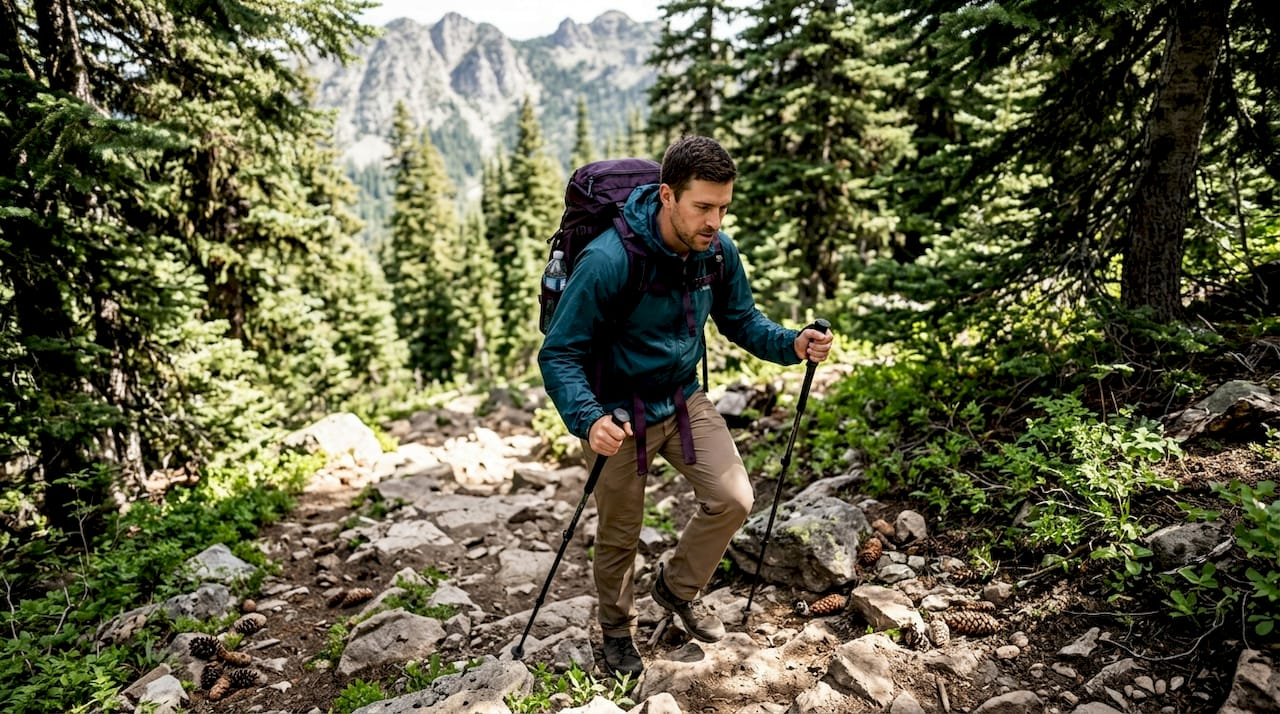
TL;DR:
- Using trekking poles reduces knee joint stress by transferring load from legs to arms during downhill hikes, preventing fatigue and cartilage wear. They enhance stability and balance on uneven terrain, especially when crossing streams, loose gravel, or snow, boosting confidence and reducing accidents. Optimal pole use involves flexible, terrain-adaptive strategies, with proper technique maximizing benefits and minimizing overreliance.
Your knees absorb up to three to four times your body weight with every downhill step. That is not a minor mechanical detail. It is the reason why understanding why use trekking poles matters before your next trail day, not after your joints are already complaining. Many hikers treat poles as optional accessories or a sign of aging, when in reality they are biomechanical tools with a clear, measurable impact on how your body handles terrain. This article breaks down the science, the technique, and the smart decision-making that separates hikers who use poles well from those who just carry them.
Table of Contents
- How trekking poles reduce joint stress and fatigue
- How trekking poles improve hiking stability and balance
- Single pole vs two poles: which is right for you?
- Expert tips to maximize trekking pole benefits
- When to use trekking poles: assessing trail and pack conditions
- Rethinking trekking poles: striking the right balance
- Explore essential outdoor gear to upgrade your next hike
- Frequently asked questions
Key Takeaways
| Point | Details |
|---|---|
| Knee joint protection | Trekking poles reduce knee load by up to 25%, especially on steep descents with heavy packs. |
| Enhanced balance | Poles provide additional ground contact points, improving stability on uneven and slippery terrain. |
| Technique matters | Proper grip, strap use, and timing maximize pole benefits and minimize fatigue. |
| Pole number choice | Two poles offer better symmetrical support; one pole is lighter and frees a hand. |
| Situational use | Use poles primarily for steep slopes, river crossings, heavy packs, and unstable footing. |
How trekking poles reduce joint stress and fatigue
Every descent you complete puts enormous compressive force on your knees. That force does not disappear on its own. It accumulates over miles, contributing to soreness, long-term cartilage wear, and the kind of knee fatigue that makes the last two miles of a hike feel miserable. The scientific reasons why trekking poles reduce strain come down to one core principle: distributing that force more evenly across your body.
Poles work by transferring a portion of your downhill load from your legs and knees to your arms, shoulders, and poles themselves. The result is a measurable drop in knee compression. Trekking poles can reduce knee joint loading during downhill walking by roughly 12% to 25%, especially with loaded packs and steep descents. That reduction is not trivial. On a long day carrying a 35-pound pack down a sustained grade, it is the difference between arriving at camp ready to eat and arriving barely able to walk.
"The load reduction effect is amplified precisely when you need it most: heavy packs, steep grades, and long mileage days. These are the conditions where pole use shifts from helpful to essential."
The muscular shift is equally important. Poles engage your triceps, shoulders, and lats, spreading effort across the body without meaningfully raising your total metabolic cost. Your legs still do the primary work, but they are no longer doing it alone. This delay in leg muscle fatigue is one of the clearest advantages of using trekking poles on multi-day trips where recovery between days is limited.
How trekking poles improve hiking stability and balance
Joint protection alone would justify carrying poles. But the balance benefits of trekking poles are just as significant, and arguably more immediate for hikers on technical terrain.
The core mechanic is simple. Without poles, you balance on two points of contact with the ground. Add poles and you move to four points of contact. That shift changes everything on wet rock, loose scree, muddy switchbacks, and stream crossings. Using trekking poles adds points of contact, effectively going from a 2-point to a 4-point stance, which improves balance on uneven surfaces. Physics and common sense both agree here.
Here is where the role of trekking poles becomes most obvious on trail:
- Stream crossings: Moving water reads differently to your feet than solid ground. A pole planted upstream gives you a third anchor point and buys time to find your footing.
- Loose scree: Sliding gravel is unpredictable. Poles let you test stability before committing your full weight to a step.
- Mud and wet roots: These are where ankle rolls and falls happen most often. Poles catch you before a stumble becomes a fall.
- Snow and ice: Even a light crust of snow over trail surface changes grip entirely. Poles provide constant correction.
- Heavy pack hiking: A loaded pack shifts your center of gravity backward and upward, making balance on varied terrain significantly harder without pole support.
The stability benefit also has a psychological effect. When you feel secure on uncertain ground, you move with more confidence and less tension. Tense hiking mechanics are inefficient and tiring. Poles let you relax into your stride, which directly reduces overall fatigue.
Single pole vs two poles: which is right for you?
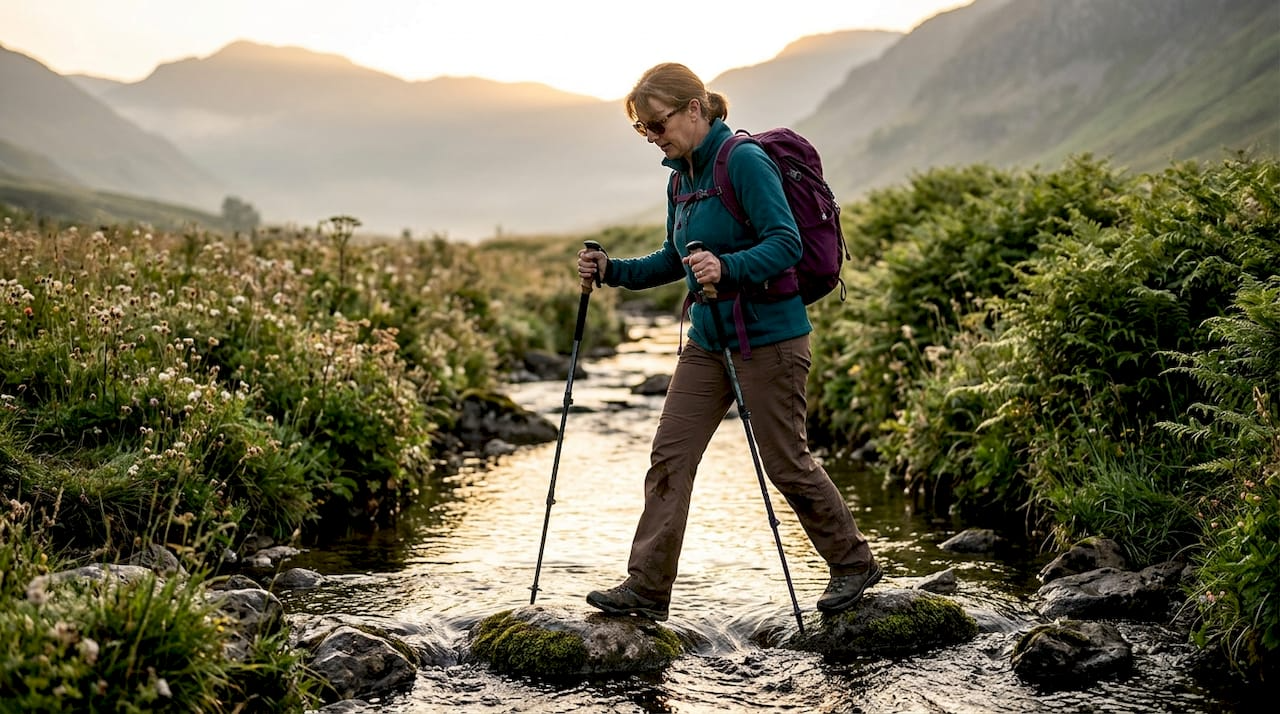
Choosing between one pole or two is less of a lifestyle decision and more of a terrain-driven call. Both configurations have legitimate uses. The mistake is rigidly committing to one approach for every hike.
| Feature | Two poles | Single pole |
|---|---|---|
| Knee load reduction | Up to 25% | Partial, asymmetrical |
| Balance support | Full, symmetrical | One-sided |
| Best terrain | Steep descents, heavy packs, crossings | Moderate trails, scrambles |
| Free hand | No | Yes |
| Weight carried | More | Less |
| Stow and redeploy speed | Slower | Faster |
Two poles provide symmetrical load distribution and up to 25% knee force reduction, while a single pole offers less reduction and asymmetrical support but allows a free hand and saves weight. That asymmetry matters on long days. Consistently offloading one side more than the other can create muscular imbalances over time, especially on descents.
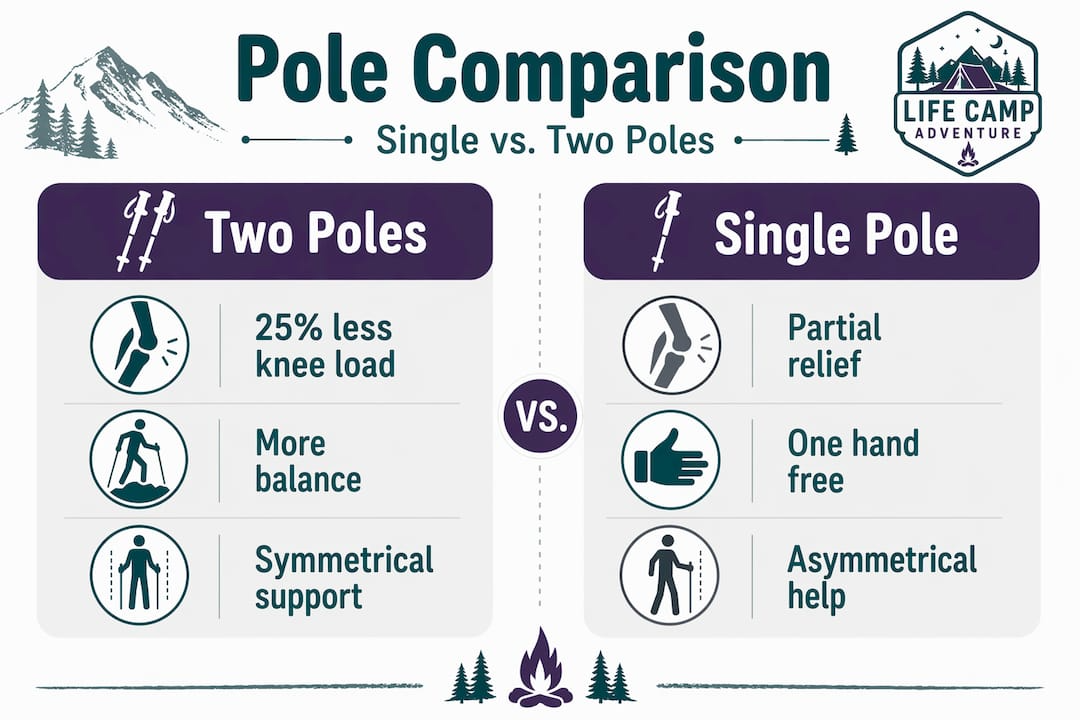
That said, one pole absolutely has its place. On a rocky scramble where you need a free hand for balance grabs, two poles become a liability. On a moderate forest trail with a light pack, carrying two poles may add effort without meaningful return. The sweet spot is flexibility.
When it comes to gear choices for loaded packs, two poles almost always win.
Pro Tip: Carry two poles on any hike with significant elevation change or technical terrain, but stow one when you hit a scrambling section. You get the full benefit of two poles where it counts and the freedom of one hand where the trail demands it.
Expert tips to maximize trekking pole benefits
Owning poles is not the same as using them well. Technique determines whether poles genuinely improve your hike or just add weight to your pack. Correct pole technique, including proper strap use, grip discipline, and timing of pole plants, maximizes benefits and prevents fatigue or discomfort.
Follow this approach for full effectiveness:
- Use wrist straps correctly. Thread your hand up through the strap from below, then grip the handle with the strap supporting your wrist. This lets you push through the strap without white-knuckling the grip, saving forearm strength over miles.
- Adjust pole length for terrain. Shorter poles for ascents, letting you push directly downward. Longer poles for descents, absorbing impact ahead of your step. A good starting point is elbow at 90 degrees on flat ground.
- Synchronize your pole plants. Plant the right pole with the left foot and the left pole with the right foot. This matches your natural walking rhythm and creates propulsive forward momentum.
- Remove wrist straps on steep descents. If you fall and your pole catches on a rock, a wrist strap can wrench or break your wrist. On very exposed terrain, grip the handle directly.
- Practice on easy terrain first. Pole technique feels awkward for the first hour. Work it out on a flat trail before you need it on a demanding one.
Proper pole usage guidance also includes knowing when to collapse and stow your poles quickly. Many experienced hikers clip one pole to their pack during a scramble and redeploy it seconds after the technical section ends.
Pro Tip: On steep descents with a heavy pack, extend your poles two to four centimeters longer than your flat-ground setting. The extra length keeps you from hunching forward and allows you to plant the pole further ahead, absorbing more impact before it reaches your knees.
When to use trekking poles: assessing trail and pack conditions
Poles are not a set-and-forget piece of gear. The real advantages of using trekking poles show up when you deploy them contextually, matching pole use to what the trail is actually asking of your body. Carrying them at all times and using them at all times are two different things.
Here is how to assess whether poles should be in your hands or on your pack:
- Steep descents: Always. This is the single scenario where the benefits of trekking poles for joint protection are most pronounced and most clearly felt.
- Stream crossings: Always, even on easy hikes. Water moves, rocks are slippery, and a pole can stop a fall that cold water and a soaked pack would make genuinely dangerous.
- Heavy pack days: Any pack over 25 pounds shifts your mechanics enough that poles pay their weight in joint protection and balance.
- Overgrown or brushy trails: Poles are useful for pushing vegetation aside before stepping into it. Snakes and irritants both get cleared with a pole tip.
- Flat, easy terrain with a light pack: Stow them. Poles clicking on a paved path or a wide gravel trail add no stability value and just slow your arm swing.
- Emergency situations: A broken pole can serve as a tent stake, a splint, or a way to signal position. Even when unused for stability, they carry secondary value.
The decision is not binary. Poles best serve varying trail conditions when you treat them as reactive tools rather than constant companions.
Rethinking trekking poles: striking the right balance
Here is the perspective most hiking guides skip: poles can be overused just as easily as they are underused, and neither extreme serves you well.
Hikers who plant poles on every flat step of a gentle trail are not getting extra protection. They are disengaging the stabilizer muscles in their ankles, hips, and core that natural terrain is supposed to train. Over time, over-reliance on poles can quietly erode the proprioceptive skills (the body's ability to sense position and balance) that keep you safe when a pole breaks, gets left behind, or is impractical to use.
On the other side, refusing to use poles because they feel unnecessary on "most" of a hike ignores the specific moments where they matter most. One bad step on a stream crossing with a loaded pack can end a multi-day trip immediately.
The best approach is flexible: carry two poles but deploy one or both depending on terrain and fatigue, which optimizes benefits without unnecessary burden. That framing shifts poles from a binary yes or no into a responsive, adaptive tool. Your fatigue level matters here too. At mile two, you may not need poles on a moderate descent. At mile fourteen on the same trail, the same descent may demand both poles and full attention.
Treat adaptive trekking pole use strategies the same way you treat pacing and nutrition: as something you manage actively throughout the hike, not something you decide once at the trailhead.
Explore essential outdoor gear to upgrade your next hike
Understanding the role of trekking poles is the first step. Putting together a complete kit that supports your stability, endurance, and safety on trail is the next one.

At Life Camp Adventure, we carry gear built for hikers who take their time on trail seriously. From essential camping gear and lightweight backpacks to durable trekking poles and weatherproof shelter, everything in our catalog is chosen for real-world performance. Whether you are planning a day hike or a multi-week backcountry trip, our product range covers the stability, comfort, and safety equipment that experienced hikers rely on. Browse what we carry and build out your kit with gear that earns its weight on every trail you tackle.
Frequently asked questions
Do trekking poles really reduce knee pain while hiking?
Yes. Trekking poles can reduce knee joint compressive forces by 12% to 25% during downhill walking, which directly translates to less pain and fatigue over long descents.
Is it better to use one or two trekking poles?
Two poles provide balanced load reduction and full stability support on steep or technical terrain, while one pole saves weight and keeps a free hand for simpler sections of trail.
When should I carry trekking poles but not necessarily use them constantly?
Carry poles on any hike with steep descents, river crossings, or a loaded pack, but stow them on flat or easy terrain where they add no practical value to your balance or joint health.
Can trekking poles help improve hiking speed and endurance?
Yes. With proper technique, poles engage your upper body to distribute effort, reducing perceived leg fatigue and allowing a more efficient pace across longer distances.
Are trekking poles beneficial for beginners and light pack hikers?
Beginners benefit from poles for stability and joint protection even on moderate trails, though poles are not always necessary for easy hikes with a light pack. Carrying them and using them selectively is a reasonable starting approach.
