
TL;DR:
- Portable power banks have become essential, providing reliable on-the-go charging for outdoor activities and emergencies. They eliminate reliance on outlets, support multiple devices with fast charging, and boost confidence during travel or power outages. Choosing the right capacity and features ensures optimal performance and safety for everyday and outdoor use.
A portable power bank is a compact, rechargeable battery pack that charges electronic devices without a wall outlet. If you've ever watched your phone die mid-trail with three miles left to the trailhead, you already understand why use portable power banks matters more than most gear decisions. Battery anxiety affects 50% of smartphone users, and nearly 70% now rely on portable chargers daily. That number tells you something real: people have stopped treating power banks as a backup plan and started treating them as standard kit.
Why use portable power banks for everyday and outdoor life
Power banks, also called portable chargers or battery packs, have shifted from emergency accessories to essential daily productivity tools used for navigation, streaming, remote work, and communication. That shift happened because modern devices drain faster than ever. A full day of GPS tracking, photo capture, and music playback on a hiking trail can kill a smartphone battery in under four hours.
The core benefits of portable chargers come down to five practical realities:
- Freedom from outlets. You charge when and where you need to, not when infrastructure allows.
- Emergency backup. A dead phone during a storm, a car breakdown, or a backcountry detour is a genuine safety risk.
- Multi-device charging. Most mid-range power banks include two or more USB ports, so your phone, earbuds, and GPS tracker charge simultaneously.
- Fast charging technology. A 15 to 20 minute charge from a modern fast-charging power bank can power a smartphone for several hours. That matters when you have a short window at a trailhead outlet.
- Reduced battery anxiety. Knowing you carry a full charge in your pack changes how confidently you use your phone for navigation and communication.
"Portable chargers serve as insurance, providing security and independence from unreliable power grids during travel or emergencies." — Sold Magazine
Pro Tip: Charge your power bank the night before any trip, not the morning of. A full charge takes two to four hours for most mid-capacity models, and rushing it means you leave with 80% instead of 100%.
How to choose the right power bank capacity for your needs

Capacity is measured in milliampere-hours (mAh). The higher the number, the more charge the bank holds. But there's a catch most buyers miss: actual usable charge is about 65% to 70% of the advertised capacity due to energy conversion losses. A 10,000mAh bank delivers roughly 6,500 to 7,000mAh of real charge. Plan around that number, not the label.
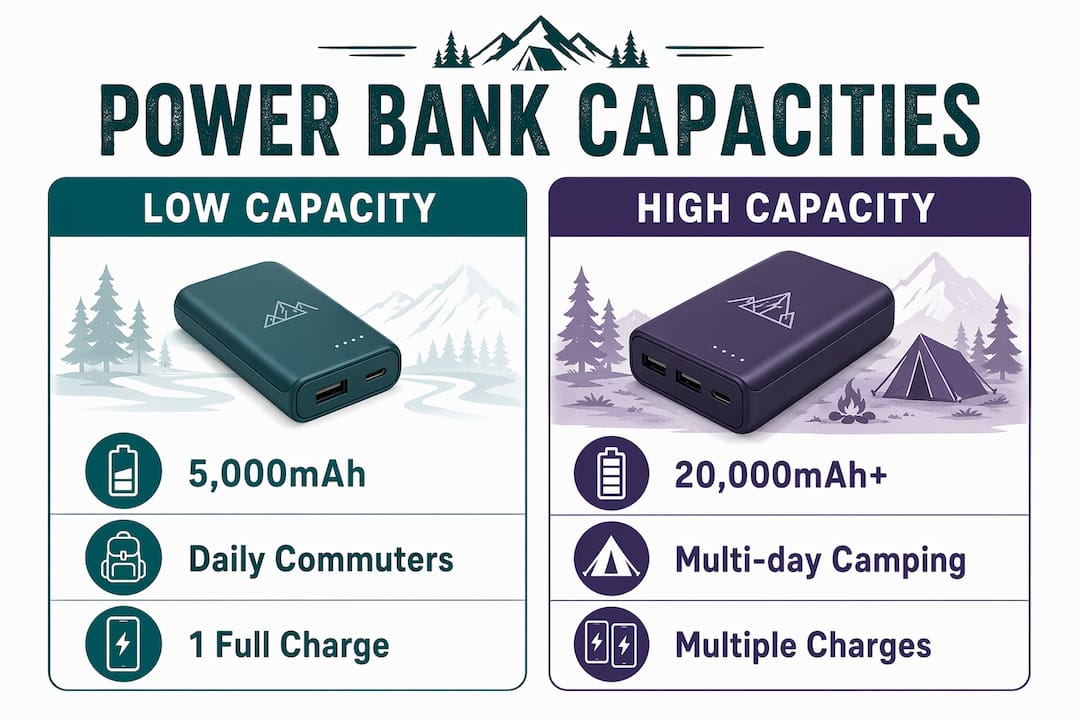
| Capacity | Best for | Approximate phone charges |
|---|---|---|
| 5,000mAh | Light daily commuters | 1 full charge |
| 10,000mAh | Travelers and day hikers | 2 full charges |
| 20,000mAh+ | Multi-day campers and backpackers | 4 to 5+ charges |
Beyond capacity, these features separate a good power bank from a great one:
Fast charging support. Look for Power Delivery (USB-C PD) or Qualcomm Quick Charge compatibility. These protocols cut charge times significantly compared to standard 5W output.
Pass-through charging. This feature lets you charge the bank and your devices simultaneously, turning the unit into a multi-port hub when you find an outlet at a campsite or airport.
Built-in cables. Power banks with integrated Lightning or USB-C cables remove the risk of forgetting a cable entirely. For backpackers counting every ounce and every item, that matters.
Brand reputation and safety certifications. Reputable brands include built-in protections against overcharging, overheating, and short circuits. Cheap, uncertified units skip these safeguards. For gear you carry in a tent or a backpack, that's not a risk worth taking.
Pro Tip: If you're buying for backpacking specifically, check the weight per mAh ratio, not just total capacity. A 10,000mAh bank at 180 grams beats a 20,000mAh bank at 450 grams for most three-day trips.
Power banks vs. other charging solutions
Understanding why choose power banks over alternatives requires an honest look at what each option actually delivers.
| Charging solution | Portability | Requires outlet | Works outdoors | Multi-device |
|---|---|---|---|---|
| Portable power bank | High | No | Yes | Yes |
| Wall charger | None | Yes | No | Limited |
| Wireless charger | Low | Yes | No | No |
| Portable solar panel | Medium | No | Yes | Yes |
Wall chargers deliver fast, reliable power but require infrastructure. They're useless on a trail, in a car, or during a power outage. Wireless chargers add convenience at home but are slower than wired charging and completely dependent on a power source. Portable solar panels, like those covered in Lifecampadventure's guide to solar panels for outdoor use, pair well with power banks for extended off-grid trips but can't replace them on cloudy days or in dense forest cover.
Power banks win on three specific criteria: they work in any environment, they charge at full speed regardless of weather, and they require no external input during use. For outdoor enthusiasts, that combination is unmatched by any single alternative.
Practical uses for hiking, travel, and emergencies
The advantages of portable power become clearest when you map them to specific scenarios. Here's how power banks perform where it actually counts.
Hiking and backpacking. GPS apps like Gaia GPS and AllTrails drain batteries fast, especially with the screen on. A power bank keeps navigation running for the full day. Pair it with a headlamp, and you've covered both communication and visibility. Lifecampadventure's breakdown of backpacking benefits covers why reliable gear, including power, defines a safe trip.
Multi-day camping. At a campsite without hookups, a 20,000mAh power bank covers a phone, a Bluetooth speaker, and a headlamp battery for two to three nights. Combine it with a quality camping lantern that charges via USB, and you reduce the number of separate batteries you carry.
Air travel and long transit. Airports and trains have limited outlets, and the ones available are usually occupied. A 10,000mAh bank covers a full international flight for most travelers, handling both a phone and wireless earbuds without hunting for a seat near a wall.
Emergencies and power outages. A fully charged power bank provides hours of communication capability when the grid goes down. For families in storm-prone areas, keeping a 20,000mAh bank charged at home is the same logic as keeping a flashlight in the drawer.
Sports and athletic use. Devices like the Aiming Fluid Golf GPS speaker and power bank show how portable power has moved into performance monitoring. Athletes who track workouts, heart rate, and GPS routes need continuous power throughout a session.
Pro Tip: Store your power bank at 50% to 80% charge when not in use for extended periods. Storing at full charge or fully depleted degrades lithium-ion battery cells faster and shortens the bank's total lifespan.
Key takeaways
Portable power banks are the most practical charging solution for anyone who spends time away from outlets, whether on a trail, in transit, or during an emergency.
| Point | Details |
|---|---|
| Core function | Power banks deliver on-the-go charging without any outlet access required. |
| Capacity planning | Account for 65% to 70% real usable output when selecting mAh capacity. |
| Best capacity for most users | A 10,000mAh model balances charge capacity and carry weight for daily and trail use. |
| Key features to prioritize | Fast charging, pass-through charging, and built-in cables add the most real-world value. |
| Safety and brand quality | Certified brands include overcharge and overheat protection that cheap units skip entirely. |
Why I carry a power bank on every single trip
I've made the mistake of leaving a power bank behind because the trip felt short. Four hours into what was supposed to be a six-hour day hike, my phone was at 11% with GPS still running. That's the moment you realize the importance of power banks isn't theoretical.
The advice I'd push back on is the instinct to buy the biggest capacity available. Most people overestimate how much power they actually need and end up carrying a 20,000mAh brick that weighs more than their water filter. For a single overnight trip, a 10,000mAh bank is almost always enough. Save the high-capacity units for multi-day expeditions where you genuinely can't recharge.
The feature I've come to value most is the built-in cable. It sounds minor until you're standing at a trailhead realizing your charging cable is on your desk at home. Banks with integrated USB-C cables remove that variable entirely.
One habit that separates prepared adventurers from frustrated ones: treat your power bank like your water bottle. You wouldn't leave home with an empty bottle. Don't leave with an uncharged bank. Make it part of your pre-trip checklist, not an afterthought.
— Billy
Gear up for your next adventure with Lifecampadventure

A reliable power bank is only one piece of a well-built kit. At Lifecampadventure, we've put together resources and gear guides specifically for people who take their outdoor time seriously. Whether you're planning a weekend camping trip or a multi-week expedition, having the right power solution paired with quality gear makes the difference between a frustrating experience and a confident one. Start with our guide to essential camping gear types to see how portable power fits into a complete outdoor setup. For a broader look at selecting gear that holds up in the field, our camping equipment guide covers what to prioritize and why.
FAQ
What does a portable power bank actually do?
A portable power bank stores electrical energy in a lithium-ion battery and releases it through USB ports to charge devices like smartphones, earbuds, and GPS units without a wall outlet.
How many times can a power bank charge a phone?
A 10,000mAh power bank delivers roughly two full charges for a standard smartphone, accounting for the 65% to 70% real usable output due to energy conversion losses.
Are power banks worth it for short trips?
Yes. Even a single-day hike with GPS navigation, photography, and music playback can drain a phone battery completely. A compact 5,000 to 10,000mAh bank adds minimal weight and covers that gap reliably.
What capacity power bank do I need for camping?
Multi-day campers without access to power hookups need at least 20,000mAh to cover a phone, earbuds, and small accessories across two to three nights of use.
Can I take a power bank on a plane?
Most power banks up to 100Wh (roughly 27,000mAh at 3.7V) are allowed in carry-on luggage under TSA and IATA rules. Check your specific bank's watt-hour rating before flying, as checked baggage rules are stricter.
