TL;DR:
- Down sleeping bags are lightweight, packable, and long-lasting, making them ideal for dry, cold conditions. Moisture remains their main vulnerability, but modern treatments improve their water resistance for three-season use. Proper storage and moisture management are essential to maximize their performance and durability in the backcountry.
Down sleeping bags are insulation products made from the soft, fluffy clusters beneath the feathers of waterfowl, prized for an unmatched warmth-to-weight ratio and compressibility no synthetic material has matched. If you've ever carried a synthetic bag on a five-day alpine route and felt every ounce of it by day three, you already understand the core argument. The question of why use down sleeping bags comes down to three measurable advantages: weight, packability, and lifespan. This guide breaks down exactly how down insulation works, where it outperforms synthetic fill, and when you should reach for something else instead.
Why use down sleeping bags: warmth, weight, and fill power explained
Down insulation works by trapping air in tiny filaments, creating a thermal barrier that relies on still air to block heat loss. The more loft a down cluster can generate, the more air it traps, and the warmer you stay per ounce of fill. This is the physics behind why a 15-degree down bag can weigh under two pounds while a synthetic bag at the same rating often tips the scale significantly higher.

Fill power is the standard industry measure for down quality. It measures the cubic inches one ounce of down occupies when allowed to fully expand. A 650 fill power bag is solid for three-season camping. An 800 or 900 fill power bag is what mountaineers and ultralight backpackers reach for when every gram counts.
The weight difference is not trivial. Down bags weigh 20–40% less than equivalent synthetic bags at the same temperature rating. On a 20°F-rated bag, that translates to 8–16 ounces of savings over a comparable synthetic option. Half a pound to a full pound off your back matters on day four of a backcountry trip.
Fill power, weight, and pack size compared
| Fill Power | Typical Weight (20°F bag) | Packed Size | Best Use |
|---|---|---|---|
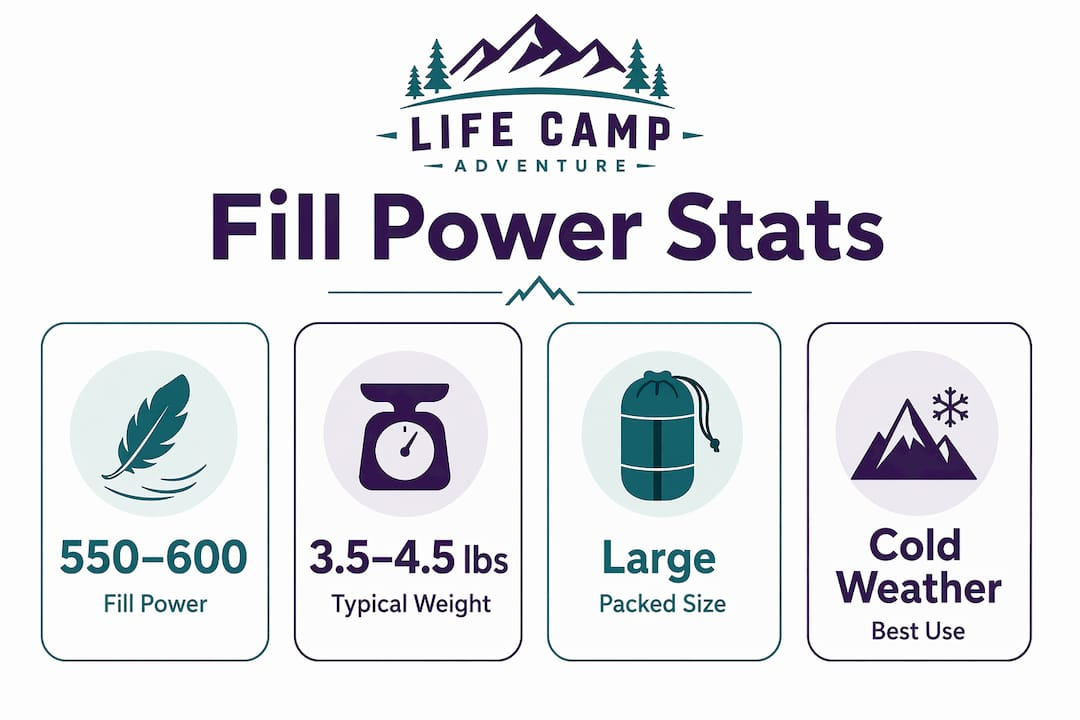
| 550–600 | 3.5–4.5 lbs | Large | Car camping, budget builds |
| 650–700 | 2.5–3.5 lbs | Medium | Three-season backpacking |
| 750–800 | 1.8–2.5 lbs | Small | Alpine, ultralight trekking |
| 850–900+ | 1.2–1.8 lbs | Very small | Mountaineering, expeditions |
Pro Tip: When comparing bags at the same temperature rating, always check the fill weight, not just the fill power. A bag with 900 fill power but minimal fill weight may not outperform a 750 fill power bag with more fill.
How does moisture affect down sleeping bags?
Down's biggest vulnerability is water. When down clusters get wet, they lose nearly all loft and insulating value, collapsing into a cold, damp mass that offers almost no warmth. Synthetic fibers, by contrast, retain 80–85% of their warmth when wet. That gap is the single most important factor when choosing between the two materials for a specific trip.
Modern hydrophobic treatments have narrowed this gap considerably. Technologies like DownTek and Nikwax coat individual down filaments with a water-resistant finish, allowing them to repel light moisture and dry faster than untreated down. These treatments do not make down waterproof, but they buy you meaningful protection against condensation, light rain, and the humidity that builds inside a tent overnight.
Here is how to keep your down bag dry and performing in the field:
- Store your bag in a waterproof compression sack during travel and pack-out, especially in wet weather.
- Use a quality tent with a full rain fly and good ventilation to reduce interior condensation.
- Air out your bag every morning when possible, even for 10–15 minutes, to release body moisture that accumulates overnight.
- Never pack a damp bag. If it gets wet, dry it fully before compressing it for storage.
- In consistently wet climates like the Pacific Northwest, consider a treated down bag or a synthetic alternative for multi-day trips.
Pro Tip: Carry a lightweight silnylon dry bag sized for your sleeping bag. It adds almost no weight and protects your most critical piece of warmth gear from a single bad river crossing or unexpected downpour.
The practical takeaway is this: treated down bags like those using DownTek or Nikwax technology are suitable for three-season conditions and mixed weather. For sustained rain or high-humidity environments, synthetic insulation is the safer choice.
Are down sleeping bags worth the investment?
The upfront cost of a quality down bag is real. High-quality down bags start at $250–$500 or more, while reliable synthetic bags run $80–$200. That price gap stops most first-time buyers. But the math changes when you factor in lifespan.
Quality down sleeping bags last 15–20 years with proper care. A $400 down bag used for 20 years costs roughly $20 per year to own. A $150 synthetic bag that loses significant loft after 5–7 years costs $25–$30 per year. Down wins on cost per year of ownership, and it wins by a wider margin the more you use it.
What drives down bag pricing
| Price Range | Fill Power | Expected Lifespan | Best For |
|---|---|---|---|
| $250–$350 | 550–650 | 10–15 years | Recreational backpacking |
| $350–$500 | 700–750 | 15–20 years | Serious backpacking, alpine |
| $500+ | 800–900+ | 20+ years | Mountaineering, expeditions |
Proper care is what separates a 10-year bag from a 20-year bag. Storing your bag uncompressed, washing it with a down-specific detergent like Nikwax Down Wash, and using a waterproof compression sack in the field are the three practices that protect your investment. Compressing a down bag in a stuff sack for months at a time crushes the clusters and permanently reduces loft. Hang it or store it loose in a large cotton storage sack when it's not in use.
For serious outdoor enthusiasts who camp more than 15 nights a year, a quality down bag is not an extravagance. It is the more economical choice over a decade. You can read more about choosing the right camping equipment to make sure your full kit holds up the same way.
In which climates and activities do down bags perform best?
Down sleeping bags deliver their greatest advantages in specific conditions. Knowing where they shine helps you decide when to pack one and when to leave it at home.
Dry, cold alpine environments. Above treeline in the Rockies, Sierra Nevada, or Cascades, humidity is low and temperatures drop hard at night. Down's warmth-to-weight advantage is fully realized here. A 900 fill power bag at two pounds outperforms any synthetic option in these conditions.
Ultralight backpacking. When you are packing light for multi-day expeditions, every ounce you cut from your sleep system goes back into your legs. Down is the standard choice for thru-hikers on the Pacific Crest Trail and Continental Divide Trail for exactly this reason.
Mountaineering and high-altitude expeditions. At altitude, cold is extreme and moisture is manageable with the right tent and vapor barrier strategies. Down bags with 800+ fill power are standard kit for routes on Denali, Aconcagua, and similar objectives.
Desert camping. Desert nights are cold and dry. Down performs perfectly in these conditions, and the packability means it takes up minimal space in a pack loaded with water.
Three-season backpacking with treated down. Bags using DownTek or Nikwax-treated fill extend down's usability into shoulder seasons and mixed conditions. They are not a replacement for synthetic in genuinely wet climates, but they handle morning dew and light rain without issue.
When synthetic insulation is the better call: consistently wet or humid climates like the Pacific Northwest, canoe tripping where immersion risk is real, and any trip where you cannot guarantee your bag stays dry. For those scenarios, a quality synthetic bag is the right tool. You can explore down vs synthetic sleeping bag options in more detail to match your specific trip profile.
Key takeaways
Down sleeping bags are the superior choice for weight, packability, and long-term value in dry and cold conditions, but require moisture management to perform reliably.
| Point | Details |
|---|---|
| Warmth-to-weight ratio | Down bags weigh 20–40% less than synthetic at the same temperature rating. |
| Fill power matters | Higher fill power means more warmth per ounce; 750+ is the threshold for serious backcountry use. |
| Moisture is the main risk | Wet down loses nearly all insulating value; use treated down or synthetic in wet climates. |
| Long-term value | A $400 down bag cared for properly costs about $20 per year over a 20-year lifespan. |
| Best conditions | Dry, cold, alpine, and desert environments are where down sleeping bags outperform all alternatives. |
Down bags in practice: what I've learned after years in the backcountry
I've used down sleeping bags on routes from the Wind River Range in Wyoming to the high desert of Utah, and my honest position is this: down is the right choice for most serious backcountry trips, but only if you treat moisture management as a non-negotiable part of your system.
The biggest mistake I see is people buying a quality down bag and then stuffing it into a non-waterproof pack pocket for a week in the Cascades. The bag survives, barely, but it never fully dries, and by night three it is noticeably less warm. A $15 dry bag solves that problem entirely.
Treated down has genuinely changed how I pack. I used to carry a synthetic bag any time rain was in the forecast. Now I default to a DownTek-treated bag for three-season trips and only switch to synthetic when I'm canoe camping or doing a coastal route where soaking is likely. The weight savings on a seven-day trip are significant enough to feel in my knees by the end of the week.
One thing most guides skip: how you store your bag between trips matters as much as how you use it in the field. I keep mine hanging in a closet in a large mesh storage sack. Bags stored compressed for months lose loft faster than bags stored loose. That single habit has kept my current bag performing like new after eight years of regular use.
If you are on the fence about whether a down bag is worth the price, ask yourself how many nights a year you actually sleep in it. More than 15 nights a year, and the math strongly favors down. Fewer than that, and a mid-range synthetic bag is a perfectly reasonable choice.
— Billy
Gear up with Lifecampadventure for your next adventure
Lifecampadventure carries a curated selection of outdoor sleeping bags and essential camping gear built for the conditions you actually face. Whether you're planning a desert solo, an alpine push, or a three-season thru-hike, the right sleep system starts with understanding your environment and matching your gear to it. Browse the full range of top-rated outdoor gear to find down sleeping bags, waterproof compression sacks, and the accessories that protect your investment trip after trip. Good gear, chosen carefully, is the difference between a great night's sleep and a miserable one at 11,000 feet.
FAQ
What is fill power and why does it matter for down bags?
Fill power measures the cubic inches one ounce of down occupies when fully expanded. Higher fill power means more warmth per ounce, so a 900 fill power bag is lighter and warmer than a 600 fill power bag at the same temperature rating.
How long do down sleeping bags last?
Quality down sleeping bags last 15–20 years with proper care, including storing them uncompressed and washing with a down-specific detergent. Synthetic bags typically lose significant loft after 5–7 years of regular use.
Are down sleeping bags worth it for casual campers?
For campers who sleep outdoors more than 15 nights per year, down bags are the more economical choice over time despite the higher upfront cost. Casual campers who camp fewer than 10 nights a year may find a quality synthetic bag a more practical investment.
Can down sleeping bags get wet?
Untreated down loses nearly all insulating value when wet. Modern treated down using technologies like DownTek or Nikwax repels light moisture and dries faster, but no down bag should be relied on in sustained rain without a waterproof outer layer.
When should I choose synthetic over down?
Synthetic insulation retains 80–85% of its warmth when wet, making it the better choice for consistently wet or humid climates, canoe trips, and any situation where keeping your bag dry is not guaranteed.
