TL;DR:
- Practicing Leave No Trace helps protect ecosystems, wildlife, and public lands from damage caused by increased trail use. Education and modeling responsible behaviors prevent restrictions that limit outdoor access for everyone. Collective adherence ensures land remains open, healthy, and sustainable for future generations.
Leave No Trace (LNT) is defined as a set of seven principles developed by the Leave No Trace Center for Outdoor Ethics and endorsed by the U.S. National Park Service to guide outdoor visitors in reducing their impact on natural environments. Practicing these principles protects ecosystems, preserves wildlife habitats, and keeps public lands open for everyone. A 2023 survey of over 500 professional land managers found that 91% agree LNT promotes and protects environmental health and recreational experiences. That number tells you everything about why practice leave no trace matters: it is not a personal preference but a proven standard that land managers rely on to sustain the places you love to visit.
Why practice Leave No Trace: the environmental case
Trail usage in the U.S. has roughly doubled since 2010, causing measurable degradation across public lands. More boots on the ground means more soil compaction, more erosion along stream banks, and more vegetation loss on popular routes. Without LNT practices, that damage compounds every single season.
The consequences are not abstract. Unmanaged campfire rings scar soil for decades. Trampled vegetation along social trails fragments habitat and exposes bare ground to erosion. Improperly disposed waste contaminates water sources and spreads pathogens to wildlife and other visitors. These are not edge cases. They are the documented results of high-use areas where LNT adherence is low.
LNT is practical stewardship, not just a moral position. Choosing a durable surface to camp on, packing out all trash, and staying on marked trails are engineering decisions that prevent irreversible damage. Each choice either adds to or subtracts from the cumulative load a landscape can absorb.
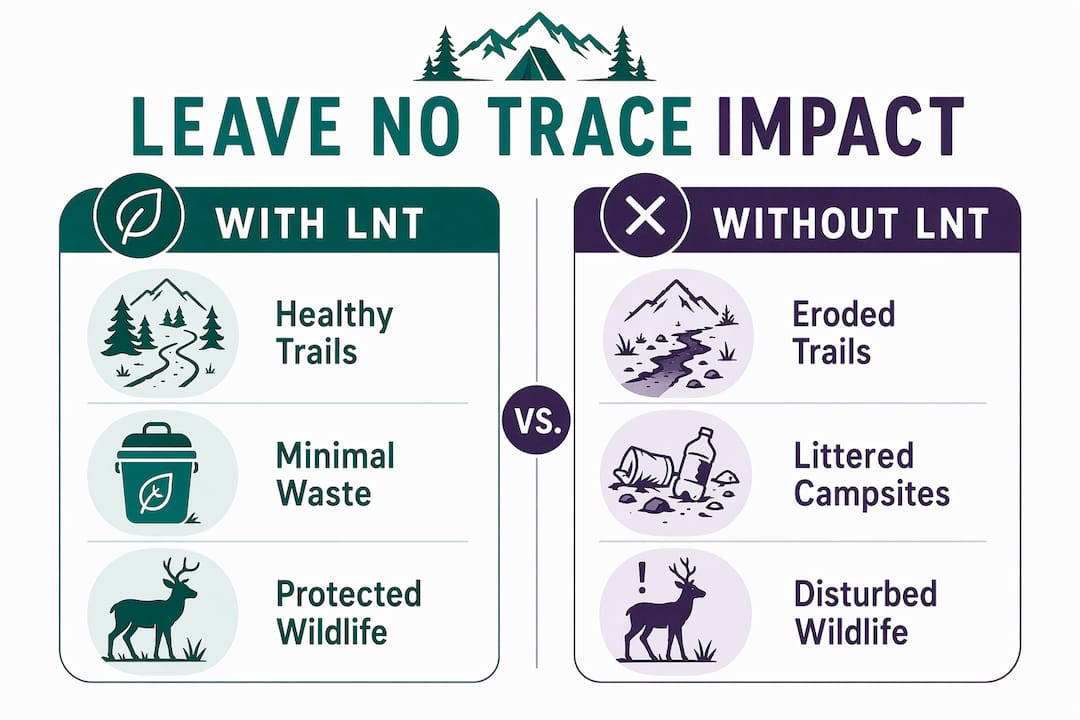
The table below shows the direct contrast between visiting with and without LNT practices.
| Condition | With LNT practices | Without LNT practices |
|---|---|---|
| Soil and trail health | Trails remain stable; minimal erosion | Compaction, widening, and erosion accelerate |
| Water quality | Waste disposed correctly; water sources protected | Contamination from waste and soap runoff |
| Vegetation | Native plants intact; campsites recover quickly | Trampled ground cover; slow or no recovery |
| Wildlife behavior | Animals maintain natural foraging patterns | Habituation, food conditioning, and conflict |
| Visitor access | Trails stay open; no permit restrictions needed | Closures, permit lotteries, and fire bans imposed |
Pro Tip: Pack a small trowel and use the cat-hole method, digging 6–8 inches deep and at least 200 feet from water, trails, and campsites, to dispose of human waste without contaminating the surrounding environment.
How does Leave No Trace protect wildlife?
Human food scraps and trash alter natural foraging behaviors and can directly endanger wildlife. A bear that associates campsites with food becomes a safety risk and is often euthanized. A fox that learns to beg from hikers loses the skills to survive on its own. These outcomes start with a single granola bar left on a picnic table.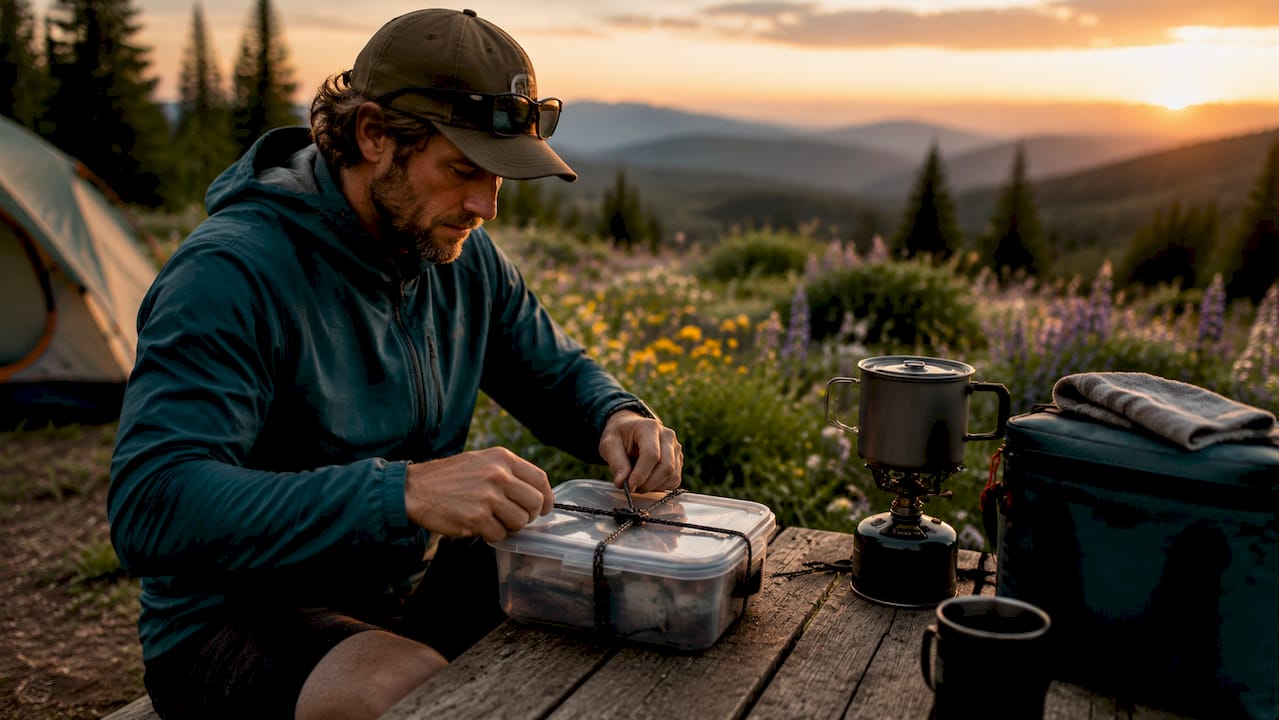
Staying on designated trails protects more than your boots. Native plants growing beside paths stabilize soil and provide food and cover for insects, birds, and small mammals. When visitors cut switchbacks or wander off-trail, they fragment that habitat in ways that take years to heal. The small consistent choices each visitor makes add up to either a healthy corridor or a broken one.
Key wildlife-protective behaviors every outdoor enthusiast should follow:
- Store food in bear canisters or hang it at least 10 feet off the ground and 4 feet from the trunk of a tree.
- Never approach, feed, or attempt to photograph wildlife at close range.
- Keep dogs on a leash at all times and clean up pet waste immediately.
- Observe wildlife from a distance of at least 100 yards for predators and 25 yards for other animals.
- Pack out all food waste, including fruit peels and shells, which are not native to most trail environments.
Most outdoor visitors do not set out to cause harm. Well-intentioned actions, like tossing an apple core into the brush because it is "natural," still disrupt local ecosystems by introducing non-native food sources and attracting animals to human zones. Good intentions require good information.
Pro Tip: Before any trip, check the eco-friendly camping practices specific to your destination. National forests, state parks, and wilderness areas each have different wildlife concerns and regulations.
What gaps exist in LNT education, and how can you help?
Nearly 9 out of 10 land managers report that most visitors have only limited or average understanding of LNT practices. That gap is not a failure of interest. It is a failure of access to good information and practical modeling. Visitors who want to do the right thing often simply do not know what that looks like on the ground.
Education closes that gap faster than enforcement. The Leave No Trace Center for Outdoor Ethics offers a Leave No Trace 101 course that takes about 45 minutes to complete and awards a certificate upon finishing. That is a small time investment for a lasting shift in behavior. Sharing that resource with your hiking group before a trip costs nothing and multiplies your impact.
Hands-on, activity-based learning teaches LNT more effectively than passive reading, both for kids and adults. Modeling correct behavior in real scenarios, like demonstrating how to select a campsite or showing a child how to pack out trash, creates habits that stick. Here is how to build LNT education into your outdoor community:- Complete the LNT 101 online course before your next trip and share the certificate link with your group.
- Assign one person per trip as the "LNT lead" to model correct behaviors and answer questions in the field.
- Use trail-side moments, like a littered campsite or a trampled meadow, as teaching opportunities rather than complaints.
- Introduce LNT principles to children through games and scavenger hunts that reward low-impact choices.
- Post your LNT practices on social media to normalize responsible outdoor behavior in your network.
Effective LNT habits form through modeling in real scenarios, not through passive study. When experienced hikers demonstrate correct behavior on the trail, newer visitors absorb those norms naturally. You do not need a certification to teach. You need consistent, visible practice.
Pro Tip: Before a group trip, send a one-page LNT summary covering the seven principles. Frame it as trip prep, not a lecture. People follow norms when they feel like part of a community that holds those norms.
How does LNT keep trails open and prevent restrictions?
Failing to practice LNT leads directly to permit lotteries, trail closures, and fire bans. Angels Landing in Zion National Park and Mount Whitney in California are real examples where overuse and degradation forced land managers to impose permit systems. Those restrictions exist because voluntary behavior was not enough to prevent irreversible damage.
Trail usage has doubled since 2010. That volume means the margin for error is smaller than ever. One poorly placed campfire, one shortcut through a meadow, one bag of trash left behind multiplies across thousands of visitors and becomes a land management crisis. The math is straightforward: more visitors plus lower LNT compliance equals faster degradation and faster restrictions.
LNT is the engineering foundation that keeps public lands accessible. When visitors collectively practice it, land managers can maintain open access without imposing hard controls. When they do not, the only tools left are closures, fees, and permit caps.
| Scenario | Voluntary LNT observance | Enforced controls |
|---|---|---|
| Trail access | Open to all visitors | Permit lotteries or timed entry |
| Campfire rules | Responsible use with existing rings | Seasonal or permanent fire bans |
| Campsite availability | Dispersed camping allowed | Designated sites only, often limited |
| Cost to visitor | Free or low-cost access | Permit fees and reservation systems |
| Land manager burden | Routine maintenance | Crisis response and restoration projects |
The long-term benefit of collective LNT practice is simple: you keep the freedom to go where you want, when you want, without a lottery ticket. That freedom is worth every extra minute spent packing out your trash or planning your trail route responsibly.
Key takeaways
Practicing Leave No Trace is the single most effective behavior outdoor enthusiasts can adopt to protect ecosystems, preserve wildlife, and sustain open access to public lands.
| Point | Details |
|---|---|
| LNT has proven land manager support | 91% of professional land managers confirm LNT protects environmental health and recreational access. |
| Doubled trail use raises the stakes | Trail usage has roughly doubled since 2010, making consistent LNT adherence more critical than ever. |
| Wildlife depends on your choices | Leaving food scraps or approaching animals disrupts natural behaviors and creates lasting harm. |
| Education gaps are your opportunity | Nearly 90% of visitors have limited LNT knowledge; modeling correct behavior multiplies your impact. |
| Voluntary LNT prevents forced restrictions | Collective responsible behavior keeps trails open and avoids permit systems and closures. |
The part most people get wrong about Leave No Trace
Most people treat Leave No Trace as an all-or-nothing standard. They assume that because they cannot be perfect, the principles do not fully apply to them. That thinking is the single biggest obstacle to real conservation progress.
LNT focuses on reducing cumulative impact, not achieving perfection. One person's minor impact is negligible alone, but cumulative impact across thousands of visitors causes significant environmental damage over time. The goal is continuous improvement, not a flawless record. Every time you pack out one more piece of trash or stay on the trail instead of cutting a corner, you are contributing to a healthier outcome.The other misconception I see constantly is that LNT is for wilderness purists. It is not. It applies to day hikes, car camping, kayaking trips, and backpacking alike. The principles scale to every outdoor context. A family picnic in a state park and a solo summit attempt both benefit from the same core behaviors.
What I have found is that the outdoor community is genuinely motivated to do right by the places they love. The gap is not motivation. It is habit. Build the habit of checking your campsite before you leave, carrying a small trash bag for others' litter, and speaking up when you see someone feeding wildlife. Those small, consistent actions are what LNT actually looks like in practice.
— Billy
Gear that supports responsible outdoor adventures
Responsible outdoor adventures start before you leave the trailhead. The right gear reduces your footprint, keeps your campsite clean, and makes LNT practices easier to follow in the field.
Lifecampadventure carries camping gear built for low-impact adventures, from packable tents that fit designated footprints to cookware that handles backcountry meals without leaving residue or waste. Choosing gear designed for durability and efficiency means fewer consumables, less waste, and a lighter impact on the environments you visit. Browse the full range of essential camping equipment at Lifecampadventure to find what fits your next trip and your commitment to keeping wild places wild.
FAQ
What is Leave No Trace?
Leave No Trace is a set of seven principles developed by the Leave No Trace Center for Outdoor Ethics and endorsed by the U.S. National Park Service to help outdoor visitors minimize their impact on natural environments.
Why should I practice Leave No Trace on every trip?
One person's impact may seem minor, but it combines with thousands of other visitors to cause significant environmental damage. Consistent LNT practice prevents that cumulative harm.
How does Leave No Trace protect wildlife?
Human food and waste alter natural foraging behaviors and can lead to habituation, conflict, or death for wildlife. Storing food properly and packing out all waste removes those risks.
What happens if visitors do not follow LNT principles?
Overuse and degradation trigger permit lotteries, trail closures, and fire bans. Real examples include permit systems at Angels Landing and Mount Whitney, both imposed due to visitor impact.
How long does it take to learn Leave No Trace?
The official LNT 101 online course takes about 45 minutes and awards a certificate upon completion, making it one of the fastest ways to build a solid foundation in outdoor ethics.
