TL;DR:
- Water filtration removes particles, parasites, and bacteria by forcing water through a small pore membrane. Most portable filters in the ultrafiltration range stop Giardia and bacteria but not viruses or dissolved chemicals, which require additional treatment methods. Always verify filter certifications and consider trip-specific needs for effective backcountry water safety.
Water filtration is the process of forcing water through a physical barrier that traps particles, parasites, and many bacteria by size, giving you safer drinking water from backcountry streams, lakes, and rivers. For most wilderness trips, a portable filter rated to 1 micron or smaller covers the two biggest biological threats you'll face: Giardia and Cryptosporidium. Viruses and dissolved chemicals are a different story, and knowing that gap before you leave the trailhead matters.
Quick TL;DR, by trip type:
- Day hike (established trails, clean source): A squeeze or straw filter rated to 1 μm is enough for most U.S. wilderness water.
- Multi-day backpacking: Carry a squeeze or pump filter plus chemical tablets as a backup for viral coverage.
- Group basecamp: A gravity filter with high flow capacity handles volume; pair with a UV device for viral protection.
- Emergency kit: Chemical tablets plus a compact straw filter cover both biological and viral threats when weight is critical.
How does water filtration work at the pore level?
Filtration works by size exclusion: water is forced through a porous membrane or barrier, and anything larger than the pores gets physically trapped. The smaller the pore, the more it catches. That single principle explains why pore size is the most important number on any filter's label.Three membrane categories cover most of what you'll see on gear:
| Filtration type | Pore size range | What it typically removes |
|---|---|---|
| Microfiltration | 0.05–5 μm | Sediment, protozoa (Giardia, Cryptosporidium), some larger bacteria |
| Ultrafiltration | 0.001–0.05 μm | Protozoa, bacteria, some larger viruses |
| Nanofiltration / Reverse osmosis | <0.001 μm | Viruses, dissolved chemicals, heavy metals |
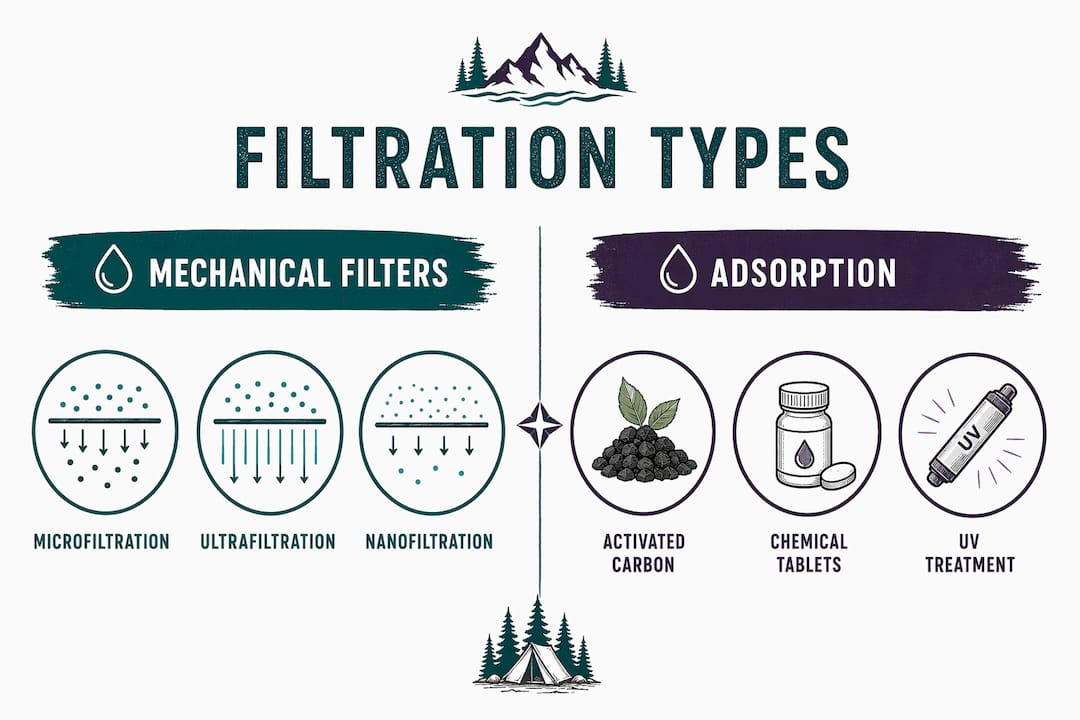
Mechanical sieving handles the biological threats. Adsorption works differently: activated carbon doesn't block by size but instead bonds chemically to chlorine, some heavy metals, and organic compounds that cause taste and odor problems. Many combined filtration systems pair a membrane with an activated carbon stage to cover both biological and chemical concerns.
Common portable filter types campers actually use
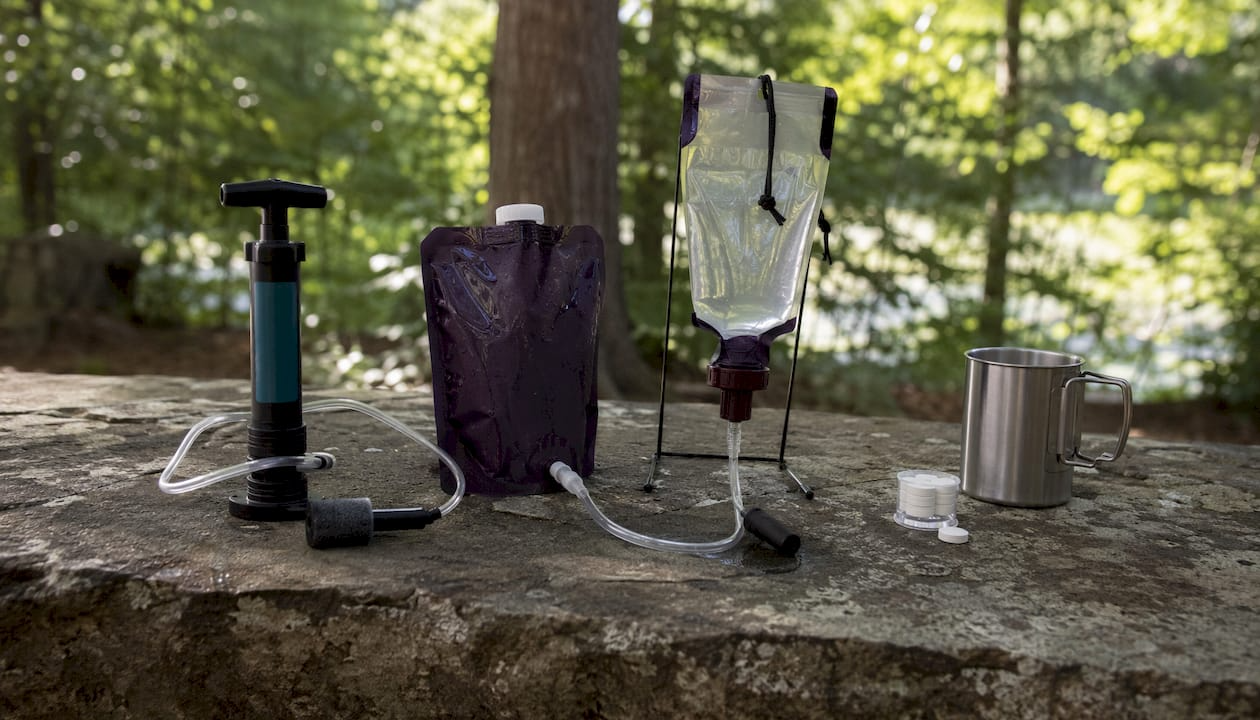
Six filter types dominate backcountry use, each forcing water through a barrier in a different way.
- Pump filters use a hand-operated piston to push water through a cartridge. They work on demand, let you filter directly into any container, and handle silty sources well. Heavier than most alternatives, typically 10–16 oz.
- Gravity filters hang a dirty-water reservoir above a clean one and let gravity do the work. Ideal for group camps where you need volume without effort. Slow for a single hiker in a hurry.
- Squeeze filters push water through a membrane by squeezing a soft reservoir. Ultralight (some under 3 oz), fast, and packable. The membrane can crack if frozen.
- Straw and bottle filters let you drink directly from a source or a personal bottle. No setup, minimal weight. Not practical for filtering water to cook with or share.
- Inline filters attach between a hydration bladder hose and the bite valve. Hands-free hydration on the move. Flow rate is lower than pump or squeeze options.
- UV devices and chemical tablets are adjuncts, not standalone mechanical filters. UV light inactivates pathogens by disrupting their DNA; chemical tablets (iodine, chlorine dioxide) disinfect chemically. Neither removes sediment or improves turbidity.
Portable field filters are typically lightweight, and use mechanical hand pumps or siphon/drip systems to move water through the filter element.
| Filter type | Flow speed | Weight | Ease of use | Maintenance |
|---|---|---|---|---|
| Pump | Medium | Heavy | Moderate | Backflush, replace cartridge |
| Gravity | Slow | Medium | Easy | Backflush, hang setup |
| Squeeze | Fast | Very light | Easy | Backflush regularly |
| Straw/bottle | Fast | Lightest | Very easy | Backflush, limited life |
| Inline | Medium | Light | Very easy | Backflush, freeze risk |
| UV device | Instant | Light | Easy | Battery management |
What does a portable filter actually remove?
Most backcountry filters stop parasites and bacteria. Viruses require either a finer membrane (ultrafiltration or nanofiltration) or a separate chemical/UV treatment step.
| Contaminant | Size / type | Treatment needed |
|---|---|---|
| Giardia | 0.05–5 μm protozoan | Microfiltration (≥1 μm rated filter) |
| Cryptosporidium | ~4–6 μm protozoan | Microfiltration (≥1 μm rated filter) |
| Bacteria (e.g., E. coli) | 0.05–5 μm | Ultrafiltration or 1 μm filter |
| Viruses (e.g., norovirus) | 0.001–0.05 μm | Nanofiltration, UV, or chemical treatment |
| Turbidity / sediment | Particulate | Any mechanical filter; pre-filter sock helps |
| Chlorine / taste/odor | Dissolved chemical | Activated carbon stage |
| Heavy metals / chemicals | Dissolved | Reverse osmosis or activated carbon (type-dependent) |
Pro Tip: A filter labeled "improves taste and odor" is a carbon filter, not a pathogen-rated filter. Look for NSF/ANSI Standard 53 or 58 certification, or a manufacturer's explicit claim of protozoan and bacterial removal, before counting on it in the backcountry. Activated carbon filters remove chlorine and some heavy metals but are not designed to remove pathogens.
How to choose a portable water filter for your trip
Choose by the threats you expect at your destination plus the constraints of your trip: weight budget, group size, and how long you'll be out.
Decision criteria checklist:
- Pore size and certification: Look for 0.1 μm or smaller for bacterial and protozoan coverage; check for NSF/ANSI certification or explicit pathogen-removal claims.
- Flow rate: Measured in liters per minute. Higher flow matters more for groups; solo hikers can tolerate slower filters.
- Weight: Squeeze and straw filters win for ultralight trips; pump and gravity filters suit basecamps.
- Filter life: Rated in liters (often 500–100,000 L depending on type). Match to your trip length and carry a spare cartridge for extended trips.
- Maintenance method: Backflush-capable filters last longer in silty conditions. Know your method before you go.
- Freeze resistance: Hollow-fiber membranes crack when frozen. Keep your filter in a sleeping bag at night in cold conditions.
- Replacement cost: Factor in cartridge cost over the filter's life, not just the purchase price.
By trip type:
- Day hike: A squeeze or straw filter at 1 μm is sufficient for most U.S. wilderness sources. Weight and packability matter most.
- Multi-day solo backpacking: A squeeze filter plus a small supply of chlorine dioxide tablets gives you biological and viral coverage without significant weight penalty.
- Group basecamp: A gravity filter handles volume with minimal effort. Add a UV device for viral protection and a pre-filter sock for silty sources. Check hydration strategies for hikers to plan total water volume per person per day.
For a complete gear list that pairs a filter with your other must-have backpacking items, cross-reference your filter choice against your pack weight before finalizing.
Using and maintaining your filter in the field
Routine maintenance prevents the two most common field failures: clogged membranes and cracked hollow fibers. Neither is hard to avoid.
- Prime before first use. Push clean water through the filter in the direction of flow until it runs clear. This saturates the membrane and establishes full flow rate.
- Pre-filter turbid sources. Pour silty or cloudy water through a bandana, coffee filter, or dedicated pre-filter sock before it enters your filter. This dramatically extends membrane life.
- Backflush after heavy use. Push clean water backward through the filter to dislodge trapped sediment. Backflushing frequency depends on source turbidity: after silty sources, a short backflush every 1–2 liters preserves flow; in clean mountain streams, you can go many liters between flushes.
- Clean ceramic elements by abrasion. Ceramic filters clog with surface sediment. Gently scrub the outer surface with a soft brush or clean cloth in the field to restore flow.
- Store dry. Before packing out, blow air through the filter to remove standing water. A wet membrane stored in a sealed bag can grow mold or freeze and crack.
- Replace cartridges on schedule. Don't wait for flow to drop to near-zero. Track liters filtered against the manufacturer's rated life.
Troubleshooting quick-check:
- Slow flow: Backflush immediately; pre-filter your source next time.
- Taste or smell in filtered water: The membrane is fine but your carbon stage (if any) is exhausted; replace it.
- Frozen filter: Do not use until fully thawed and inspected for cracks. When in doubt, retire it.
Pro Tip: In silty rivers, backflush after every 1–2 liters rather than waiting for flow to drop. Catching the clog early takes 30 seconds; clearing a fully blocked membrane in the field can take much longer. See Lifecampadventure's gear maintenance guide for storage and long-term care tips.
When filtration alone isn't enough
The two most common gaps in standard portable filters are viruses and dissolved chemical contamination. Knowing when you're in one of those scenarios can prevent serious illness.
- Remote areas with human or animal waste nearby: Viral contamination (norovirus, hepatitis A) is a real risk. A 0.1 μm filter won't stop viruses. Add chlorine dioxide tablets or a UV device after filtering.
- Alpine snowmelt near old mines or industrial sites: Heavy metals and dissolved chemicals pass straight through hollow-fiber membranes. Reverse osmosis and nanofiltration address these, but neither is practical as a portable backcountry option. Avoid the source or carry enough treated water from a known clean source.
- Stagnant water after flooding: Flood water carries chemical runoff, sewage, and elevated viral loads. Filter plus chemical treatment is the minimum; boiling after filtering adds another layer.
- International travel or areas with reported contamination: Use a purifier (not just a filter) or boil water for at least one minute at elevations below 6,500 feet, three minutes above.
Many hikers pair a mechanical filter with UV or chemical tablets when traveling in areas with potential viral contamination or after storms. For a full breakdown of purification options beyond filtration, the Lifecampadventure guide on purifying water outdoors covers boiling, chemical, and UV methods in detail.
Quick gear checklist by trip type
Match redundancy and capacity to your trip length and group size. More days out means more chances for a filter to clog, freeze, or fail.
| Trip type | Primary filter | Backup / adjunct | Extras to pack |
|---|---|---|---|
| Day hike | Squeeze or straw (1 μm) | Chemical tablets | None required |
| Overnight / multi-day solo | Squeeze or pump (1 μm) | Chlorine dioxide tablets | Spare cartridge if >5 days |
| Group basecamp | Gravity filter (high volume) | UV device | Pre-filter sock, spare cartridge |
| Emergency kit | Straw filter | Chemical tablets | Compact UV pen, extra batteries |
For a broader outdoor survival checklist that includes water treatment alongside shelter, navigation, and first aid, Lifecampadventure has you covered.
Key Takeaways
A portable filter rated to 1 micron or smaller removes Giardia, Cryptosporidium, and most bacteria from backcountry water, but viruses and dissolved chemicals require additional treatment.
| Point | Details |
|---|---|
| Pore size is the critical spec | Choose a filter rated 1 μm or smaller to remove protozoa and bacteria from wilderness water. |
| Viruses need extra treatment | Standard hollow-fiber filters don't stop viruses; add UV or chlorine dioxide tablets in high-risk areas. |
| Always check the label | The CDC advises verifying certified removals on the product label before trusting any filter for pathogens. |
| Backflush early and often | In silty water, backflush every 1–2 liters to prevent clogging and extend filter life. |
| Match gear to trip type | Day hikers need a squeeze filter; groups and multi-day trips need higher capacity and a chemical backup. |
Why Lifecampadventure prioritizes certified filtration
At Lifecampadventure, we've seen what happens when campers grab a filter based on marketing copy rather than label specs. A filter that "purifies" water in the product name but carries no pathogen-removal certification is a liability in the backcountry, not a safety tool. Our position is straightforward: carry a filter with a documented pore-size rating and a certified removal claim, then add a chemical or UV backup for any trip where viral risk is plausible.
Packable redundancy is the principle we come back to every time. A squeeze filter plus a small tube of chlorine dioxide tablets weighs almost nothing and covers every biological threat you're likely to face in U.S. wilderness. That combination is more reliable than any single device, no matter how premium.
For gear that's built to hold up on real trips, explore the survival essentials guide at Lifecampadventure, or browse the full adventure gear selection to find filtration and water treatment options sized for your next trip.
Useful sources and further reading
These are the primary authoritative sources used to verify pore-size ranges, certification guidance, and field maintenance recommendations in this guide. Always cross-check product claims against these references and confirm NSF/ANSI certification on any filter you buy.
- CDC: About home water treatment systems — Verifies microfiltration, ultrafiltration, and nanofiltration pore-size categories and what each removes.
- CDC: Choosing home water filters — Source for the label-checking guidance: always verify what a filter is certified to remove before use.
- UGA/CDC collaborative guide: Water filters, Cryptosporidium, and parasites — Confirms the 1-micron absolute pore-size threshold for parasite removal.
- TU Delft: Micro- and ultrafiltration primer — Technical basis for size-exclusion filtration principles and field maintenance (backflushing, ceramic abrasion).
- ScienceDirect: Water filtration overview — Covers combined-method systems and the limits of portable filters for dissolved chemicals and heavy metals.
- US EPA: Water filtration — Foundational regulatory reference for filtration standards in the United States.
Reminder: Check the NSF/ANSI certification on any filter you purchase. A certified claim on the label is the only reliable indicator that a filter performs as advertised for pathogen removal.
