TL;DR:
- The Life Camp Adventure Family Cabin Tent is the best choice for families seeking space, ease of setup, and reliable three-season weather protection. It offers standing height, a covered vestibule, and mid-range waterproofing with taped seams, making it suitable for most U.S. camping conditions. Proper tent size, waterproof ratings, and livability features are crucial for a satisfying family camping experience.
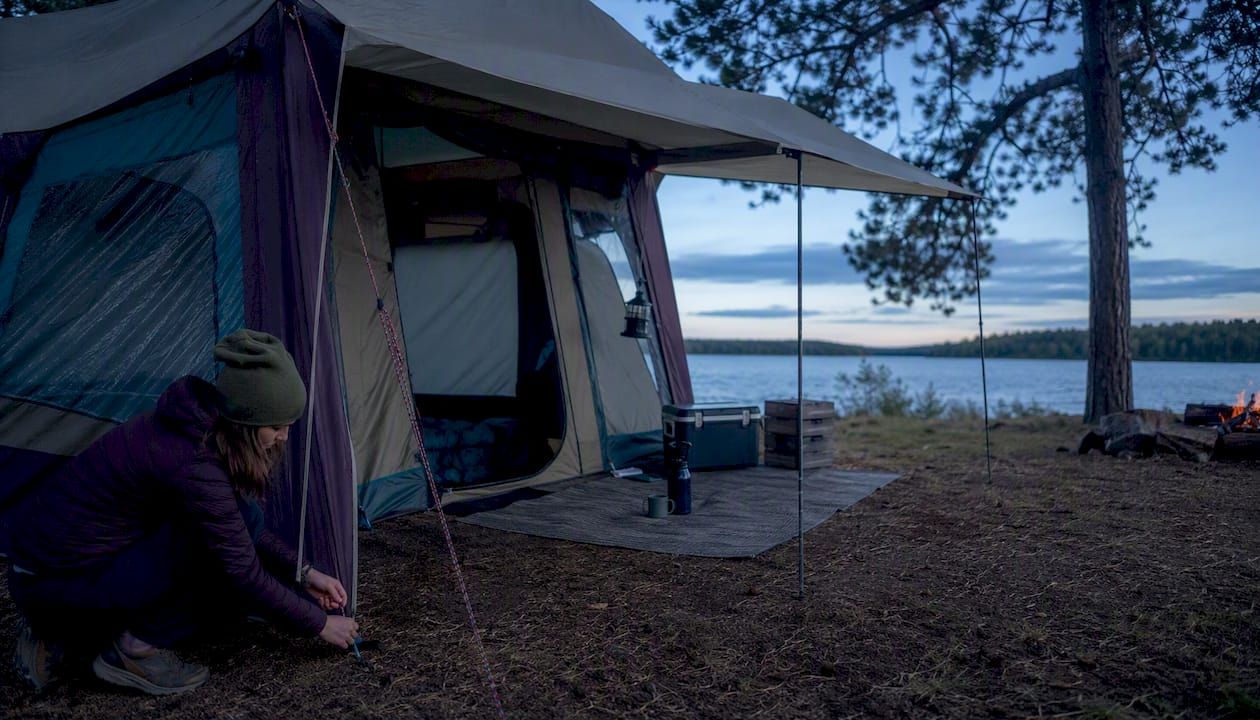
For most families who want real living space, a straightforward setup, and dependable 3-season weather protection, the Life Camp Adventure Family Cabin Tent is the strongest pick. It delivers a balanced combination of usable floor area, covered vestibule storage, and mid-range waterproofing that fits the way most American families actually camp.
One critical rule before you buy anything: subtract two from the stated capacity to estimate comfortable sleeping space. A "6-person" tent typically fits four comfortably. A Hydrostatic Head (HH) rating of 1,500–3,000 mm covers standard 3-season U.S. camping; anything below 1,500 mm is a fair-weather-only shelter. Higher-performance tents can be found with HH ratings above 5,000 mm for severe weather conditions.
Quick picks:
- Editor's pick: Life Camp Adventure Family Cabin Tent — space, easy setup, and solid wet-weather protection in one package
- Best value: Coleman Skydome XL 8 — wide floor, near-vertical walls, and a price that leaves room in the gear budget
- Easiest setup: Core Equipment Instant Cabin 6 — pre-attached poles pitch in under two minutes
- Most space: Coleman Montana 8 / The North Face Wawona 8 — generous floor area for large families or groups
- Budget pick: Coleman Sundome 6 — reliable fair-weather shelter at a low entry price
How do the top rated family tents compare at a glance?
The table below covers the key decision dimensions. Capacity figures assume shoulder-to-shoulder occupancy; for comfortable family use, subtract two from the stated capacity.
| Tent | Best for | Capacity / Floor Area / Peak Height | Setup | Weather protection | Vestibule / Layout | Price range |
|---|---|---|---|---|---|---|
| Life Camp Adventure Family Cabin Tent | Most families: space + easy setup + 3-season use | 6P / spacious cabin floor / 6 ft+ standing height | Moderate, color-coded poles | HH mid-range, taped seams, bathtub floor | Covered vestibule, gear porch | Mid-range |
| The North Face Wawona 6 | Families wanting premium build and tall interior | 6P / — / 6 ft 2 in | Moderate | HH 1,200 mm+, taped seams | Large vestibule | $$$ |
| The North Face Wawona 8 | Large families, premium 3-season | 8P / — / 6 ft 2 in | Moderate | Taped seams, solid floor | Two doors, large vestibule | $$$$ |
| REI Co-op Base Camp 6 | Wet-weather and wind-exposed sites | 6P / — / 6 ft | Moderate-complex | High HH, fully taped, geodesic | Minimal vestibule | $$$ |
| REI Co-op Westward 6 | Car-camping families who want a porch | 6P / cabin layout / 6 ft+ | Moderate | HH mid-range, taped | Large awning/porch | $$$ |
| REI Co-Op Wonderland X | Families wanting modular room dividers | 6P+ / large cabin / 6 ft+ | Moderate | Taped seams | Divided rooms, porch | $$$$ |
| Coleman Skydome XL 8 | Value-focused families needing space | 8P / ~100 sq ft / 6 ft | Easy, near-vertical walls | HH 1,200 mm, welded floor | Side storage pocket | $$ |
| Coleman Skydome (Sundome 6) | Entry-level 3-season family use | 6P / — / 5 ft 11 in | Easy | HH 1,200 mm, welded floor | Small vestibule | $ |
| Coleman Sundome Dark Room 6 | Families needing morning sleep / festival | 6P / — / 5 ft 11 in | Easy | HH 1,200 mm, welded floor | Small vestibule | $$ |
| Coleman Skydome Darkroom 6P | Same as above, Skydome frame | 6P / — / 6 ft | Easy | HH 1,200 mm | Small vestibule | $$ |
| Coleman Skydome XL Dark Room 10P | Very large families, blackout sleep | 10P / large / 6 ft | Easy | HH 1,200 mm | Side pocket, large floor | $$ |
| Coleman Skydome with Dark Room Technology | Blackout + easy setup | 6P / — / 6 ft | Easy | HH 1,200 mm | Small vestibule | $$ |
| Coleman Montana 8 | Large families, car-camping | 8P / ~100 sq ft / 6 ft | Moderate | HH 1,200 mm, welded floor | Gear porch | $$ |
| Coleman Evanston 6 | Budget families wanting a screened porch | 6P / — / 5 ft 10 in | Easy | HH 1,200 mm | Screened porch | $ |
| Coleman Instant Cabin Tent | Fastest setup for families | 6–8P / cabin / 6 ft | Instant (< 2 min) | HH 1,200 mm | Gear porch | $$ |
| WeatherMaster 10-Person Tent by Coleman | Large groups, screened room | 10P / very large / 6 ft | Moderate | HH 1,200 mm | Screened room | $$ |
| Coleman Cortes Octagon 8 | Glamping-style family base | 8P / octagonal / 6 ft+ | Moderate | HH mid-range | Central living space | $$ |
| Coleman Vail 4 | Small families, weekend trips | 4P / compact / 5 ft 8 in | Easy | HH 1,200 mm | Small vestibule | $ |
| Coleman Weathermaster 4XL Air | Families wanting air-frame ease | 4P+ / large / 6 ft+ | Air pump | HH mid-range | Porch | $$$ |
| Core Equipment Instant Cabin 6 | Fastest setup, frequent campers | 6P / — / 6 ft | Instant (< 2 min) | HH 1,500 mm, taped | Gear loft, pockets | $$ |
| Core Equipment Instant Cabin 6 | Large families on a budget | — / large / 6 ft | Moderate | HH 1,500 mm | Divider, two rooms | $$ |
| Kelty Discovery Basecamp 6 | Budget families, fair-weather | 6P / — / 5 ft 10 in | Easy | HH 1,200 mm | Small vestibule | $ |
| Ozark Trail 3-Room Cabin Tent | Budget large families | — / very large / 6 ft | Moderate | HH 1,000 mm | Three rooms | $ |
| Outsunny 4–6 Person Camping Tent | Occasional fair-weather use | 4–6P / compact / 5 ft | Easy | HH 1,000 mm | Small vestibule | $ |
| Big Agnes Bunk House 6 | Families wanting bunk-style sleeping | 6P / — / 6 ft | Moderate | HH 1,200 mm, taped | Two doors | $$$ |
| Big Agnes Copper Spur | Backpacking families (lighter loads) | 4P / compact / 4 ft | Moderate | HH 1,200 mm, taped | Two vestibules | $$$$ |
| Big Agnes Wyoming Trail 4 | Small families, 3-season | 4P / mid / 5 ft 6 in | Moderate | HH 1,200 mm, taped | Vestibule | $$$ |
| Marmot Tungsten 4 | Small families, wet-weather | 4P / mid / 5 ft 6 in | Moderate | HH 1,500 mm+, taped | Vestibule | $$$ |
| Marmot Tungsten 6 | Medium families, wet-weather | 6P / mid / 5 ft 8 in | Moderate | HH 1,500 mm+, taped | Vestibule | $$$ |
| Marmot Limestone 4P | Small families, 3-season | 4P / mid / 5 ft 10 in | Moderate | HH 1,500 mm, taped | Large vestibule | $$$ |
| Marmot Limestone 6P | Medium families, 3-season | 6P / large / 5 ft 10 in | Moderate | HH 1,500 mm, taped | Large vestibule | $$$ |
| Marmot Limelight 2 Person Tent | Couples / solo parents | 2P / compact / 4 ft 3 in | Easy | HH 1,500 mm, taped | Vestibule | $$$ |
| Fanttik Zeta C6 Pro | Tech-forward families, fast setup | 6P / cabin / 6 ft | Instant hub | HH 2,000 mm | Gear porch | $$ |
| Gazelle T4 Hub | Small families, hub setup | 4P / mid / 6 ft | Hub (< 90 sec) | HH 1,500 mm | Porch | $$$ |
| MSR Habitude 6 | Families prioritizing weather protection | 6P / — / 6 ft | Moderate | HH 1,500 mm+, taped | Large vestibule | $$$$ |
| Snow Peak Amenity Dome L | Premium car-camping families | 6P / large / 5 ft | Moderate | HH 1,500 mm, taped | Vestibule | $$$$ |
| Snow Peak Alpha Breeze | Premium glamping families | 6P / large / 6 ft+ | Moderate | HH 1,500 mm | Porch | $$$$ |
| White Duck Regatta Bell Tent | Glamping / canvas lovers | 5P / circular / 7 ft+ | Moderate | Canvas, HH varies | Open plan | $$$$ |
| Zempire Evo TM V2 Inflatable Air Tent | Families wanting air-frame ease | 6P / large / 6 ft+ | Air pump | HH 3,000 mm+ | Porch, living area | $$$ |
| Zempire Evo TXL V2 Air | Large families, air-frame | 8P+ / very large / 6 ft+ | Air pump | HH 3,000 mm+ | Large porch | $$$$ |
| Zempire Aerodome II Pro Air | Families wanting dome air tent | 6P / large / 6 ft+ | Air pump | HH 3,000 mm+ | Porch | $$$ |
| Kampa Hayling 6 Air | UK-style air tent for U.S. families | 6P / large / 6 ft | Air pump | HH 3,000 mm+ | Porch | $$$ |
| Quechua Air Seconds 4.1 | Budget air-frame families | 4P / mid / 5 ft | Air pump | HH 2,000 mm | Small porch | $$ |
| Quechua ARPENAZ 4.2 | Budget families, fair-weather | 4P / mid / 5 ft 6 in | Easy | HH 2,000 mm | Small vestibule | $ |
| Heimplanet Backdoor Classic | Premium inflatable, design-focused | 3–4P / compact / 5 ft 6 in | Air pump | HH 5,000 mm | Minimal | $$$$ |
| Robens Pioneer 4EX | Small families, wet-weather | 4P / mid / 5 ft 8 in | Moderate | HH 3,000 mm+, taped | Vestibule | $$$ |
| Outwell Earth 4 | Small families, 3-season | 4P / mid / 5 ft | Moderate | HH 3,000 mm, taped | Vestibule | $$$ |
| Vango Beta 550XL | Families wanting tunnel layout | 5P / large / 5 ft 10 in | Moderate | HH 2,500 mm, taped | Porch | $$$ |
| Oztent RV5 | Families wanting fastest pitch | 5P / cabin / 6 ft | < 30 sec | HH 3,000 mm | Side awning | $$$$ |
| Tarptent Hogback | Ultralight solo/small family | 2P / compact / 4 ft | Moderate | HH 1,500 mm | Vestibule | $$$ |
| REI Half Dome 3 | Small families, backpacking | 3P / compact / 4 ft | Easy | HH 1,200 mm, taped | Two vestibules | $$ |
| Sierra Designs Meteor Storm 4 Person Tent | Small families, storm-ready | 4P / mid / 4 ft 6 in | Moderate | HH 1,500 mm+, taped | Vestibule | $$$ |
Editor's note: The Life Camp Adventure Family Cabin Tent leads this list because it hits the criteria most families actually need: standing room, a covered gear zone, mid-range HH with taped seams, and a setup process that doesn't require a manual re-read at dusk. A mid-range tent in the $200–$400 bracket consistently delivers better waterproofing, stronger poles, and larger layouts than budget alternatives.
How do you choose the right family tent?
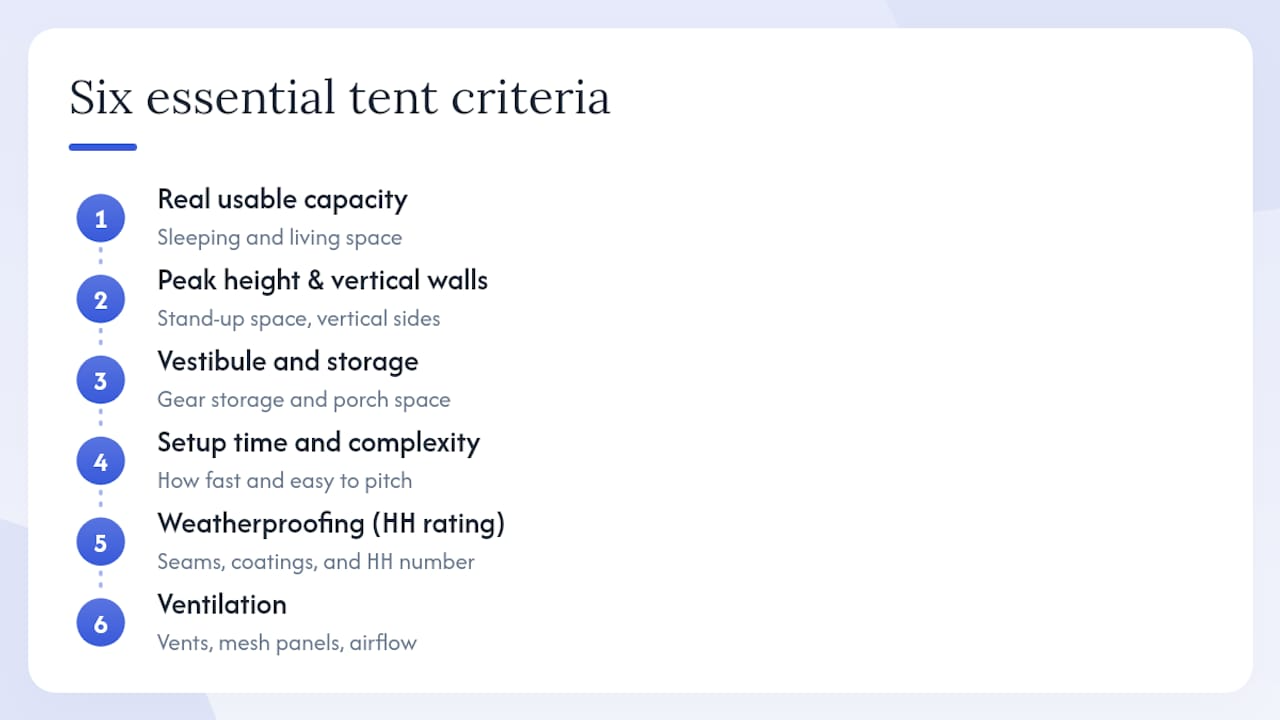
The six criteria below are what parents actually use when a tent either works or fails on a real trip.
Real usable capacity
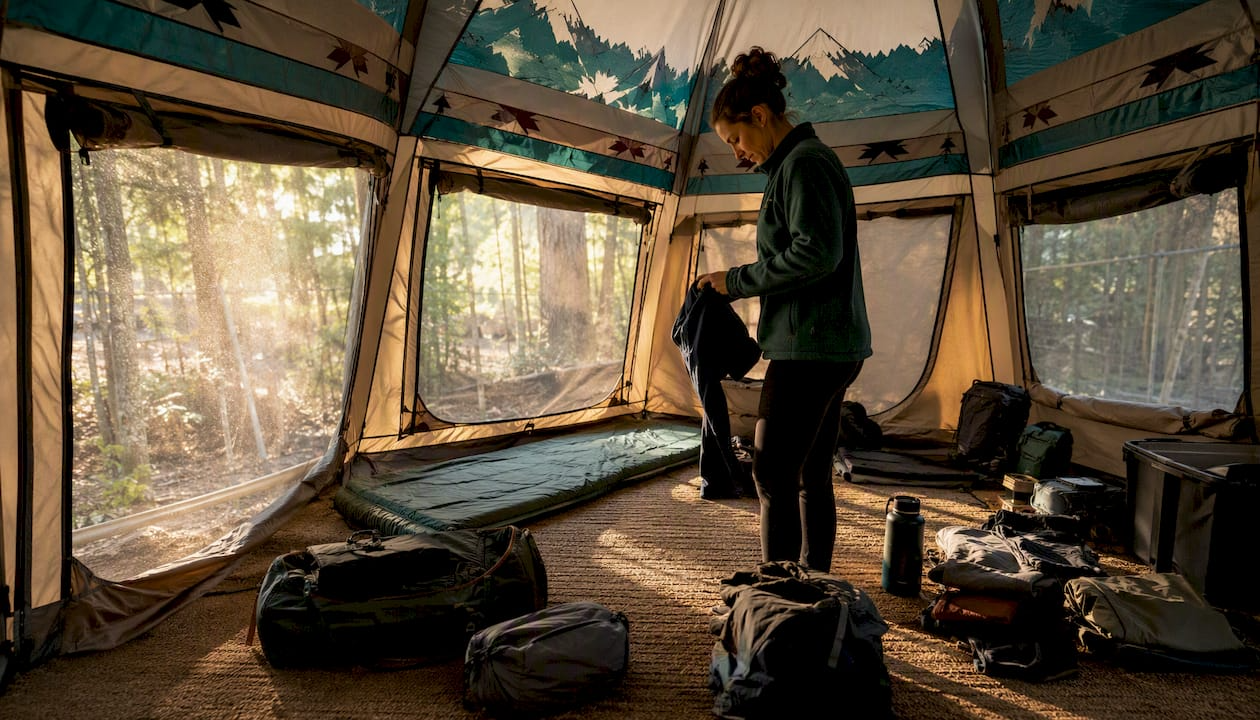
Advertised person counts assume shoulder-to-shoulder sleeping with no gear inside. For a family of four with sleeping pads, a dog, and a bag of shoes, a 6-person tent is the minimum. An 8-person tent gives you room to move. Use the subtract-two rule every time.
Peak height and vertical walls
A tent where adults can stand upright changes the entire experience of a multi-day trip. Cabin-style tents with near-vertical walls (6 ft or taller) let you dress, organize gear, and wrangle kids without hunching. Reviewers consistently rate peak height and vestibule area as the top livability factors on family trips, and it shows up clearly in parent satisfaction scores.
Vestibule and gear storage
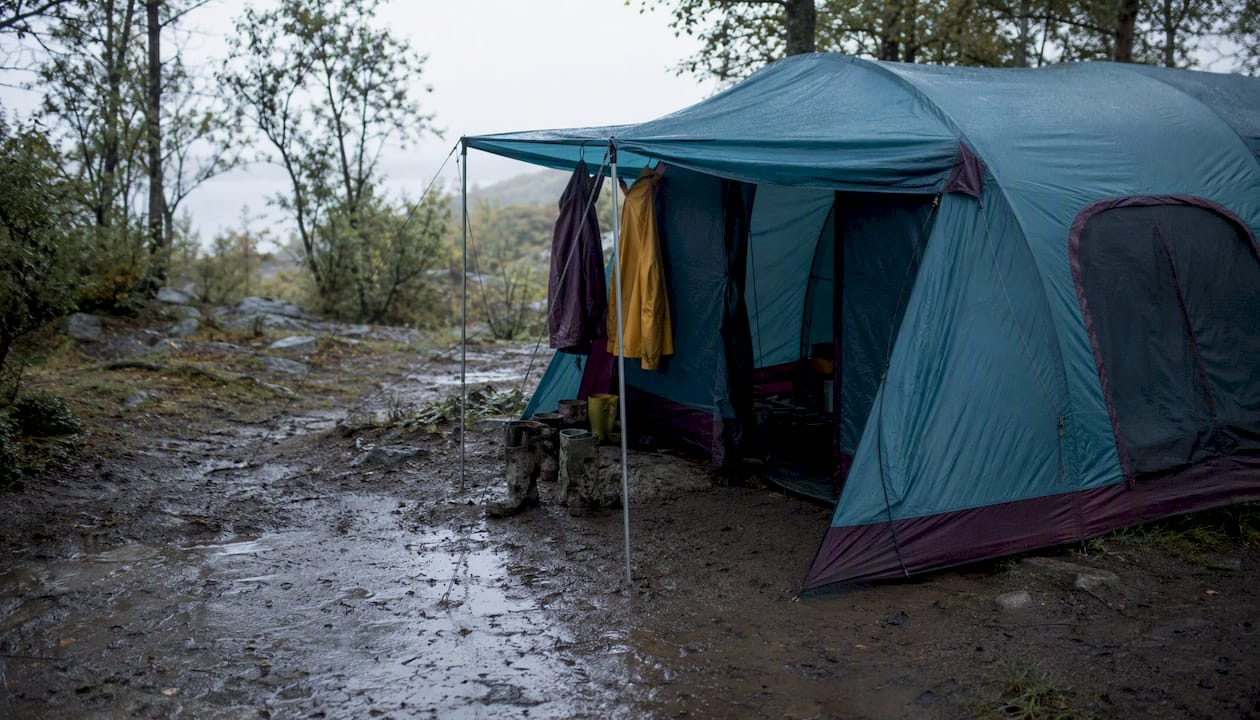
A covered vestibule is where muddy boots, wet rain gear, and the dog's leash live. Without one, all of that comes inside. Look for at least 15–20 sq ft of covered porch space for a family of four.
Setup time and complexity
Instant-cabin tents with pre-attached poles pitch in under two minutes. Standard cabin tents with color-coded poles take 15–25 minutes with two adults. Air-frame tents need a pump but eliminate pole fiddliness entirely. Match the setup style to how often you camp: if you move sites frequently, instant or hub designs pay off fast.
Weatherproofing: what HH numbers mean
An HH rating of 1,500–3,000 mm handles standard U.S. 3-season rain. Below 1,500 mm is fair-weather territory. Factory-sealed seams and a bathtub-style floor prevent water from wicking in at the base, which is where most family tents fail first. If a tent lists "water-resistant" without an HH number, treat it as fair-weather only.
Ventilation
A fully sealed tent traps condensation overnight. Look for mesh inner panels, adjustable vents near the peak, and a rainfly that doesn't sit flush against the inner wall. This matters most in humid summer conditions and shoulder-season camping.
Pre-buy checklist:
- Confirm peak height is 6 ft or taller for adult comfort
- Check HH rating: 1,500 mm minimum for variable weather
- Verify seams are taped or factory-sealed, not just "water-resistant"
- Look for a bathtub floor (raised edges sewn into the floor panel)
- Measure vestibule square footage, not just door count
- Check zipper quality: YKK zippers outlast generic alternatives significantly
- Confirm footprint and awning accessories are available for the model
Pro Tip: Prioritize livability over the sleeping-capacity number on the box. A 6-person tent that gives a family of four standing room and a gear vestibule beats a 4-person tent that technically fits four sleeping bags but nothing else.
Detailed reviews: which tent fits your family?
The profiles below are organized by use case. Specs follow manufacturer-published data; price bands use the $/$$/$$$/$$$$ scale from the comparison table.
Life Camp Adventure Family Cabin Tent — editor's pick for most families
Best for: Families of 4–6 who want standing room, a covered gear zone, and reliable 3-season protection without a steep learning curve.
This is the tent Lifecampadventure recommends for most U.S. families, and the reasoning is straightforward. The cabin-style frame delivers 6 ft+ standing height, near-vertical walls that maximize usable floor space, and a covered vestibule that keeps gear and wet items out of the sleeping area. Waterproofing sits in the mid-range HH bracket with taped seams and a bathtub floor, which covers the vast majority of 3-season U.S. camping conditions. Setup uses color-coded poles and a logical sequence that two adults can complete in under 20 minutes on the first attempt.
- Weather protection: — Mid-range HH, taped seams, bathtub floor
The warranty and customer-focused support from Lifecampadventure add a layer of confidence that budget alternatives rarely match. For a family buying their first serious tent or upgrading from a fair-weather dome, this is the clearest fit.
The North Face Wawona 6 and Wawona 8
The Wawona 6 is one of the most consistently praised cabin tents in its price range. A 6 ft 2 in peak height, large vestibule, and taped seams make it a genuine 3-season family shelter. The Wawona 8 scales the same geometry up for larger families, adding a second door and more floor area. Both carry a premium price tag, but the build quality justifies it for families who camp frequently. The trade-off is packed weight: neither packs small.
Coleman Skydome family (Skydome XL 8, Sundome 6, Darkroom variants)
Coleman's Skydome line covers more family use cases than any other single brand. The Skydome XL 8 offers roughly 100 sq ft of floor space, near-vertical walls, and a welded floor at a price that leaves room for the rest of your gear budget. The Sundome 6 and Coleman Sundome Dark Room 6 are the entry-level picks: reliable fair-weather shelters with an HH of 1,200 mm that handles light to moderate rain. The Coleman Skydome Darkroom 6P and Coleman Skydome with Dark Room Technology add blackout fabric for families with young children who need morning naps or festival campers who sleep past sunrise. The Coleman Skydome XL Dark Room 10P extends the same concept to very large families. All Skydome models share an easy, near-vertical wall design that maximizes floor space for the footprint.
Coleman Instant Cabin Tent and Core Equipment Instant Cabin 6
Both are built for families who hate setup. The Coleman Instant Cabin Tent uses pre-attached poles that unfold in one motion; the Core Equipment Instant Cabin 6 adds a 1,500 mm HH rating, a gear loft, and interior pockets. Instant-style tents can pitch very quickly, often in under two minutes. which matters enormously when you arrive at a campsite after dark with tired kids. The trade-off is packed size: both are bulkier than standard pole tents.
REI Co-op Base Camp 6, Westward 6, and Wonderland X
The REI Co-op Base Camp 6 is the wet-weather specialist in this group. Its geodesic structure and fully taped seams handle wind and sustained rain better than most cabin tents. The interior is shorter than a cabin design, so tall adults will notice the difference. The REI Co-op Westward 6 swings the other direction: a large awning porch, cabin layout, and comfortable standing height make it a strong car-camping choice for families who want an outdoor living area. The REI Co-Op Wonderland X adds modular room dividers for families who want separate sleeping zones, at a higher price point.
Big Agnes Bunk House 6 and family models
The Big Agnes Bunk House 6 is designed specifically for families, with a layout that accommodates bunk-style sleeping pads and two doors for easy access. Taped seams and solid pole construction make it a reliable 3-season option. The Big Agnes Copper Spur and Big Agnes Wyoming Trail 4 are lighter, more packable options for families who hike to their campsite rather than drive.
Marmot Tungsten 4/6, Limestone 4P/6P, and Limelight 2
Marmot's family of 3-season tents covers small to medium families with a consistent emphasis on weather protection. The Marmot Limestone 6P is the standout for families: a large vestibule, 5 ft 10 in peak height, and HH 1,500 mm+ with taped seams. The Marmot Tungsten 4 and Marmot Tungsten 6 are slightly more compact and better suited to families who camp in consistently wet conditions. The Marmot Limelight 2 Person Tent serves solo parents or couples on lighter trips.
Air-frame tents: Zempire, Kampa, Quechua, Heimplanet
Air-frame tents replace poles with inflatable beams, which simplifies assembly and creates very livable interiors with no sharp angles. The Zempire Evo TM V2 Inflatable Air Tent and Zempire Evo TXL V2 Air are the most spacious options in this category, with HH ratings above 3,000 mm and large porches. The Zempire Aerodome II Pro Air offers a dome geometry in the same air-frame format. The Kampa Hayling 6 Air is a well-regarded European-style air tent available in the U.S. market. The Quechua Air Seconds 4.1 is the budget entry point for air-frame camping. The Heimplanet Backdoor Classic is a premium, design-forward inflatable with an HH of 5,000 mm for families who camp in severe conditions. All require a pump; most include one.
Coleman Weathermaster 4XL Air, Zempire, and other air options
The Coleman Weathermaster 4XL Air brings the air-frame concept into Coleman's accessible price range, with a large porch and standing height. It suits families who want the simplicity of air-frame setup without the premium price of European brands.
Budget picks: Ozark Trail, Kelty, Outsunny, Quechua ARPENAZ
The Ozark Trail 3-Room Cabin Tent delivers the most floor space per dollar in this roundup, with three rooms and a very large footprint. The HH rating sits around 1,000 mm, which means it handles light rain but struggles in sustained downpours. The Kelty Discovery Basecamp 6 and Outsunny 4–6 Person Camping Tent follow the same pattern: functional fair-weather shelters that cut corners on weatherproofing, zippers, and long-term seam durability. The Quechua ARPENAZ 4.2 is a compact budget option for small families on occasional trips. These tents work well for summer camping in dry climates; families in the Pacific Northwest or Southeast should budget up.
Specialty and premium picks
The White Duck Regatta Bell Tent is for families who want a glamping aesthetic: a canvas construction, 7 ft+ center height, and a circular floor plan that creates a genuine living space. Canvas breathes better than nylon but weighs significantly more. The Oztent RV5 pitches in under 30 seconds with a unique fold-out frame, making it the fastest-pitching tent in this entire roundup. The Gazelle T4 Hub uses a hub-and-pole system that sets up in under 90 seconds. The Fanttik Zeta C6 Pro combines an instant hub design with a 2,000 mm HH rating for tech-forward families. The MSR Habitude 6 is a premium 3-season option with a large vestibule and strong weather protection for families who camp in demanding conditions. The Snow Peak Amenity Dome L and Snow Peak Alpha Breeze are Japanese-made premium tents with meticulous build quality and a high price to match. The Robens Pioneer 4EX, Outwell Earth 4, and Vango Beta 550XL are European-market tents available in the U.S. with HH ratings of 2,500–3,000 mm and taped seams. The Sierra Designs Meteor Storm 4 Person Tent and Tarptent Hogback serve small families or solo parents who prioritize storm resistance in a compact package. The REI Half Dome 3 is the classic backpacking option for small families who hike to their sites. The Coleman Cortes Octagon 8 and Coleman Evanston 6 round out the Coleman lineup: the Octagon 8 creates a central gathering space with its octagonal geometry, while the Evanston 6 adds a screened porch at a budget price.
What do tent specs actually mean, and how were these picks vetted?
Understanding a few key numbers makes every tent decision faster and more confident.
Hydrostatic Head (HH): The pressure in millimeters of water a fabric can withstand before leaking. An HH of 1,500–3,000 mm covers standard U.S. 3-season camping. Above 5,000 mm is for severe or alpine conditions. Below 1,500 mm is fair-weather only. The floor fabric typically needs a higher HH than the canopy because it bears direct ground pressure.
Denier (D): The thickness of the fabric threads. Higher denier means heavier, more abrasion-resistant fabric. A 68D floor is noticeably more durable than a 40D floor over multiple seasons of use.
Bathtub floor: A floor panel with raised, sewn-in edges that run 4–8 inches up the tent wall before meeting the canopy. This prevents ground water from wicking in at the seam. It's one of the most underrated features in a family tent.
Seam sealing: Factory-taped seams are sealed at the factory with a waterproof tape over every stitch line. "Seam-sealed" without the word "taped" or "factory" sometimes means the seams were treated with a liquid sealer, which degrades faster. Fully taped seams are the standard to look for.
How these picks were vetted: Selections were evaluated against manufacturer-published specifications, in-field testing protocols used by experienced gear reviewers that cover setup time, weather stress testing, and family-focused usability, and the use-case matching approach that major roundups use to cluster picks by family need rather than price alone. Spec claims were cross-referenced with manufacturer data sheets. Where HH ratings were not publicly listed, tents were categorized conservatively.
Key spec to confirm: Always check whether a tent's seams are factory-taped or only water-resistant treated. That single distinction separates a tent that handles a real rainstorm from one that leaks at the stitch lines after 30 minutes of steady rain.
How do you set up a family tent without the campsite chaos?
A good setup starts before you leave the driveway.
Setup steps for a standard cabin tent:
- Choose a flat, debris-free site; clear rocks and sticks before laying anything down
- Lay the footprint or ground cloth first, oriented to match the tent door direction
- Spread the tent body over the footprint and locate all pole sleeves or clips
- Assemble poles by color code or number; insert the longest poles first on cabin designs
- Raise the tent body by lifting the center pole or threading the ridge pole
- Stake the four corners before attaching the rainfly so the body holds its shape
- Attach the rainfly and stake out guylines, starting windward
- Adjust tension so the rainfly doesn't touch the inner wall (this prevents condensation transfer)
For instant-cabin tents: unfold the pre-attached frame, extend the legs to their locked position, stake corners, and attach the rainfly. Two adults can complete this in under two minutes.
For air-frame tents: lay flat, connect the pump to the main inflation valve, inflate to the manufacturer's recommended pressure (usually marked on the tube), then stake and attach the rainfly.
Common mistakes to avoid:
- Don't learn a new tent for the first time after dark with tired kids in tow
- Don't skip the footprint: ground abrasion is the fastest way to wear through a tent floor
- Don't over-tighten zippers when the fabric is wet and swollen; ease them gently
- Don't store a tent damp: mold and delamination follow within weeks
- Don't ignore guylines in open sites; a cabin tent without staked guylines can collapse in a 20 mph gust
Maintenance that extends tent life:
- Rinse with cold water after every trip; never machine-wash a tent
- Re-apply seam sealer to any stitched seam that shows cracking or peeling, typically every 2–3 seasons
- Lubricate zippers with a wax-based zipper lubricant (not petroleum-based) twice per season
- Store loosely in a large mesh bag rather than compressed in the stuff sack
- Register the warranty immediately after purchase; most manufacturers require registration for claims
Pro Tip: Test-pitch your tent in the backyard before the first trip. Pack a small "tent kit" in a zip pouch: a rubber mallet, two spare stakes, a tube of seam sealer, and zipper lubricant. That kit has saved more camping trips than any other single preparation.
For a full pre-trip checklist, the family camping checklist from Lifecampadventure covers everything from tent stakes to first aid.
Key Takeaways
The Life Camp Adventure Family Cabin Tent is the strongest pick for most U.S. families because it combines standing room, a covered vestibule, mid-range HH waterproofing with taped seams, and a setup process that two adults can manage without frustration.
| Point | Details |
|---|---|
| Use the subtract-two rule | A "6-person" tent comfortably sleeps four; always size up for real family use. |
| HH 1,500–3,000 mm is the 3-season standard | Below 1,500 mm is fair-weather only; taped seams and a bathtub floor are equally important. Above 5,000 mm is for severe or alpine conditions. |
| Peak height and vestibule area drive livability | Standing room and a covered gear zone matter more than the sleeping-capacity number on the box. |
| Mid-range pricing ($200–$400) hits the sweet spot | This bracket delivers better waterproofing, stronger poles, and larger layouts than budget tents. |
| Lifecampadventure's Family Cabin Tent is the editor's pick | It balances space, setup ease, and 3-season protection for most U.S. families at a mid-range price. |
The case for buying a tent that fits how you actually camp
There's a version of this article that ranks tents purely by star ratings and review counts. This isn't that article.
The real failure mode in family tent buying isn't choosing the wrong brand. It's choosing the wrong design for how your family actually uses a tent. A geodesic 4-season tent with a 4 ft peak height is technically impressive and genuinely miserable for a family of four on a three-day car-camping trip. A 10-person cabin tent with a 1,000 mm HH is a disaster waiting to happen in the Pacific Northwest in September.
The tents that consistently work for families share three traits: enough standing height that adults don't feel like they're crouching in a storage unit, a vestibule that keeps the sleeping area clean and organized, and weatherproofing that matches the actual climate where the family camps. Everything else, including brand prestige, packed weight, and color options, is secondary.
Budget tents are genuinely fine for fair-weather summer camping in dry climates. The "budget tax" shows up specifically in variable weather: weaker seams, lower HH ratings, and zippers that fail after a season of hard use. Families who camp in the Southeast, Pacific Northwest, or mountain West more than twice a year should treat a mid-range HH and taped seams as non-negotiable, not a premium upgrade.
One more thing: the tent that gets used is better than the tent that sits in the garage because setup is too complicated. If your family camps three weekends a year and dreads the setup, an instant-cabin or hub tent is the right call even if a traditional pole tent offers marginally better weather performance. Ease of use is a real spec.
Lifecampadventure has the family tent your next trip needs
Skipping the guesswork of sorting through dozens of options is exactly what the Life Camp Adventure Family Cabin Tent is built for. You get standing room for adults, a covered vestibule that keeps mud and wet gear out of the sleeping area, mid-range HH waterproofing with taped seams, and a color-coded pole setup that two adults can complete in under 20 minutes.
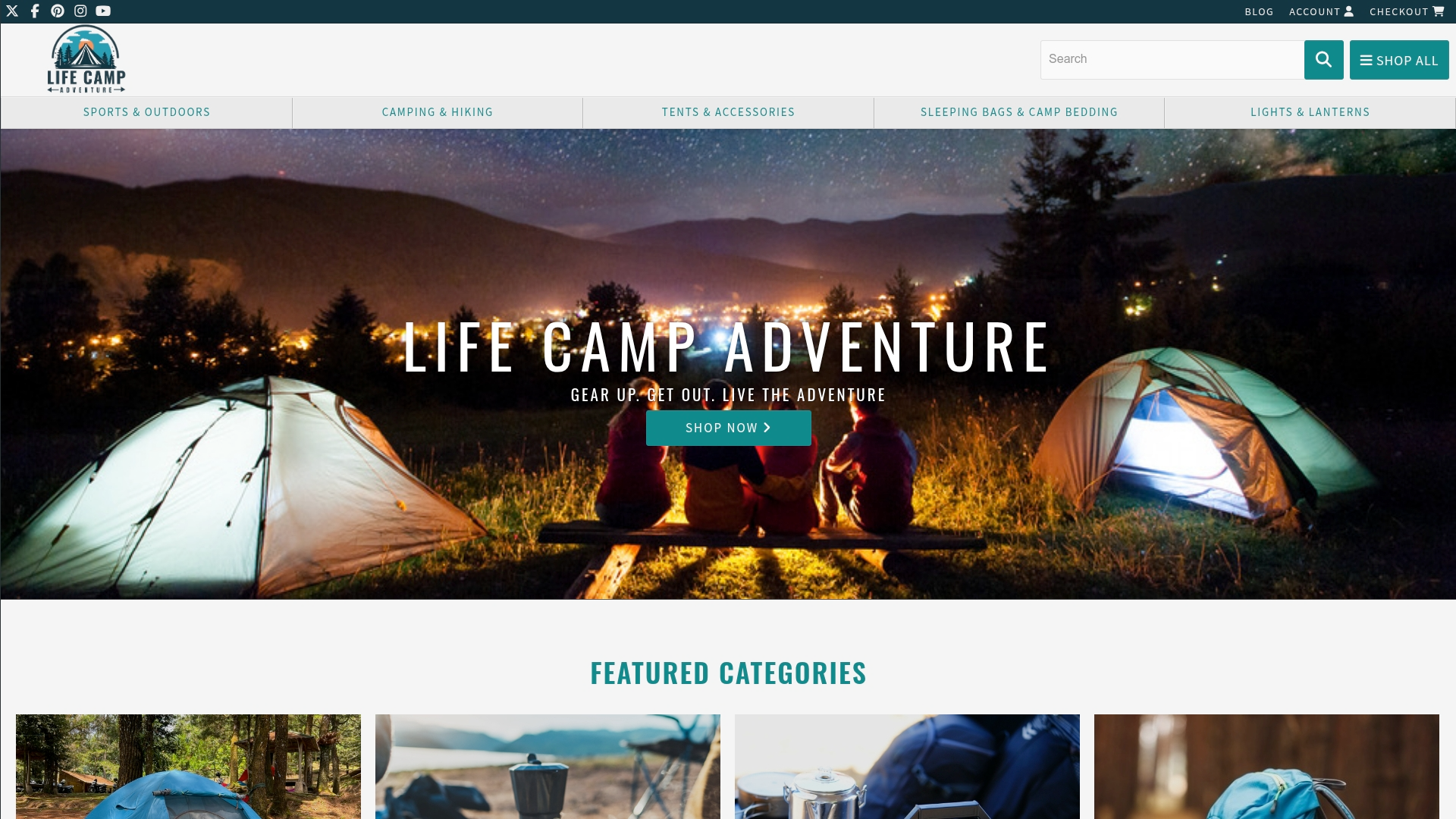
Lifecampadventure carries the full range of family camping gear alongside the tent: sleeping bags, camp furniture, cookware, and the accessories that make a campsite feel like a basecamp rather than a pile of gear. For families building out a complete kit, the outdoor gear comparison guide covers the rest of what you need.
The Life Camp Adventure Family Cabin Tent is available now. View the full specs and order directly at lifecampadventure.com/camping-tents-compared-comparison.
Authoritative sources and further reading
The claims in this article draw on the following sources. Check manufacturer spec pages for precise HH ratings and floor area measurements, as these can vary by production year.
- Hydrostatic Head & Waterproofness Ratings Explained — SlingFin's technical breakdown of HH ratings, seam sealing, and what the numbers mean for real-world camping conditions
- The Best Camping Tents: Tested & Ranked — OutdoorGearLab's in-field testing methodology, capacity guidance, and setup-time data used throughout this article
- Best Family Tents: Top Picks to Suit Every Budget — Live for the Outdoors' use-case-based roundup structure, which informed the "best for" category framing
- Best Family Camping Tents: Peak Gear Guide — Source for peak height and vestibule area as primary livability factors in family tent selection
- The 7 Best Cheap Family Tents (Bought & Tested) — Camping Guidance's hands-on budget tent testing, used for the trade-off notes on lower-priced options
- Family Camping Tents: The Complete Buying & Setup Guide — CampingZest's mid-range pricing guidance and value-tier analysis
- NPS Camping Resources — National Park Service guidance on campsite selection and Leave No Trace practices relevant to site preparation and setup
For families planning trips in areas with active weather or wildfire conditions, weather.gov and inciweb.wildfire.gov provide current conditions before you head out.
