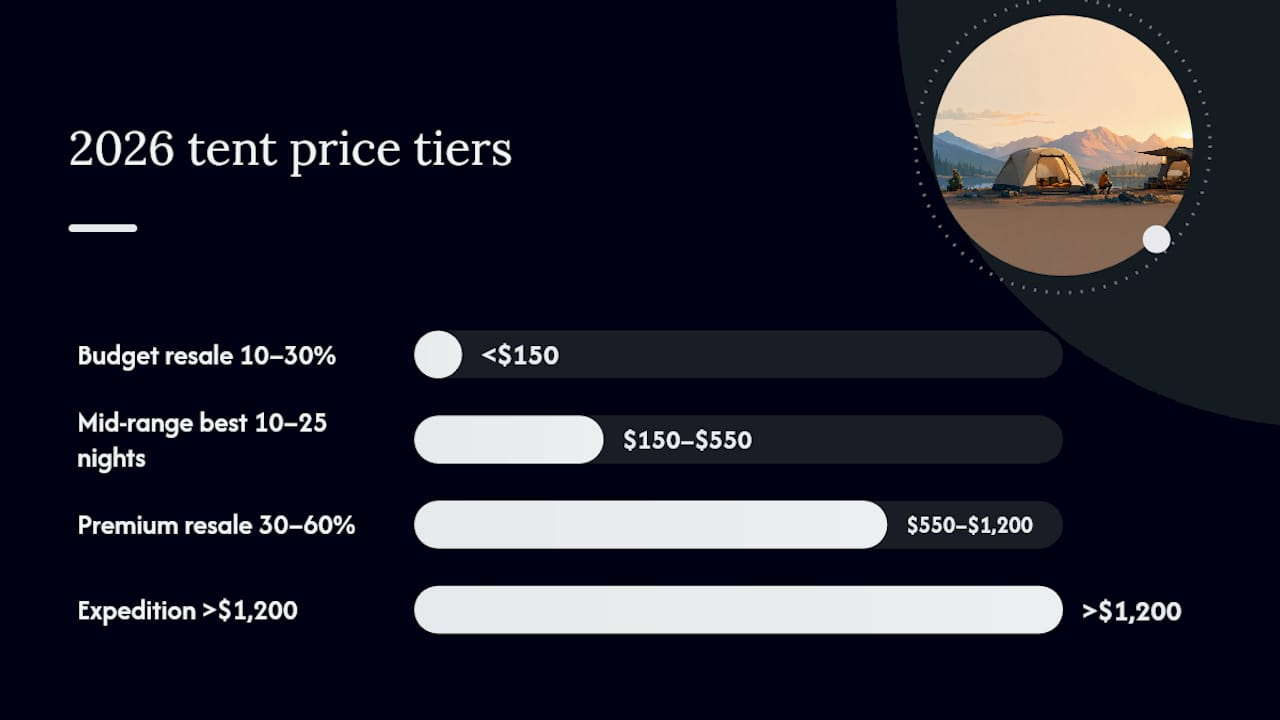
Expect to pay anywhere from under $50 to well over $1,000 for a tent in 2026, with the recreational sweet spot landing between $150 and $550 for most U.S. shoppers. That range covers a lot of ground, so here is the short version of who pays what.
- Casual car campers typically spend $80–$250 on a 3-person or 4-person dome tent that handles three-season conditions without demanding much from them.
- Frequent backpackers usually land in the $200–$600 band, where lighter fabrics, better pole alloys, and meaningful warranties start showing up.
- Alpine and expedition buyers routinely pay $600–$1,200+ for double-wall, 4-season construction that can take sustained wind and snow loads.
Two forces are pushing prices in 2026: oil-based fabric costs (nylon and polyester are petroleum derivatives) and ongoing freight volatility from Asia, where most tent manufacturing is concentrated. Neither is moving sharply enough to force a panic buy, but waiting for a significant price drop is unlikely to pay off. The sections below break down every tier, type, and use case with specific dollar figures so you can match a budget to your actual camping plans.
Key Takeaways
The $150–$550 recreational sweet spot covers the vast majority of U.S. campers in 2026, with cost-per-use math consistently favoring mid-range tents for anyone camping 10–25 nights per year.
| Point | Details |
|---|---|
| 2026 price sweet spot | Most shoppers land between $150 and $550; budget starts under $50, expedition exceeds $1,200. |
| Best buying window | Late August through October clearance sales offer 25–40% off mid-range and premium models. |
| Cost-per-use math | Subtract expected resale value before dividing; premium tents retain 30–60% vs. 10–30% for budget. |
| Mid-range wins for most | Campers doing 15–30 nights per year get the best lifetime value from the $200–$450 tier. |
| Lifecampadventure tents | Covers budget through premium tiers with clear warranty terms and a full tent comparison tool. |
2026 tent prices by type and quality tier
The table below reflects U.S. retail price sampling across major online and specialty retailers in early 2026. "Budget" means the lowest-price models that still function as intended. "Mid" is where most shoppers land. "Premium" covers performance-focused models. "Expedition" is purpose-built for extreme conditions.
Canvas and wall tent prices reflect data from White Duck Outdoors' 2026 canvas tent price guide, which lists bell tents from roughly $450 to $1,600 and outfitter-grade wall tents from $1,650 to $3,800+.
What moves price within each type:
- 3-season backpacking: Fabric denier (20D vs. 70D), pole material (DAC Featherlight vs. generic aluminum), and hydrostatic head rating (HH) are the biggest levers. A 20D silnylon floor with 3,000mm HH costs more to produce than a 68D polyester floor at 1,500mm HH.
- Family cabin tents: Floor area and the number of room dividers drive cost. Fiberglass poles keep budget models cheap but add weight and break more often. Steel-hub frames appear in mid-range; aluminum throughout is a premium signal.
- Pop-up / instant: The folding hub mechanism is the expensive part. Budget versions use plastic hubs that crack in cold weather; better models use metal.
- Canvas / glamping: Weight and cotton-poly blend ratio matter. A heavier canvas (12 oz/sq yd) costs more to produce and ship but breathes better and lasts longer than a lighter 8 oz blend.
- 4-season mountaineering: Geodesic or semi-geodesic pole geometry, reinforced guy-out points, and factory-taped seams all add to production cost. Tested CleverHiker reviews consistently show that 4-season models with full-coverage rainflies and vestibule space command a significant premium over 3-season equivalents.
Regional variation and shipping: Shoppers in the continental U.S. generally see free or low-cost shipping from major online retailers on orders above $50–$100. Remote Alaska and Hawaii addresses often add $30–$80 in freight for bulkier family or canvas tents.
Pro Tip: For most campers who go out 5–15 nights a year, a mid-range 3-season tent at $200–$350 outperforms both ends of the spectrum. Budget models often need seam sealing and pole replacement within two seasons; premium models carry features (full geodesic geometry, 4-season ratings) that a casual camper will never need.
What tents cost by capacity and use case
Capacity is the fastest way to narrow a budget. Here is what each common configuration costs in 2026, with low, typical, and premium price points.
2-person (2P) tents
- Low: $80–$150 (basic dome, fiberglass poles, 1,500mm HH)
- Typical: $200–$380 (aluminum poles, 2,000–3,000mm HH, freestanding)
- Premium: $400–$800 (ultralight fabrics, DAC poles, taped seams)
3-person (3P) tents
- Low: $100–$180
- Typical: $220–$420
- Premium: $450–$900
4-person tents
- Low: $120–$220
- Typical: $250–$500
- Premium: $500–$1,000
6–8-person family cabin tents
- Low: $150–$280
- Typical: $300–$600
- Premium: $600–$1,200
Festival / one-off tents
- Low: $30–$60 (throwaway-grade, expect one or two uses)
- Typical: $80–$180 (decent enough to resell or donate)
Ultralight backpacking tents (sub-2 lb)
- Low: $250 (rare; usually a compromised design)
- Typical: $400–$650
- Premium: $700–$1,200+
Thru-hike setups (shelter system including footprint)
- Low: $200–$350 (tarp-tent hybrid, no floor)
- Typical: $400–$700 (single-wall or semi-freestanding)
- Premium: $700–$1,400 (full-featured, ultralight, double-wall)
For ultralight backpacking tents, the weight-to-price curve is steep: shaving 8 oz off a 2P tent often adds $150–$300 to the price because it requires higher-grade fabrics and precision manufacturing.
How capacity affects price beyond just size: A larger tent needs more fabric, more poles, more zippers, and more floor material. A 6P cabin tent uses roughly 3–4 times the material of a 2P backpacking tent, but it does not cost 3–4 times as much because the fabric is heavier and cheaper per square foot. Per-person cost actually tends to drop as you scale up in family tents. A $350 4P tent works out to $87.50 per person; a $250 2P tent is $125 per person. That math matters when you are outfitting a family.
What actually drives tent prices in 2026
Price is not random. Every dollar above the floor reflects a specific manufacturing or design decision. Knowing which ones matter to you makes it easier to decide where to spend and where to save.
The biggest cost drivers:
- Fabric denier and weave: Lower denier (15D–30D) fabrics are lighter but cost more per yard to produce with adequate strength. A 15D ripstop nylon rainfly costs more than a 75D polyester one, even though it weighs less.
- Hydrostatic head (HH) rating: A 3,000mm HH floor is meaningfully more waterproof than a 1,500mm floor. Factory-taped seams add another $20–$60 to production cost but eliminate the need for field seam sealing.
- Pole material: DAC Featherlight aluminum poles are lighter and more elastic than generic aluminum; carbon fiber poles cost more still. Fiberglass is the cheapest option and the most likely to snap in cold weather.
- Zippers: YKK zippers cost more than no-name alternatives but last significantly longer. On a tent you plan to use for five or more years, zipper quality matters.
- Testing and R&D: Brands that publish wind-load ratings and conduct independent weather testing build that cost into the price. You are paying for documented performance, not just a spec sheet claim.
- Labor: Most tent manufacturing is in China, Vietnam, and Bangladesh. Labor cost differences between factories are real but smaller than fabric and pole cost differences.
Channel effects on price: Big-box retailers and discount platforms push average selling prices lower by stocking high-volume, lower-spec models. Specialty outdoor retailers and DTC brands maintain higher prices but typically offer curated assortments, repair services, and knowledgeable staff. As noted in IndexBox's global tent market analysis, channel strategy is one of the primary levers brands use to manage average selling price. Buying DTC often means paying closer to MSRP but getting better warranty support and access to replacement parts.
Reading a spec sheet: Look for these specific notations when comparing tents online:
- HH mm (hydrostatic head in millimeters): 1,500mm is the minimum for rain protection; 3,000mm+ is solid; 5,000mm+ is premium.
- Denier (D): lower is lighter and usually more expensive; higher is heavier and more durable.
- Pole alloy: 7001 or 7075 aluminum is stronger than 6061; DAC or Easton branding signals quality.
- "Seams taped" vs. "seams sealed": factory-taped is more reliable than field-applied sealant.
Warranty and spare parts as a hidden price factor: A tent with a lifetime warranty and an active spare-parts program has a lower effective lifetime cost than a cheaper tent with no repair path. Pole sections, clips, and guy lines are cheap to replace if the manufacturer sells them. If they do not, a broken pole means buying a new tent. CampChap's expert analysis makes the case that spare-parts availability, warranty terms, and repair turnaround often reduce lifetime cost even when the upfront price is higher.
Why tent prices are where they are in 2026
The global tent market is large and growing. ResearchAndMarkets estimates the market at approximately $20.25 billion in 2026, with a projected 5.8% CAGR through 2032. IndexBox's analysis puts global consumption at 1.1 million tons in 2024 with a 3.2% CAGR forecast to 2035. Both figures point to steady, not explosive, growth. That matters for buyers because a stable market does not produce the kind of price spikes or crashes that would make timing your purchase critical.
What is pushing prices in 2026:
- Raw materials: Nylon and polyester are oil derivatives. When crude oil prices rise, fabric costs follow with a 3–6 month lag. Aluminum prices, which affect pole costs, have been volatile since 2022 and remain elevated.
- Freight: Ocean freight rates from Asia normalized after the 2021–2022 spike but remain above pre-pandemic levels. Brands that locked in long-term shipping contracts are better insulated; smaller brands pass more of the cost through.
- Tariffs and trade policy: Tariff changes affecting goods imported from Asia have added cost pressure on tent imports in 2025–2026. Some brands have responded by shifting production or absorbing margin; others have raised retail prices by 5–12%.
- Innovation at the premium end: Lighter fabrics, higher HH ratings, and improved pole geometry continue to push premium prices upward. The gap between a $300 mid-range tent and a $700 premium tent is wider in real terms than it was five years ago because the premium tier has genuinely improved.
- Seasonal promotional patterns: The deepest discounts on 2026 camping gear tend to appear in late August through October (end-of-season clearance) and again in November (Black Friday). Spring sales in March and April are common but shallower, typically 15–20% off versus 25–40% in fall clearance.
Should you buy now or wait? For most shoppers, waiting for a significant structural price drop is not a realistic strategy. Material costs are not falling, and the market is growing. If you need a tent for a trip in the next six months, buy during the next promotional window. If your trip is in spring, fall clearance is your best window.
How to get the best price on a tent in 2026
Timing and channel choice matter more than most shoppers realize. Here is where the real savings are.
When to buy:
- Late August through October is the best window for clearance pricing on current-season models. Retailers need to move inventory before winter, and discounts of 25–40% are common on mid-range and premium tents.
- Black Friday and Cyber Monday bring additional cuts, though popular models sell out fast. Have a shortlist ready before the sale starts.
- March and April see modest spring promotions (15–20% off) as retailers restock for the camping season. Good for specific models you have been watching.
- Avoid May through July unless you find a specific deal. Demand is highest and discounts are smallest.
Where to look:
- DTC brand websites often have the best warranty support and access to replacement parts, though prices are usually at or near MSRP outside of sale periods.
- Specialty outdoor retailers carry curated selections and knowledgeable staff. Price-match policies are common and worth asking about.
- Big-box retailers stock high-volume models at lower price points. Good for budget and entry-mid tents; less useful for premium or technical models.
- Online marketplaces (general e-commerce platforms) offer the widest selection and price comparison, but return policies vary and counterfeit or misrepresented products exist. Stick to verified sellers.
- Used-gear platforms (dedicated outdoor gear resale sites and local buy-sell groups) can yield 30–50% savings on premium tents that retain their structure and waterproofing.
Inspecting a used tent before you buy:
- Check the floor for delamination, punctures, or thin spots. Run your hand across it and look for soft patches.
- Inspect every zipper. Zip and unzip each one fully. Sticky or skipping zippers are expensive to repair.
- Look at the seam tape. Peeling or bubbling tape means the tent will leak and re-taping is labor-intensive.
- Flex each pole section. Cracks or deep dents near the ferrule are a failure risk.
- Set the tent up if possible. A tent that pitches correctly and holds its shape is a good sign; a saggy or asymmetrical pitch suggests bent or missing poles.
Rentals: when they make more sense than buying:
Event tent rentals are a different category from camping tent rentals, but the math applies to both. Baystate Tent's 2026 rental pricing guide shows that a 20×40 high-peak frame tent in New England runs $700–$900+ before add-ons. For a one-time event, that is almost always cheaper than buying. For camping, renting makes sense if you camp fewer than three nights a year or are testing a tent type before committing to a purchase.
If you are renting for an event, TentRentalFinder's booking guidance recommends booking 4–6 months ahead in peak wedding season.
Pro Tip: Register your tent's warranty the day you buy it, and order one spare pole section and a repair sleeve at the same time. Replacement parts are often discontinued within two or three years of a model's release, and a $15 spare pole section can save a $400 tent from becoming landfill.
Three realistic 2026 buying scenarios
These three scenarios are built around real use patterns, not idealized ones. Each includes a cost-per-use estimate based on a five-year ownership window.
Scenario A: Budget build for occasional use
Who this fits: Someone camping 3–8 nights per year, mostly car camping at established campgrounds, not expecting extreme weather.
- Tent: 4-person dome, polyester fly, fiberglass or basic aluminum poles, 1,500–2,000mm HH. Typical price: $120–$200.
- Footprint/ground cloth: $15–$30 (or a cut piece of Tyvek).
- Total outlay: $135–$230.
- Estimated lifespan: 3–5 years with reasonable care.
- Cost per night (5 nights/year, 4 years): roughly $7–$12 per night.
The trade-off is real: budget tents often need seam sealing after the first season, and pole failures are more common. Budget tents typically retain only 10–30% of their purchase price at resale, so there is limited recovery if you decide to upgrade.
Scenario B: Sensible mid-range build
Who this fits: A camper going out 10–25 nights per year across a mix of car camping and occasional backpacking trips, wanting a tent that lasts 7–10 years.
- Tent: 3-person or 4-person, aluminum poles, 2,500–3,000mm HH, factory-taped seams, freestanding. Typical price: $280–$450.
- Footprint: $30–$50.
- Total outlay: $310–$500.
- Estimated lifespan: 7–10 years.
- Cost per night (15 nights/year, 8 years): roughly $2.60–$4.20 per night.
This is where the best camping tent reviews consistently land their top picks. The mid-range is the most competitive segment in 2026, with genuine quality improvements over budget models and none of the weight-obsession tax of the premium tier. For family camping trips, a mid-range 6P cabin tent in the $300–$500 range hits the same cost-per-night math.
Scenario C: Premium or expedition build
Who this fits: A backpacker logging 30+ nights per year, a mountaineer, or someone who camps in genuinely harsh conditions and cannot afford gear failure.
- Tent: 2-person ultralight or 4-season double-wall, DAC poles, 3,000–5,000mm HH, taped seams, geodesic geometry. Typical price: $600–$1,200.
- Footprint: $50–$80.
- Total outlay: $650–$1,280.
- Estimated lifespan: 10–15 years with proper care.
- Cost per night (35 nights/year, 12 years): roughly $1.55–$3.05 per night.
Premium tents retain 30–60% of their purchase price at resale, which meaningfully lowers the effective cost if you sell before the tent wears out. Canvas and glamping setups (bell tents at $450–$1,600, wall tents at $1,650–$3,800+) follow a similar long-lifespan logic but are not portable in the backpacking sense.
Pro Tip: When calculating cost-per-use, subtract your expected resale value before dividing. A $700 tent that sells for $350 after five years has a net cost of $350, not $700. That changes the math significantly compared to a $200 budget tent that sells for $40.
How we checked 2026 prices
Data sources and sampling:
- U.S. retailer price checks across major online outdoor retailers, big-box stores, and DTC brand websites, sampled in January and February 2026.
- Published market reports from IndexBox and ResearchAndMarkets for macro market-size and CAGR figures.
- Consumer price guides and editorial roundups, including CleverHiker's tested tent reviews and the Adnan Painting and Remodeling digital database tent cost guide.
- Canvas and specialty tent pricing from White Duck Outdoors' 2026 price guide.
- Rental pricing from Baystate Tent's 2026 rental guide and TentRentalFinder's booking report.
- Used-gear resale value estimates from CampChap's budget vs. premium analysis.
Geographic scope: All prices are U.S. retail prices in USD. Shipping costs were noted where they materially affect the delivered price (Alaska, Hawaii, and rural addresses). Sales tax was not included in any range, as it varies by state.
MSRP vs. sale prices: Price ranges reflect both MSRP and commonly available sale prices. We did not use one-day flash sale prices as the floor.
Methodology note: Price ranges in this guide are based on U.S. retail sampling from January–February 2026 and published market data. Prices change with seasonal promotions, inventory levels, and supply-chain shifts. We recommend verifying current prices directly with retailers before purchasing, and we plan to refresh this data ahead of the spring camping season.
Why sensible price bands matter more than chasing the cheapest tent
The most common mistake in tent buying is treating price as the primary filter. A $90 tent that leaks after two seasons and needs a pole replacement in year one has a higher effective cost than a $300 tent that runs clean for eight years. That is not an argument for always buying premium. It is an argument for matching the tent's durability to your actual use pattern.
The data in this guide points to a consistent conclusion: the $200–$450 mid-range is where most U.S. campers get the best return on their money. Below that, quality compromises accumulate. Above $600, you are paying for performance that most campers will never need. The exceptions are real: if you are thru-hiking the PCT or setting up a base camp above 12,000 feet, the premium tier earns its price. For everyone else, the mid-range is the honest answer.
One thing the price guides rarely say clearly: the cheapest tent you can find is often the most expensive tent you will own, once you count the replacements.
Lifecampadventure's tent selection for every budget
Lifecampadventure carries tents across the full range covered in this guide, from entry-level 3-season domes to canvas glamping setups, with pricing that maps directly to the budget, mid, and premium tiers described above. Every tent in the catalog is selected for durability, weather performance, and value at its price point, not just to fill a slot.
For backpackers, the selection includes lightweight 2P and 3P models with aluminum poles and taped seams in the $200–$450 range. Family campers will find 4-person through 8-person cabin tents with steel-hub frames and room dividers starting around $180. Canvas and glamping options cover bell tents and larger structures for buyers who want a longer-lasting, more comfortable base camp.
Every purchase comes with clear warranty information and access to replacement parts. Browse the full tent comparison, filter by capacity and season rating, and find the price point that fits your camping calendar at Lifecampadventure's tent comparison page. If you are not sure where to start, the tent selection guide walks through every decision point from capacity to season rating to pole material.
Sources
- Tents Market Global Forecast (ResearchAndMarkets)
- Tent Cost Guide: Price Ranges for Buying a Tent in the U.S. 2026 – Adnan Painting and Remodeling - Digital Database
- How Much Does a Canvas Tent Cost? Complete 2026 Price Guide by Tent Type — White Duck Outdoors
- Budget Vs Premium Tents: Which Is Worth It? 7 Expert Tips — CampChap
