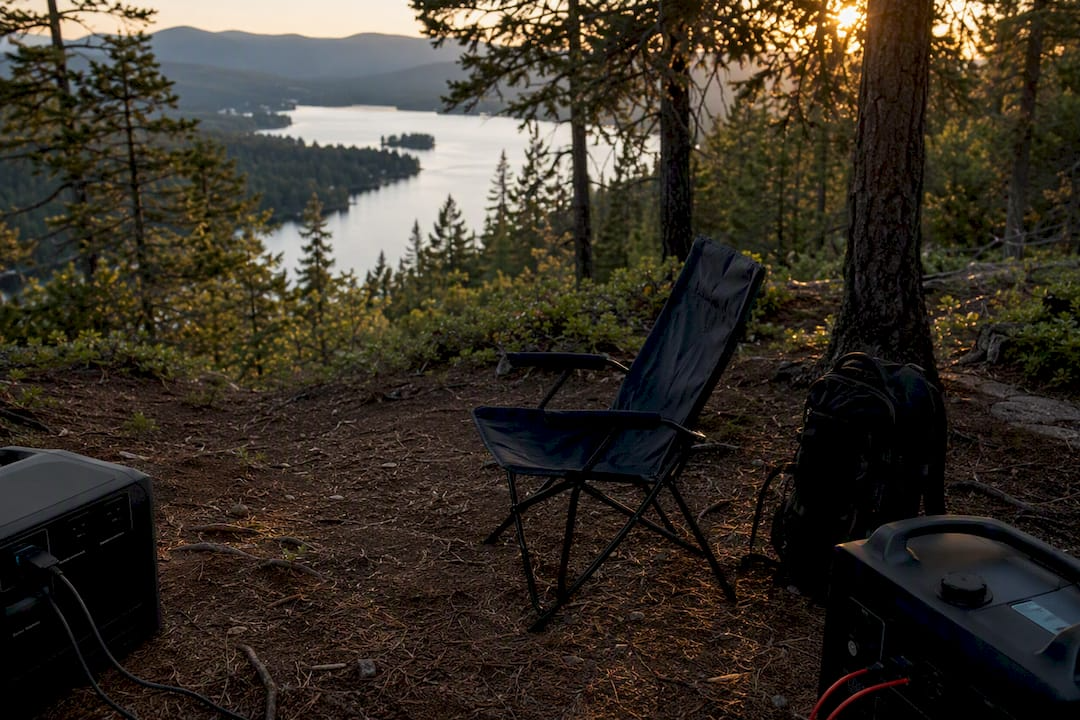
For quiet, indoor, or short-to-moderate backup needs, a portable power station is best. For continuous high-wattage demands and multi-day outages, a fuel generator wins. The right pick depends on three things: how long you need power, whether you're running surge-heavy appliances like pumps or A/C units, and whether the unit has to run indoors.
TL;DR:
- Power stations are ideal for indoor use, quiet operation, and short-to-moderate outages, but are limited in continuous high-wattage capacity compared to generators.
- Generators can provide longer runtime and handle surge loads more easily, especially for heavy appliances like sump or well pumps, but produce emissions and are noisy.
- Recharging power stations typically takes hours via wall outlets or solar, whereas generators refuel in minutes with gasoline or propane, impacting logistics during extended outages.
- For safety, power stations pose no carbon monoxide risk and can operate indoors, while generators must be kept outdoors and away from air intakes due to exhaust hazards.
- Cost differences favor generators for ongoing high-demand use due to lower upfront price and fuel expenses, but power stations are more economical for occasional, light loads and have minimal maintenance.
Power Station vs Generator: The Feature Comparison
Every buying decision comes down to matching your load to the machine's strengths. Here's how the two stack up across the categories that actually matter:
- Power output: Generators typically win for sustained high-wattage jobs; power stations cap out lower but cover most household electronics.
- Runtime: Generators run as long as you have fuel; power stations run until the battery, measured in watt-hours, is empty.
- Surge handling: Generators absorb the starting-watt spikes of motors and compressors far more easily than batteries.
- Noise: Power stations run near-silent; generators can hit 50 to 70+ decibels depending on load and enclosure.
- Safety: Power stations produce zero emissions; generators produce carbon monoxide and require outdoor placement.
- Charging/fuel: Power stations recharge from wall outlets or solar; generators refuel in minutes with gasoline, propane, or natural gas.
- Maintenance: Power stations need almost none; generators need oil changes, filter checks, and periodic run cycles.
The gap in practice: a mid-size generator can output 3,000 to 7,000 running watts for as long as fuel lasts, while a comparable power station stores a fixed 1,000 to 3,000 Wh that depletes with use, according to Harbor Freight's buying comparison.
How Do Power Stations and Generators Make Electricity?
A generator burns fuel to spin an engine, which drives an alternator that produces electricity in real time. It's rated by two numbers: running watts (what it sustains) and starting watts (the brief spike needed to kick on a motor). That gap between the two ratings is why generators handle surge loads so much more comfortably than batteries.
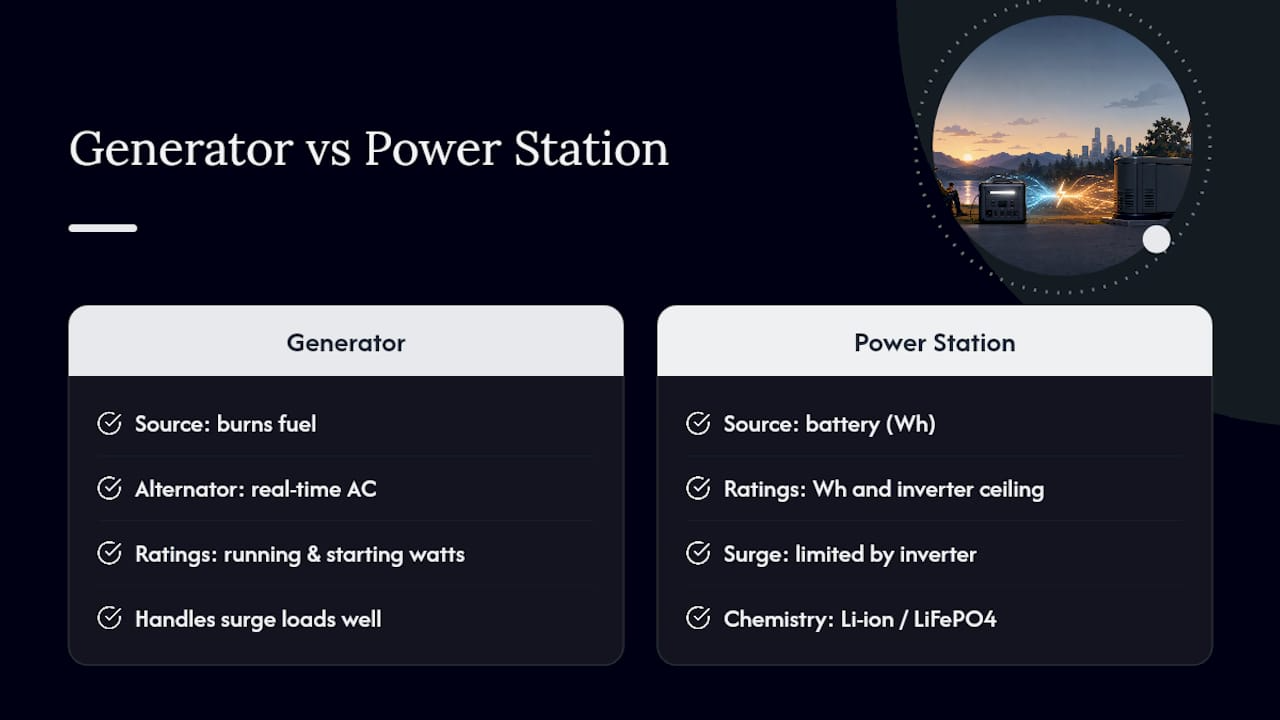
A power station works differently. It stores energy chemically in a battery, rated in watt-hours (Wh), and releases it through an inverter with its own fixed watt ceiling. Most modern units use lithium-ion or LiFePO4 cells, and LiFePO4 typically delivers thousands more charge cycles over its lifespan, according to The Gadgeteer's 2026 buying guide.
The runtime math is simple: divide the battery's Wh rating by your device's wattage draw to estimate hours of use. Real-world efficiency losses from the inverter and battery age typically shave a bit off that number.
How Long Will Each One Actually Run Your Gear?
Numbers make this comparison real. Here's what to expect from common household loads:
- Refrigerator: A standard kitchen fridge draws enough that a power station delivers roughly 7 to 14 hours per 1,000 Wh stored, depending on fridge size and ambient temperature.
- CPAP machine: Low draw means a 1,000 Wh power station can often cover multiple nights of use.
- Router and modem: Minimal wattage, so even a compact station keeps you connected for a full outage.
- Sump pump or well pump: These carry heavy starting-watt spikes that most power stations struggle to absorb, which is where generators take over.
The recharge gap matters just as much as runtime. Refueling a generator takes minutes. Recharging a power station from a wall outlet can take hours, and solar recharging depends entirely on panel size and sunlight, often stretching into a full day for a full charge. That logistics difference shapes which tool suits a short outage versus a week without power.
Is It Safe to Run a Generator Indoors?
No. Generators burn fuel and produce carbon monoxide, a gas you can't see or smell, which makes indoor or enclosed-space operation dangerous. Every generator needs to run outdoors, positioned away from windows, doors, and vents, with exhaust directed away from your living space. Power stations, by contrast, produce no combustion byproducts and run safely inside a tent, RV, or apartment.
Noise is the other divide. A power station's only sound is a small cooling fan. A running generator is audible well beyond your campsite or backyard, which matters at a quiet-hours campground or in a tight-lot neighborhood.
- Install a battery-powered CO detector near any space where a generator operates nearby.
- Keep generator exhaust at least 20 feet from windows, doors, and vents.
- Route power cords along walkways, not across them, to avoid trip hazards.
Pro Tip: If you're car camping near other sites, run a decibel check before you buy. A power station lets you brew coffee and charge devices at 6 a.m. without a single complaint from your neighbors.
What Does Each Option Cost to Own Over Time?
Sticker price only tells part of the story. Generators tend to cost less per watt of output but add ongoing fuel and maintenance expenses. Power stations cost more per watt-hour of stored energy but carry a much lower cost per year of ownership if you use them occasionally.
- Generators need regular oil changes, air filter checks, spark plug replacement, and periodic test runs to stay reliable.
- Power stations need almost no maintenance beyond occasional full charge cycles, though LiFePO4 batteries hold up longer than standard lithium-ion over thousands of cycles.
- Frequent, heavy use (weekly jobsite work, whole-home backup) tends to favor a generator's lower per-watt cost.
- Occasional use (a few camping trips a year, short outages) tends to favor a power station's near-zero upkeep.
Fuel costs add up fast for generators run over multiple days, while a power station's "fuel" is either free sunlight or a modest electric bill.
How Do You Recharge a Power Station in the Field?
Three paths get you back to full power: a wall outlet, solar panels, or a generator acting as a charger. Wall charging is fastest and most predictable. Solar charging depends heavily on panel wattage, panel count, and how much direct sun you're getting.
- Wall (AC) charging: typically the quickest option, often a few hours depending on the station's input rating.
- Solar charging: slower and variable; a strong midday sun with multiple panels can rival AC speed, while cloudy conditions stretch it out considerably.
- Generator-to-battery charging: works, but you lose some efficiency converting fuel to AC and then AC back into stored battery power.
- Stackable battery add-ons: let you expand total Wh capacity without buying a second full unit, useful for extended outages.
Pairing a power station with portable solar panels turns it into a genuinely renewable setup for multi-day trips, as long as you plan around weather.
How Should You Decide Between the Two?
Work through this checklist in order:
- List your primary loads. Fridge, CPAP, lights, laptop, or heavy appliances?
- Check for surge loads. Does anything have a motor, compressor, or pump?
- Set a runtime goal. Hours, one night, or multiple days?
- Confirm indoor use. Will this run inside a tent, apartment, or attached garage?
- Plan your recharge method. Wall outlet, solar, or fuel refill?
- Set your budget. Upfront cost versus ongoing fuel and maintenance.
| Scenario | Better fit |
|---|---|
| Apartment backup, CPAP, camping | Power station |
| Homeowner backup for fridge and sump pump | Generator, or hybrid setup |
| Jobsite or off-grid cabin, continuous heavy loads | Generator |
| Extended outage with mixed essential and heavy loads | Hybrid: battery for quiet essentials, generator for surge loads |
If your list mixes light electronics with a sump pump or window A/C unit, a hybrid approach using a generator to recharge a battery bank covers both needs without oversizing either machine, according to Powerhornet's comparison guide.
Field Notes on Power Stations From Lifecampadventure
Lifecampadventure has spent years helping campers pack smarter, and a few lessons repeat across every trip report. Weight and packability matter more once you're hiking a station into a backcountry site rather than pulling it from a trunk. Cold weather can quietly rob a battery of usable capacity, so storing your unit somewhere above freezing preserves runtime. Pairing a station with portable power banks for smaller devices stretches your main battery's capacity for the loads that actually need it.

What Actually Matters When You're Choosing
Most buying guides treat this as a spec sheet contest, watts against watt-hours, decibels against fuel tanks. That misses the real question: what happens the night the power goes out? If you're in an apartment with a CPAP machine, the generator's extra wattage is irrelevant. You can't run it there anyway. If you're a homeowner with a sump pump in a flood-prone basement, a power station's silence means nothing when the pump can't start.
The conventional advice oversells "one winner." The research backs a more honest split: power stations solve the indoor, quiet, moderate-runtime problem that generators structurally cannot touch, and generators solve the sustained, high-surge problem that batteries cannot yet match. Cold storage is the detail most buyers skip. Buy for your actual outage pattern, not the specs that look most impressive on a shelf tag.
— Billy
Gear Up for Reliable Power on Your Next Trip
Lifecampadventure isn't a generator manufacturer, and it won't pretend to be one. What Lifecampadventure does well is outfitting the accessories layer around your power setup: the portable solar panels that keep a battery topped off on the trail, the compact power banks for phones and headlamps, and the broader gear that makes a campsite or backup kit actually livable.

If you're building a preparedness kit around a power station rather than a generator, start with the accessories that extend its usefulness: solar input, backup power banks, and the small gear that rounds out a reliable setup. Browse Lifecampadventure's camping gear comparison to see what pairs well with the power source you've already chosen, and check out the survival essentials guide for the rest of your kit.
Sources
- Power Stations vs. Generators: What's the Difference?
- Portable Power Stations vs Generators
- How Long Will a Portable Power Station Run My Refrigerator?
- Power Station vs Generator: What Is the Difference?
- Portable power station vs generator: Which to buy in 2026
