For most U.S. backcountry trips, an ultralight squeeze filter is the right call. It weighs as little as 3 oz, flows at roughly 1.7 L/min, and removes bacteria and protozoa from alpine streams without adding pump fatigue or mechanical complexity. Groups heading to a basecamp need a gravity system instead: the Platypus GravityWorks 4L handles a moderate flow hands-free and weighs a moderate amount, which means dinner water for four people without anyone standing over a pump. International travelers and anyone heading into areas with poor sanitation need a true purifier, not just a filter, because filters alone cannot inactivate viruses. Emergency kits call for a compact chemical or UV backup that weighs almost nothing and covers the gap when your primary system fails.
Here is the short version of what each category delivers:
- Ultralight squeeze filters (2–4 oz): remove bacteria and protozoa; best for solo U.S. backcountry; no virus protection
- Gravity systems (10–14 oz): hands-off throughput for groups; same contaminant removal as squeeze; slow per-liter but high total volume
- Purifiers (pump, press, or UV) (8–18 oz): remove or inactivate viruses in addition to bacteria and protozoa; required for international travel or high human-impact water sources
- Chemical tablets (under 1 oz): treat viruses and bacteria; need 20–30+ minutes of dwell time; best as a backup, not a primary system
The weight range across all categories runs from very light to moderately heavy. Flow rates vary significantly under ideal conditions, though real-world speeds drop with turbidity and clogging. The CDC's guidance on water disinfection for international travelers draws a hard line between filters and purifiers, and that distinction should drive your purchase decision before anything else.
How do the top portable water filters compare at a glance?
Manufacturer flow rates assume clear, low-turbidity water; real-world throughput is lower without regular maintenance.
| Product | Best For | Weight (oz) | Flow Rate (L/min) | Contaminant Removal | Filter Life / Replacement | Maintenance | Capacity | Price |
|---|---|---|---|---|---|---|---|---|
| Sawyer Squeeze | Solo backpacking, ultralight | ~3 | ~1.7 | Bacteria, protozoa (0.1 μm) | 100,000 L rated / no cartridge cost | Backflush with syringe | Soft flask (sold separately) | under $50 |
| Katadyn BeFree | Trail running, day hikes | 1.7 | 1.7 | Bacteria, protozoa (0.1 μm) | 1,000 L / replacement flask | Shake/rinse, EZ-clean membrane | standard soft flasks | under $50 |
| LifeStraw Peak Squeeze | Backpackers, multi-mode use | 1.7 | 1.0 | Bacteria, protozoa (0.2 μm) | 1,000 L / replacement filter | Backflush, squeeze or straw | Soft flask compatible | ~$50 |
| MSR Guardian | Expeditions, international, disaster | roughly 17 | 1.75 | Bacteria, protozoa, viruses (0.02 μm) | 10,000 L / self-cleaning | Self-cleaning pump stroke | Pump-fill, any vessel | ~$350 |
| Platypus GravityWorks 4L | Groups, basecamp | ~11.5 | ~1.75 | Bacteria, protozoa (0.2 μm) | 1,000 L / replacement cartridge | Backflush, gravity-fed | 4 L dirty bag | $50–$150 |
| Grayl GeoPress | International travel, single-serve | nearly 16 | Press 24 oz in ~8 sec | Bacteria, protozoa, viruses, heavy metals | 350 L / ~$30 cartridge | Press-action, rinse | 24 oz per press | ~$90 |
| SteriPEN (UV) | International travel, clear water | ~3.8 | ~1 L/90 sec | Bacteria, protozoa, viruses (UV inactivation) | rated to 10,000 liters | Battery swap, wipe lens | — | ~$50–$100 |
Budget guide: Squeeze and straw filters run under $50. Mid-range gravity systems and bottle purifiers land between $50–$150. Heavy-duty mechanical purifiers like the MSR Guardian sit above $300.
What does each top model actually do in the field?
Sawyer Squeeze: the ultralight standard
The Sawyer Squeeze is the filter most U.S. thru-hikers reach for first, and the reason is simple: roughly 3 oz and a 1.7 L/min flow rate with a rated life of 100,000 liters means you will likely never buy a replacement cartridge. It threads onto standard water bottles and Sawyer's own soft flasks, and it backflushes with the included syringe in under a minute.
Best for: Solo backpacking, thru-hiking, ultralight packing
| Spec | Value |
|---|---|
| Weight | ~3 oz |
| Flow rate | ~1.7 L/min |
| Pore size | 0.1 μm |
| Removes | Bacteria, protozoa |
| Rated life | 100,000 L |
| Price | under $50 |
Pros:
- Lightest full-featured filter in its class
- Rated life is effectively lifetime for most users
- Compatible with standard soft flasks and hydration bladders
Cons:
- No virus protection
- Flow rate degrades fast without regular backflushing
Real-world note: the most common failure mode is a cracked soft flask, not the filter itself. Carry a spare flask or use a Smartwater bottle. Backflush every few liters in silty water.
Katadyn BeFree: fastest out-of-box flow
The BeFree's hollow-fiber membrane sits inside a soft flask, so the whole unit is the filter and the bottle combined. Shake it in water, squeeze, drink. Flow rate out of the box is among the highest of any squeeze-style filter, and the EZ-clean membrane restores speed with a simple shake rather than a syringe.
Best for: Trail runners, day hikers, fast-and-light trips
| Spec | Value |
|---|---|
| Weight | 1.7 oz |
| Flow rate | 1.7 L/min |
| Pore size | 0.1 μm |
| Removes | Bacteria, protozoa |
| Rated life | 1,000 L |
| Price | under $50 |
Pros:
- Highest out-of-box flow rate among squeeze filters
- No separate backflush tool needed
- Compact, integrated design
Cons:
- 1,000 L rated life is shorter than Sawyer; replacement flask adds cost
- No virus protection
The BeFree shines on day hikes and short trips where you refill frequently. On a thru-hike, the lower rated life means tracking usage more carefully.
LifeStraw Peak Squeeze: the versatile hybrid
The Peak Squeeze works as a squeeze filter, a straw, or inline with a hydration bladder. That flexibility matters when you are moving between water sources and trip styles. At 0.2 μm pore size it removes bacteria and protozoa, and the soft-flask compatibility makes filling in shallow sources straightforward.
Best for: Backpackers who want one filter for multiple trip types
| Spec | Value |
|---|---|
| Weight | 1.7 oz |
| Flow rate | 1.0 L/min |
| Pore size | 0.2 μm |
| Removes | Bacteria, protozoa |
| Rated life | 1,000 L |
| Price | ~$50 |
Pros:
- Three use modes (squeeze, straw, inline)
- Durable build with wide-mouth flask compatibility
- Straightforward backflush
Cons:
- Lower flow rate than Sawyer or BeFree
- 1,000 L rated life requires tracking
Flow rate is the trade-off for versatility here. If you know you will only ever squeeze, the Sawyer is faster. If you want one filter that adapts to different trip setups, the Peak Squeeze earns its place.
MSR Guardian: the expedition-grade purifier
The Guardian is in a different category from the squeeze filters above. Its 0.02 μm hollow-fiber membrane removes bacteria, protozoa, and viruses mechanically, without chemicals or UV. Rated to 10,000 liters, it self-cleans with every pump stroke, which means flow rate stays consistent even in turbid water. At roughly 17 oz it is the heaviest option on this list, but for international expeditions or disaster response, that weight buys genuine peace of mind.
Best for: International travel, expeditions, emergency preparedness
| Spec | Value |
|---|---|
| Weight | roughly 17 oz |
| Flow rate | 1.75 L/min |
| Pore size | 0.02 μm |
| Removes | Bacteria, protozoa, viruses |
| Rated life | 10,000 L |
| Price | ~$350 |
Pros:
- Mechanical virus removal without chemicals
- Self-cleaning pump stroke maintains flow in dirty water
- Extremely long rated life
Cons:
- Heaviest option by a wide margin
- High upfront cost
For U.S. backcountry use, the weight and price are hard to justify. For anyone heading to regions where viral contamination is a real risk, the Guardian is the most reliable mechanical solution available.
Platypus GravityWorks 4L: the group workhorse
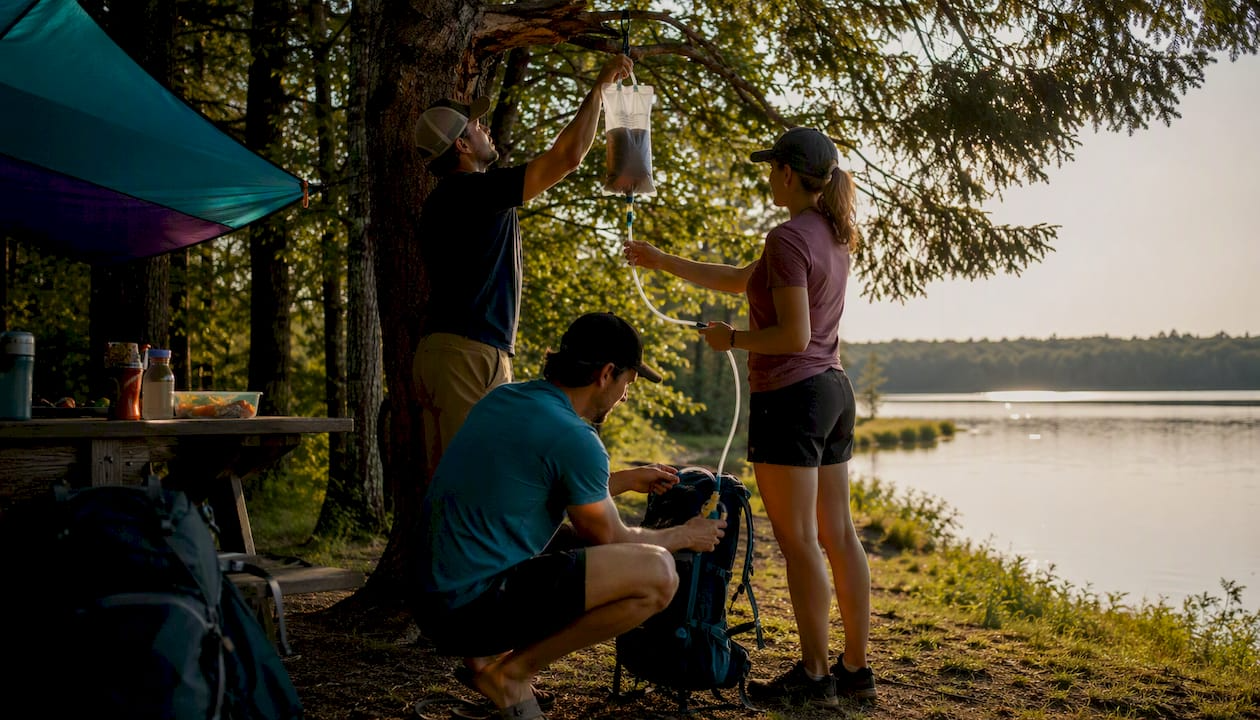
Hang the dirty bag, connect the hose, and walk away. The GravityWorks 4L filters water while you set up camp, cook, or rest, which is exactly what a group of three or four people needs after a long day. At roughly 11.5 oz and 1.75 L/min, it processes a full 4-liter bag in about two and a half minutes under good conditions.
Best for: Group camping, basecamp, family trips
| Spec | Value |
|---|---|
| Weight | ~11.5 oz |
| Flow rate | ~1.75 L/min |
| Pore size | 0.2 μm |
| Removes | Bacteria, protozoa |
| Rated life | 1,000 L |
| Price | $50–$150 |
Pros:
- Hands-free operation frees up time at camp
- 4 L capacity handles group water needs efficiently
- Backflushable cartridge
Cons:
- Bulkier than squeeze options; not ideal for solo or ultralight
- No virus protection
The GravityWorks also works as a squeeze filter in a pinch, which adds flexibility for mixed-use trips. The main limitation is the same as all gravity systems: you need a place to hang the dirty bag.
Grayl GeoPress: press-and-drink purification
The GeoPress is the closest thing to a foolproof purifier for international travel. Fill the outer cup, press the inner cup down, and 24 oz of purified water is ready in about 8 seconds. It removes bacteria, protozoa, viruses, and some heavy metals in a single press, with no waiting for chemical dwell time and no batteries to manage. The trade-off is weight (nearly 16 oz) and a 350-liter cartridge life that adds up in replacement costs for frequent travelers.
Best for: International travel, single-serve purification, urban water sources
| Spec | Value |
|---|---|
| Weight | nearly 16 oz |
| Flow rate | 24 oz per press (~8 sec) |
| Pore size | Sub-micron + activated carbon |
| Removes | Bacteria, protozoa, viruses, heavy metals |
| Rated life | 350 L / ~$30 cartridge |
| Price | ~$90 |
Pros:
- Removes viruses and heavy metals in one press
- No chemicals, no batteries, no waiting
- Works as a water bottle between uses
Cons:
- Short cartridge life at 350 L
- Heavier than squeeze options
SteriPEN (UV): the virus killer for clear water
The SteriPEN uses ultraviolet light to inactivate bacteria, protozoa, and viruses in about 90 seconds per liter. It weighs around 3.8 oz, adds no chemical taste, and is genuinely effective against viruses, which makes it a strong choice for international travel. The critical limitation: UV light does not penetrate turbid water reliably. Pre-filter or use only in clear water sources.
Best for: International travel, clear water sources, virus risk without turbidity
| Spec | Value |
|---|---|
| Weight | ~3.8 oz |
| Throughput | ~1 L per 90 sec |
| Removes | Bacteria, protozoa, viruses (UV inactivation) |
| Rated life | rated to 10,000 liters |
| Price | ~$50–$100 |
Pros:
- Kills viruses without chemicals
- Lightweight relative to mechanical purifiers
- No cartridge replacement cost
Cons:
- Requires batteries or charging
- Ineffective in turbid water without pre-filtering
- No physical removal of particulates
Pair the SteriPEN with a squeeze filter as a pre-filter in murky conditions, and you have a lightweight two-stage purification system that covers the full contaminant spectrum.
A note on pump filters: Pump-style filters like the Katadyn Hiker Pro and MSR TrailShot remain popular for their controlled fill rate and compatibility with any vessel. They work well but introduce more mechanical parts than squeeze or gravity systems, which increases the chance of field failure on long trips. For most backpackers, a squeeze or gravity system is the more reliable long-term choice.
How we test and evaluate portable water filters
Every pick in this guide is grounded in measured performance across multiple conditions, not just manufacturer spec sheets. Here is the framework used to evaluate each filter:
Flow rate under real conditions. Manufacturer flow rates assume clean, low-turbidity water. Testing includes clear mountain runoff and tannin-stained slow water to capture the range most U.S. backpackers encounter. Flow is measured in L/min at the start of a trip and again after 10+ hours of trail use without backflushing.
Ease of backflushing and maintenance. Each filter is backflushed using its included tool (or a standard syringe where no tool is included) and flow rate is re-measured. Filters that recover to near-original flow after a single backflush score higher for long-trip reliability.
Cold-weather and freeze resistance. Filters tested in sub-freezing conditions to check for membrane cracking. Any filter that retains water in its membrane overnight in freezing temperatures risks permanent damage. Gravity and squeeze systems are assessed for how easily they can be dried and stored in a sleeping bag.
Contaminant removal claims cross-checked against lab specs. Pore sizes and removal ratings are verified against manufacturer documentation and independent lab specs where available. NSF/ANSI certification status is noted where publicly listed.
Weight and packability. Each unit weighed with all included accessories (syringe, hose, bags). Packability assessed for how well the system fits in a hip-belt pocket versus a main compartment.
Durability and component failure modes. Soft flasks, couplers, and hose connections are the most common failure points. Each system is assessed for how easily failed components can be replaced or improvised in the field.
Group use simulation. Gravity systems are tested with a full dirty bag over multiple fill cycles to simulate basecamp use for three to four people across a weekend trip.
Quick field check for any filter you already own:
- Squeeze a full flask through the filter and time the output. A dramatic slowdown signals clogging.
- Check all couplers and hose connections for cracks or loose fittings.
- Smell the output water. Any chemical or musty odor suggests membrane degradation or a dirty carbon stage.
- Confirm the filter was stored dry. A filter stored wet for months may harbor bacterial growth in the housing.
How do you choose the right water filter for your trip?
Start with your primary constraint. Everything else follows from that one decision.
Weight is your constraint: solo ultralight or thru-hiking
If you are counting grams, the Sawyer Squeeze or Katadyn BeFree are the only real answers. Both weigh under 3 oz, both flow fast enough for solo use, and neither requires a pump or gravity setup. The Sawyer's 100,000-liter rated life means you will never replace the filter element; the BeFree's higher initial flow rate makes it better for frequent, quick refills on a fast-moving day hike.
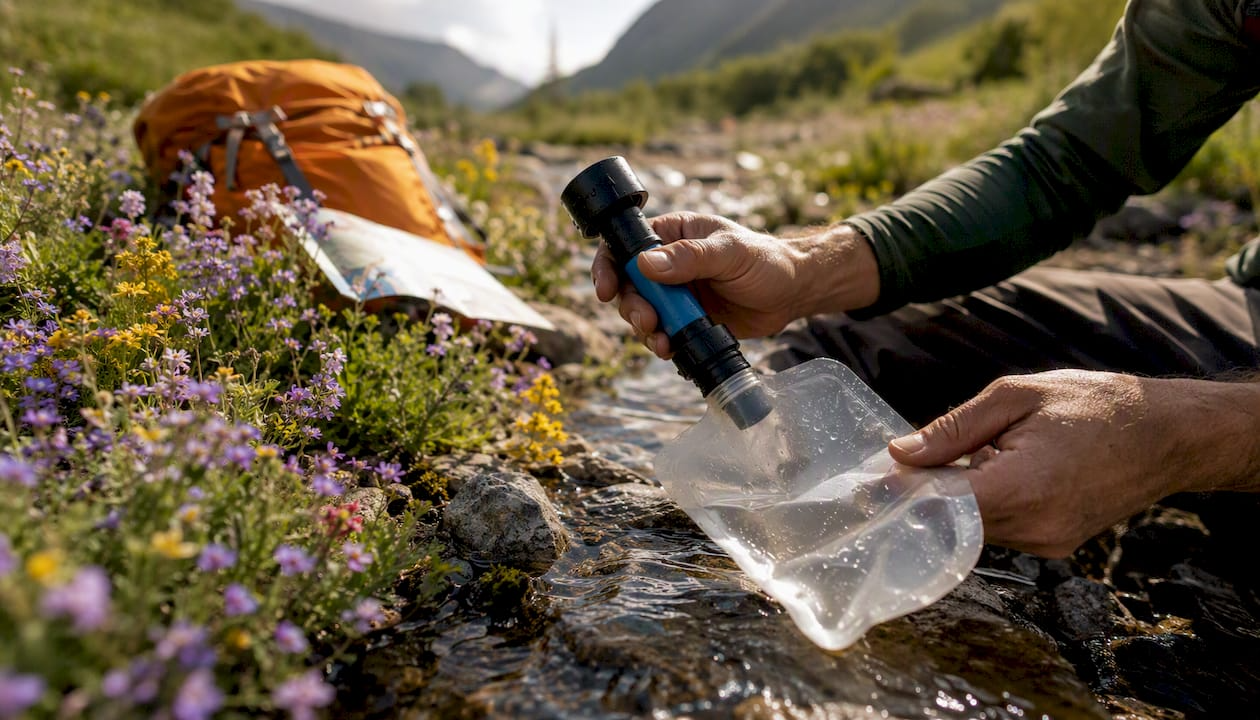
For U.S. backcountry streams, bacteria and protozoa are the primary risks. Clear alpine runoff typically carries far less viral risk than slow, lowland water near human activity, so a standard 0.1–0.2 μm filter covers the realistic threat for most domestic routes.
Group size is your constraint: basecamp or family camping
The Platypus GravityWorks 4L is the right tool. Gravity systems require no physical effort once hung, which matters when you are managing camp tasks for multiple people. The 4-liter capacity means one fill cycle handles drinking water for dinner and breakfast for a group of four. The weight penalty compared to a squeeze filter (about 8 oz more) is negligible when split across a group.
Virus risk is your constraint: international travel or high-impact water
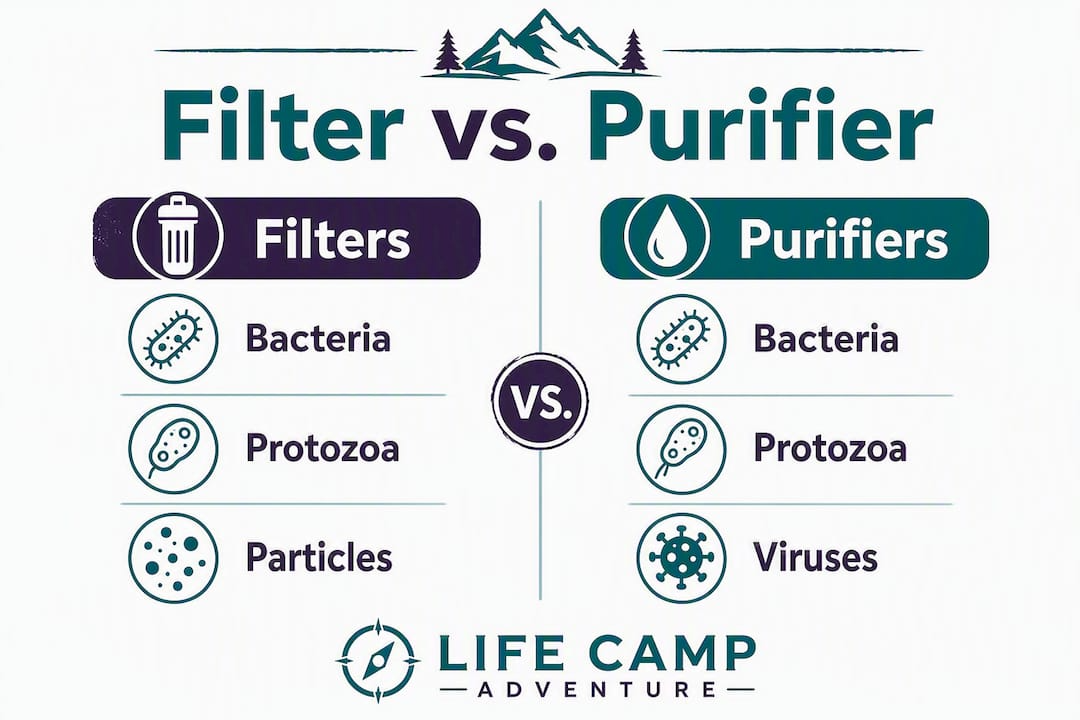
This is where the filter-versus-purifier distinction becomes non-negotiable. A standard hollow-fiber filter at 0.1–0.2 μm removes bacteria and protozoa but cannot physically block viruses, which are far smaller. For international travel, choose the Grayl GeoPress (press-action, no batteries, removes heavy metals too), the MSR Guardian (mechanical virus removal, 10,000-liter life), or the SteriPEN paired with a pre-filter for clear water. Chemical tablets are a valid lightweight backup but need 20–30+ minutes of dwell time and alter taste.
Budget is your constraint
| Budget Band | Recommended Category | Example Models |
|---|---|---|
| Under $50 | Squeeze filter | Sawyer Squeeze, Katadyn BeFree |
| $50–$150 | Gravity system or bottle purifier | Platypus GravityWorks, Grayl GeoPress, LifeStraw Peak Squeeze |
| Over $300 | Mechanical purifier | MSR Guardian |
What to pack per trip type
- Solo U.S. backcountry: Squeeze filter + spare soft flask + backflush syringe + chemical tabs as backup
- Group basecamp: Gravity system + backflush syringe + chemical tabs
- International travel: Purifier (GeoPress or Guardian) + SteriPEN or chemical tabs as secondary
- Emergency kit: Chemical tabs + compact UV pen + squeeze filter for particulate pre-filtering
Pro Tip: Use a soft, collapsible bottle for filling in shallow sources. Wide-mouth soft flasks are far easier to scoop from a trickle than rigid bottles, and they compress flat when empty, saving pack space.
What does each filter type actually remove?
The technical difference between a filter and a purifier comes down to pore size and treatment method. Filters with 0.1–0.2 μm pores remove bacteria and protozoa; viruses are roughly 10–100 times smaller and pass through standard hollow-fiber membranes. Removing or inactivating viruses requires either a sub-micron purifier membrane, UV light, or chemical treatment.
Contaminant removal by filter type
| Filter Type | Bacteria | Protozoa | Viruses | Microplastics | Heavy Metals / Chemicals |
|---|---|---|---|---|---|
| Squeeze (hollow fiber) | ✓ | ✓ | ✗ | Partial | ✗ |
| Gravity (hollow fiber) | ✓ | ✓ | ✗ | Partial | ✗ |
| Pump (hollow fiber) | ✓ | ✓ | ✗ | Partial | ✗ |
| Straw | ✓ | ✓ | ✗ | Partial | ✗ |
| Bottle/press purifier | ✓ | ✓ | ✓ | Partial | Partial (carbon stage) |
| UV (SteriPEN) | ✓ | ✓ | ✓ | ✗ | ✗ |
| Chemical (tablets) | ✓ | Partial | ✓ | ✗ | ✗ |
| Mechanical purifier (MSR Guardian) | ✓ | ✓ | ✓ | Partial | ✗ |
A few things worth noting about this matrix:
- Squeeze, gravity, and pump filters all use hollow-fiber membranes and offer equivalent contaminant removal. The differences between them are operational, not protective.
- UV treatment is highly effective against viruses but does nothing for particulates or chemicals, and it requires clear water to work reliably.
- Chemical tablets (chlorine dioxide is the most effective) handle viruses and most bacteria but are slower against Cryptosporidium and produce taste changes.
- Bottle/press purifiers like the GeoPress combine a sub-micron membrane with activated carbon, giving the broadest single-device coverage.
When to use each type
- Squeeze: Solo alpine streams, fast-moving trips, U.S. backcountry
- Gravity: Basecamp, group use, any situation where hands-free filtering is an advantage
- Pump: Controlled fill from any vessel, useful where water access is awkward; more moving parts than squeeze or gravity
- Straw: Emergency backup, short day hikes; not practical for cooking or group use
- Bottle/press purifier: International travel, urban water sources, anywhere viruses or heavy metals are a concern
- UV: International travel with clear water; pair with a pre-filter for turbid sources
- Chemical: Backup for any system; lightest option for emergency kits
For U.S. travel, the EPA's guidance on filtration and NSF/ANSI certification standards are the benchmarks to look for when evaluating a filter's removal claims. NSF/ANSI 58 covers reverse osmosis; NSF/ANSI 53 covers reduction of specific health-effect contaminants. For portable backcountry filters, manufacturer lab specs citing 0.1 μm or 0.2 μm absolute pore size are the practical standard.
How do you keep a portable filter flowing in the field?
Flow rate is the first thing to suffer when a filter is neglected, and a clogged filter in the backcountry is a genuine problem. The good news: most flow-rate issues are preventable with a simple routine.
Daily and per-use habits:
- Backflush after every heavy use session, especially in silty or tannin-stained water. A 30-second backflush with a syringe restores most of the lost flow.
- Rinse soft flasks after each fill to prevent biofilm buildup inside the bag.
- Avoid drawing from the bottom of a pool or puddle where sediment concentrates. Fill from moving water or let sediment settle before filling.
- In cold weather, keep the filter in your sleeping bag overnight. A frozen membrane cracks and cannot be repaired.
Step-by-step backflush:
- Fill the backflush syringe (or a clean soft flask) with filtered water.
- Connect the syringe to the clean-water output port of the filter.
- Push water backward through the membrane in a firm, steady stroke.
- Repeat two to three times until water runs clear from the dirty-water side.
- Shake out excess water and store the filter in a breathable bag, not a sealed plastic bag, to allow drying.
If you do not have a backflush syringe: blow through the clean-water port with your mouth using firm, steady pressure. It is less effective than a syringe but restores partial flow in a pinch.
Troubleshooting common problems:
- Dramatically slow flow despite backflushing: the membrane may be permanently clogged with fine clay or silt. Prevention is the only real fix; this is why pre-filtering through a bandana or coffee filter before squeezing matters in turbid water.
- Odd taste or smell from output: check the carbon pre-filter stage if your filter has one. A saturated carbon element passes through chemical tastes. Replace the cartridge or switch to a different water source.
- Cracked or leaking coupler: wrap the connection with athletic tape as a field repair. Replace the coupler at the next resupply.
- Gravity system draining slowly: check that the dirty bag is hung high enough for adequate head pressure, and backflush the cartridge. A height difference of at least 3 feet between the dirty bag and the clean bag is the minimum for reasonable flow.
Between-trip storage: store filters dry and at room temperature. Never store a wet filter in a sealed bag for more than a day or two. If you are putting a filter away for the season, backflush it, blow it dry, and store it with the caps on in a breathable mesh bag.
Pro Tip: Practice backflushing at home before your first trip. Knowing the feel of a properly backflushed filter versus a clogged one takes about five minutes at the kitchen sink and could save your trip. Carry a spare soft flask and a small bottle of chemical tabs on any trip longer than three days.
For a broader look at maintaining waterproof and water-related gear, the same principles of regular inspection and dry storage apply across most outdoor equipment.
What do experienced adventurers know that beginners miss?
A few high-leverage habits separate reliable water treatment from a system that fails at the worst moment.
Pack redundancy, always. A primary filter and a backup chemical treatment weigh under 2 oz combined. Chemical tablets like Aquatabs or Potable Aqua treat multiple liters per pack and cover the full contaminant spectrum including viruses. If your primary filter freezes, clogs beyond recovery, or gets lost, the tabs keep you safe. This is not optional on multi-day trips.
Know your source before you filter. Environmental source assessment matters more than any single piece of gear. Clear alpine runoff above treeline in a U.S. wilderness area carries a very different risk profile than slow, lowland water downstream of a campsite or agricultural area. Adjust your treatment method to the source, not just the destination.
Test your filter before you leave home. Fill a soft flask, squeeze through the filter, and time the output. If flow is already slow before the trip, backflush it now. A filter that takes three minutes to produce a liter at home will be nearly unusable after a day of silty water.
Understand the filter-versus-purifier line. The CDC draws this distinction clearly: filters remove bacteria and protozoa; purifiers also address viruses. For U.S. backcountry travel, a standard filter is almost always sufficient. For international travel or any water source near high human activity, a purifier or a filter-plus-chemical combination is the right call.
The CDC's guidance for international travelers states that water disinfection methods must address viruses in addition to bacteria and protozoa in regions where sanitation infrastructure is limited. A hollow-fiber filter alone is not sufficient for these conditions. UV treatment, chemical disinfection, or a certified purifier membrane are required to cover the full pathogen spectrum.
Packing checklist by trip type:
- Ultralight solo (U.S. backcountry): Sawyer Squeeze or Katadyn BeFree + spare soft flask + backflush syringe + chemical tabs
- Multi-day group: Platypus GravityWorks 4L + backflush syringe + chemical tabs + extra dirty bag
- International travel: Grayl GeoPress or MSR Guardian + SteriPEN as secondary + chemical tabs
Pro Tip: Before any trip, seal-check your filter by submerging the output end in a cup of water and blowing gently into the input. Bubbles from the output side indicate a compromised membrane. A filter that fails this test should not go in your pack.
For deeper reading on why outdoor water filtration matters and how to match treatment systems to specific trip types, Lifecampadventure's gear guides cover the full decision framework.
Key Takeaways
For most U.S. backcountry trips, an ultralight squeeze filter covers the realistic threat; for international travel or virus-risk water, only a true purifier closes the gap.
| Point | Details |
|---|---|
| Filter vs. purifier distinction | Filters (0.1–0.2 μm) remove bacteria and protozoa; purifiers also inactivate viruses — choose based on destination, not just weight. |
| Solo ultralight pick | The Sawyer Squeeze at ~3 oz and ~1.7 L/min is the best weight-to-performance ratio for solo U.S. backcountry use. |
| Group and basecamp pick | The Platypus GravityWorks 4L handles 4 liters hands-free at a moderate flow rate, making it a good tool for groups of three or four. |
| Maintenance is non-negotiable | Backflush regularly, store filters dry, and carry chemical tabs as a backup on any trip longer than two days. |
| Lifecampadventure gear resources | Lifecampadventure's survival essentials guide covers filter pairing and full kit recommendations for every trip type. |
The filter that actually matters is the one you maintain
Most debates about water filters miss the real point. The Sawyer Squeeze versus the Katadyn BeFree is not a meaningful argument for 90% of U.S. backpackers. Both weigh under 3 oz, both remove bacteria and protozoa, and both flow fast enough for solo use. The filter that matters is the one you backflush regularly, store dry, and actually carry.
What I see more often than I would like: a hiker with a premium filter that flows at a trickle because it has never been backflushed, or a traveler with a squeeze filter heading into Southeast Asia where viral contamination is a real risk. The gear choice is secondary to understanding what your water source actually contains and whether your treatment method covers it.
The one recommendation I would push harder than any specific model: pair your primary filter with a chemical backup. It weighs almost nothing, costs under $5, and covers the gap if your filter freezes, clogs, or gets left at a trailhead. That redundancy is the single highest-value upgrade most backpackers are not making.
For international travel, the filter-versus-purifier line is not a technicality. It is the difference between adequate protection and a real health risk. The Grayl GeoPress and the MSR Guardian are heavier and more expensive than a squeeze filter for a reason. If you are heading somewhere with limited sanitation infrastructure, that weight is worth carrying.
Gear up for your next trip with Lifecampadventure
There are solid options across every category in this guide, from the Sawyer Squeeze for ultralight solo trips to the MSR Guardian for expedition-level purification. The next step is building a complete kit around your primary filter.
Lifecampadventure carries the gear that turns a good filter choice into a complete water treatment system: soft flasks, backpacking essentials, and survival kit components that pair directly with the filters covered here. A practical starter kit for most U.S. backpackers includes a squeeze filter, a spare soft flask, a backflush syringe, and a pack of chemical tabs as backup. For group trips, add a gravity system and a second dirty bag.
Browse the Lifecampadventure outdoor survival checklist to build your full kit, or head to the camping gear comparison page to see how water treatment fits into a complete adventure loadout. Every product ships with straightforward return options so you can gear up with confidence before your next trip.
Useful sources for deeper research
- CDC: Choosing a home water filter — authoritative guidance on filter types, pore sizes, and what each removes; the primary source for the filter-versus-purifier distinction used throughout this guide.
- EPA: Water filtration fact sheet — U.S. regulatory context for filtration standards and contaminant removal claims; useful for understanding NSF/ANSI certification benchmarks.
- 10 Best Backpacking Water Filters and Purifiers (Treeline Review) — side-by-side spec comparisons and field-tested picks; strong source for gravity system data.
- Best Backpacking Water Filters (CleverHiker) — comprehensive field-tested rankings with weight, flow rate, and best-for picks across multiple categories.
- Best Backpacking Water Filters and Purifiers (Switchback Travel) — detailed flow-rate testing and maintenance analysis; useful for understanding real-world versus manufacturer flow claims.
