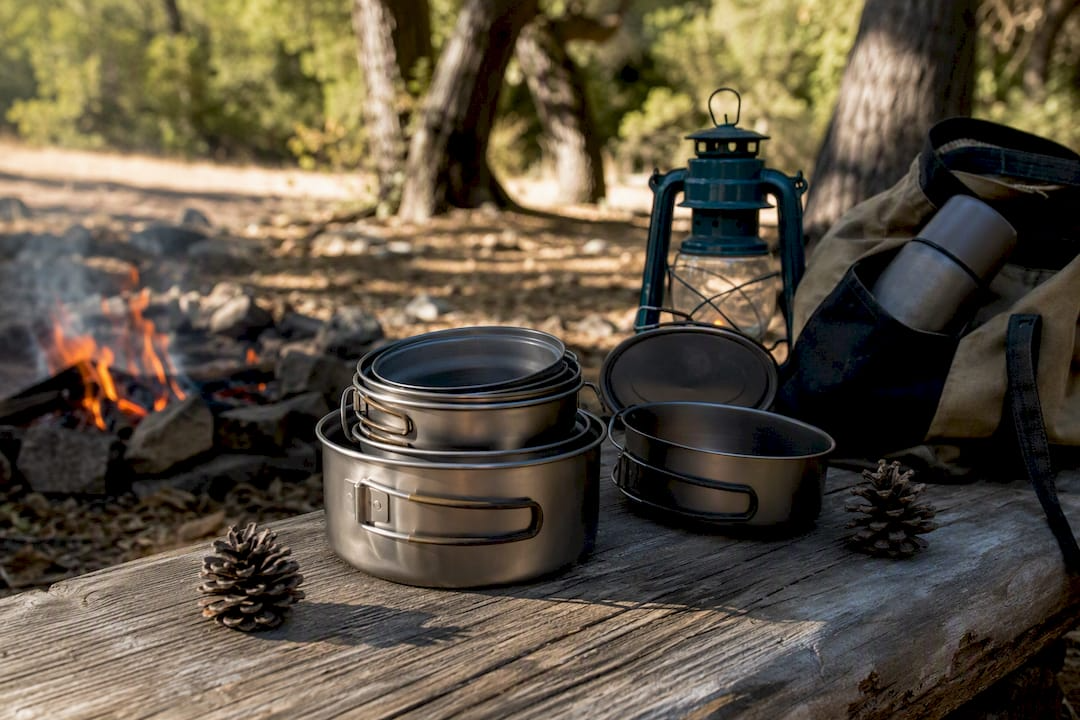
If you're fast-and-light backpacking, ultralight titanium or hard-anodized two-piece sets win every time. If you're car camping with family or cooking in a small home galley, tri-clad stainless nesting cookware sets deliver better heat control and durability without eating your storage space. The decision comes down to two questions: how much does weight matter versus cooking performance, and how many people are you actually feeding?
Backpackers should chase grams. Car campers and small-kitchen cooks should chase capacity and how tightly a set really nests, lids and handles included, not just the marketing photo. If you're not sure which camp you fall into, check whether you're hauling gear on your back or hauling it in a trunk. That single fact settles most of the argument.
Quick decision rules before you shop:
- Weight vs. capability: if ounces matter more than searing a steak, go ultralight. If you're cooking real meals for two or more people, prioritize a middleweight or full nesting set instead.
- Cooking style: boil-only meals (rehydrated food, coffee, oatmeal) need almost nothing. Sautéing, simmering sauces, or feeding a family calls for tri-clad or stainless construction with real heat distribution.
Life Camp Adventure's compact cookware guide breaks down curated picks by exactly these use-cases if you want to skip straight to shopping.
TL;DR:
- Ultralight titanium sets excel for solo backpacking but tend to cook unevenly and struggle with anything beyond boiling water.
- Midweight stainless or tri-clad sets around 1.2 to 1.8 pounds offer a good balance of durability, heat distribution, and packability for most campers.
- Prioritize removable or folding handles and check nested dimensions including lids and handles to ensure proper fit within your storage space.
- Be cautious of marketing-piece counts, as many sets inflate the number of pieces with lids and extras that do not increase actual cooking capacity.
- Durability issues like loose handle joints, plastic fittings, and peeling coatings are common failure points in cheaper cookware and should be verified before purchase.
What Makes Good Nesting Cookware Sets?
A nesting cookware set lives or dies on four things: material, heat distribution, handle design, and how the lids actually stack. Get any one of these wrong and you end up with a set that either cooks poorly or doesn't nest as compactly as the box claims.
Material choice drives everything else. Stainless steel resists dents and works on induction stovetops, making it the default choice for durability. Tri-clad construction, where an aluminum or copper core is sandwiched between stainless layers, gives you the best heat distribution of any camp-friendly material, which matters more than most buyers realize once they've scorched a pan on an uneven camp stove flame. Testers consistently favor stainless or tri-clad builds for exactly this reason. Hard-anodized aluminum trims weight while keeping decent heat transfer, and titanium goes further still, though it heats unevenly and works best for boiling rather than cooking anything delicate. Ceramic-coated nonstick surfaces cook eggs and fish without sticking, but the coating chips if you stack metal utensils or pans directly against it.
Handles make or break the nest. Fixed handles look sturdy but they're the single biggest reason sets don't nest as tightly as advertised. Removable or folding handles let pots stack flush against each other, shrinking the packed footprint by a meaningful margin. If a set advertises "ultra-compact" with fixed handles, look closer. The nested dimensions almost never account for handles sticking out the side.
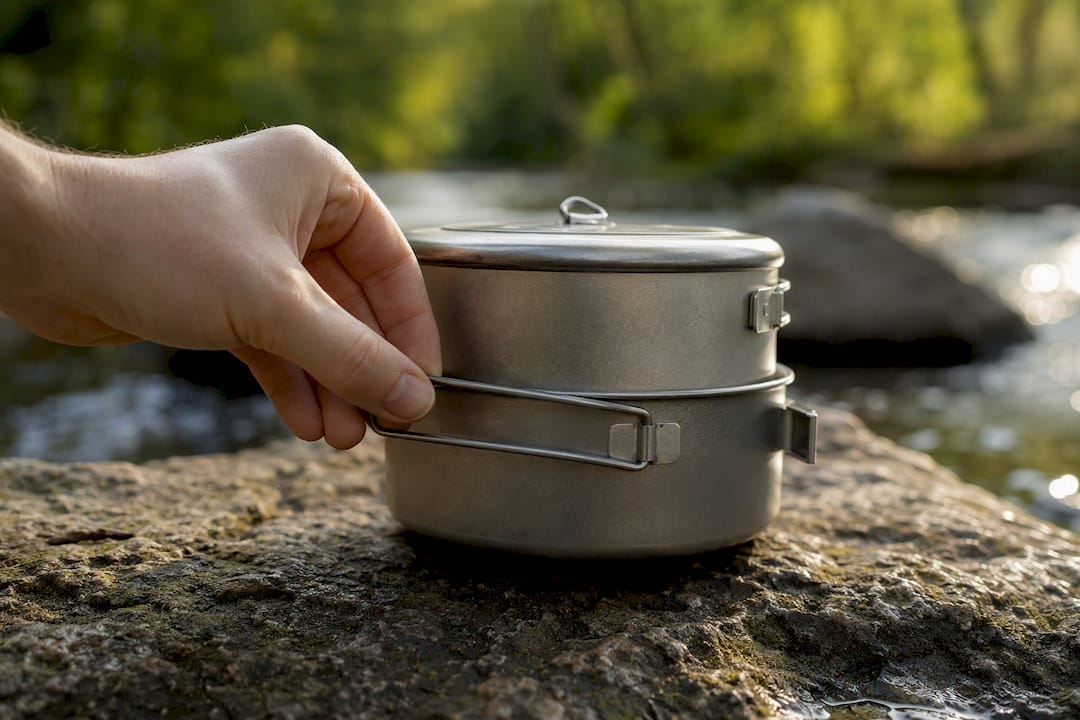
Lids and base design matter more than piece count. A well-designed lid should double as a plate, strainer, or second cooking surface. Reviewers who evaluate small-space cooking setups point to lid versatility as one of the clearest signals of a thoughtfully engineered set. Encapsulated, flat bases sit stable on uneven ground and distribute heat evenly, while thin single-wall bases create hot spots that scorch food in the center while the edges stay cold.
Coating safety is worth a quick check, too. Look for cookware explicitly labeled PFOA and PFAS free, since older nonstick formulations used chemicals that have since been phased out of quality manufacturing.
Lab and field tests show a consistent tradeoff pattern:
- Ultralight titanium sets shave the most weight but cook unevenly and struggle with anything beyond boiling water.
- Sets in the 1.2 to 1.8 pound range hit the best balance of cooking performance and packability for regular use.
- Heavier stainless and tri-clad sets sacrifice some portability but survive years of hard use without warping.
Which Nesting Cookware Format Fits Your Trips?
Nesting cookware splits into three practical categories, and matching the right one to your actual trips saves you money and cabinet space.
Ultralight backpacking sets weigh under a pound and typically include a single pot, a lid that doubles as a strainer or bowl, and sometimes a small pan. OutdoorGearLab's testing of sets like the Snow Peak Ti-Mini and MSR Trail Mini found these excel for solo trips centered on boiling water and simple meals, but they fall short the moment you try to cook for two or sear anything. Stove-fit matters most here since these pots are sized to match compact canister stoves almost exactly.
Midweight camp and car-camping sets run 1.2 to 1.8 pounds and usually include two to three pots, a frying pan, and lids that nest into a single stack. This is where sets like the GSI Outdoors Glacier Stainless and Stanley Adventure Even-Heat series earn their reputation for durability and nesting efficiency, particularly for car camping where weight matters less than longevity. Removable handles and lid design carry more weight here since you're packing and unpacking a full kitchen setup regularly.
Small-home and galley nesting cookware sacrifices ultralight weight entirely in favor of full-size pots (2.5 to 3.5 quarts) that still nest into a footprint smaller than a standard cabinet shelf. This category suits boats, RVs, and tiny apartment kitchens where the priority isn't trail weight but shelf and drawer space. Encapsulated bases and induction compatibility matter most here since these sets often live on a real stovetop, not a camp burner.
How Do You Know What Actually Fits When Nested?
Marketing photos lie by omission. A "12-piece set" often counts lids, a mesh bag, and a stuff sack as separate pieces, inflating the number while telling you nothing about real capacity. Reviewers consistently recommend ignoring total piece counts and focusing on the core pots and pans instead, since that's what determines whether you can actually cook a meal.
The real test is simple: measure nested height and diameter with a tape measure, including lids on and handles folded or attached, not the vessel alone. Buyers should verify the manufacturer's stated nested volume includes lids and removable handles, because that's the only honest comparison metric between sets. Some brands quote pot volume only, which flatters the spec sheet and misleads the buyer.
For sizing meals, a 2.5 to 3.5 quart primary pot comfortably feeds two to four people without forcing you into multiple cooking batches that waste fuel and time. A smaller "solo" pot might look impressively compact in the store, but it forces two or three rounds of cooking for a family, burning more fuel than a single larger pot would.
- Confirm nested height fits your cabinet shelf or backpack's main compartment before buying.
- Add roughly half an inch to the manufacturer's stated dimensions to account for handle clearance.
- Check whether the lid nests inside the largest pot or sits on top, since that changes total packed height significantly.
Pro Tip: Bring a tape measure to the store, or check the exact dimensions online against your pack's main compartment or your cabinet shelf height before buying. A half-inch miscalculation is the difference between a set that slides in easily and one that jams the zipper every single trip.
Smart Packing and Storage for Nesting Sets
The order you stack pieces in determines both how much space you save and how long your cookware lasts. Practitioner guidance on small-space cooking points to a clear nesting sequence: largest pot first, then progressively smaller pots and pans, with the lid or lids settling on top or tucked into whichever gap fits their profile.
- Stack largest to smallest, and slide removable handles into the gap alongside the pots rather than leaving them loose in a bag.
- Place a soft cloth, dish towel, or dedicated liner between any ceramic or nonstick surface and the metal piece nested against it. Practitioners specifically recommend this step since bare metal-on-coating contact is the fastest way to scratch a nonstick pan into uselessness.
- If your stove or fuel canister fits inside the largest pot, nest it there rather than packing it separately, but keep fuel canisters away from anything with a nonstick coating to avoid residue transfer. Life Camp Adventure's portable camp stove guide covers which stove sizes fit inside common nesting sets.
Pro Tip: Use a drawstring stuff sack sized just slightly larger than your nested set, not a bulky padded case. The tighter fit compresses the whole stack and keeps loose pieces from rattling apart in transit.
For boats and RVs, a cabinet with a raised lip or a tension strap keeps a nested stack from sliding during rough water or highway bumps, which matters more than most first-time boat cooks expect.
Common Cookware Pitfalls to Avoid
The cookware aisle is full of sets that look like a deal until you actually cook with them a few times. A handful of warning signs repeat across nearly every failure story.
- Inflated piece counts. A "20-piece" set padded with a mesh bag, plastic cups, and a spork isn't more cookware, it's marketing. Count only the actual pots and pans.
- Thin, single-ply aluminum. Flex the pan wall with your thumb in the store. If it dents easily, it will warp over an open flame and develop permanent hot spots within a season.
- Plastic handle attachments and glued trim. Reviewer feedback across multiple test cycles calls out plastic tabs and fittings as the most common failure point on cheaper sets, since they crack or melt near direct heat.
- Loose handle joins. Wiggle the handle before buying. Any play in the joint now becomes a wobble that worsens with every wash cycle.
- Coating peeling in reviews. Search recent reviews for the phrase "coating peeling" or "flaking" before buying a nonstick set. It's one of the most reliable red flags for a rushed manufacturing run.
Your 8-Point Nesting Cookware Buying Checklist
Run through these checks before you add anything to your cart, whether you're browsing online or standing in an aisle.
- Match the set class to your trip type. Ultralight for solo backpacking, midweight for car camping, full-size for small-home or galley use.
- Confirm the material fits your stove. Induction cooktops need magnetic stainless steel, not aluminum or titanium alone.
- Verify nested dimensions include lids and handles, not just the bare pot measurements on the spec sheet.
- Weigh the set yourself if possible, or check independent reviews, since listed weights sometimes exclude lids or packaging.
- Check for a warranty and replaceable parts. A set with a lifetime warranty on the pot but no replacement handles available is only half-covered.
- Confirm PFOA and PFAS-free coating claims directly on the product listing, not just in ad copy.
- Read recent reviews specifically for wear over time, not just first-impression ratings, since coating and handle problems usually surface after months of use.
- Check the return policy for bulky or fragile items, since shipping damage on cookware is more common than most buyers expect and return shipping on heavy items adds up fast.
Life Camp Adventure's Field-Tested Take on Nesting Cookware
Life Camp Adventure evaluates nesting cookware against three priorities: how tightly a set actually nests once lids and handles are accounted for, how evenly the base distributes heat across an uneven camp flame, and how long the handle attachments hold up under repeated packing and unpacking.
The sets that hold up over years of trips are rarely the lightest ones on the shelf. They're the ones where the handle join doesn't loosen after the twentieth pack-up and the base doesn't scorch unevenly on a windy stove. Weight matters, but a pot that warps in one season isn't actually saving you anything.
For solo backpackers, a titanium two-piece with a strainer lid checks every box. For car camping, a tri-clad stainless set with removable handles and a nested frying pan handles real meals without adding bulk. For small kitchens and boats, a full-size stainless set with an induction-ready base does double duty on a home stove and a camp burner alike. Readers wanting product-level detail can browse Life Camp Adventure's full cookware review breakdown for specific picks by category.
The Right Nesting Cookware Set for Your Situation
Matching your set to your actual use pattern beats chasing the lightest or the biggest option on the shelf.
- Solo backpacking: ultralight titanium or hard-anodized two-piece set, under a pound, boil-focused.
- Car camping and family trips: midweight tri-clad or stainless set in the 1.2 to 1.8 pound range with removable handles.
- Small homes, boats, and RVs: full-size stainless nesting set with an induction-ready base and generous lid versatility.
Life Camp Adventure curates compact, durable nesting cookware across all three categories, tested for real nested volume and heat performance rather than marketing photos. Browse the full cookware comparison and reviews to compare specific picks against the criteria covered here, or check current options if you're ready to buy.
What Should You Expect to Pay?
Entry-level nesting sets in aluminum or basic stainless start in the $30 to $60 range and typically cover the basics: one or two pots, a lid, and minimal extras. They work fine for occasional weekend trips but rarely survive years of hard weekly use.
Midrange sets, generally $70 to $150, bring tri-clad or heavier-gauge stainless construction, better handle systems, and more thoughtful lid design. This tier is where most car campers and small-kitchen buyers land, since the jump in durability and heat performance is noticeable compared to entry-level gear.
Premium sets, often $150 to $300 or more, add titanium components, precision-machined handle joints, and sometimes specialized coatings rated for higher heat tolerance. The value here isn't always about cooking better. It's about longevity and weight savings that matter most to frequent backpackers who put real mileage on their gear.
The smartest money question isn't "what's the cheapest set that nests," it's "how many seasons do I need this to last." A $40 set replaced every year costs more over five years than a $120 set that survives all five, and you'll spend less time troubleshooting warped pans or loose handles along the way.
Nesting Sets vs. Non-Nesting Cookware: Which Wins?
Traditional non-nesting cookware, the kind sold as open stacks or individual pieces, still has a place. If you're outfitting a fixed kitchen with unlimited cabinet space, standalone pots and pans with fixed handles often cost less per piece and sometimes offer more precise temperature control, since they're not designed around a compromise for stacking.
But the moment storage space, pack weight, or portability enters the equation, nesting sets pull ahead. A non-nesting collection of four pots and a pan can occupy triple the shelf space of an equivalent nesting set. The tradeoff runs the other way, too: nesting sets sometimes compromise handle sturdiness or pot depth to achieve that compact stack, which is exactly why checking handle joins and material gauge matters so much during the buying process outlined earlier.
For camping, boats, RVs, and small apartments, nesting wins on nearly every practical measure. For a fixed home kitchen with generous storage, the calculation shifts, and standalone cookware with heavier-gauge construction and larger cooking surfaces may serve better for everyday meal prep. The honest answer is that nesting cookware solves a space problem first and a cooking-performance problem second, while non-nesting sets do the reverse.
Well-Regarded Nesting Cookware Options and Their Tradeoffs
A handful of nesting cookware lines show up repeatedly in independent testing, each with a distinct strength and a real limitation worth knowing before you buy.
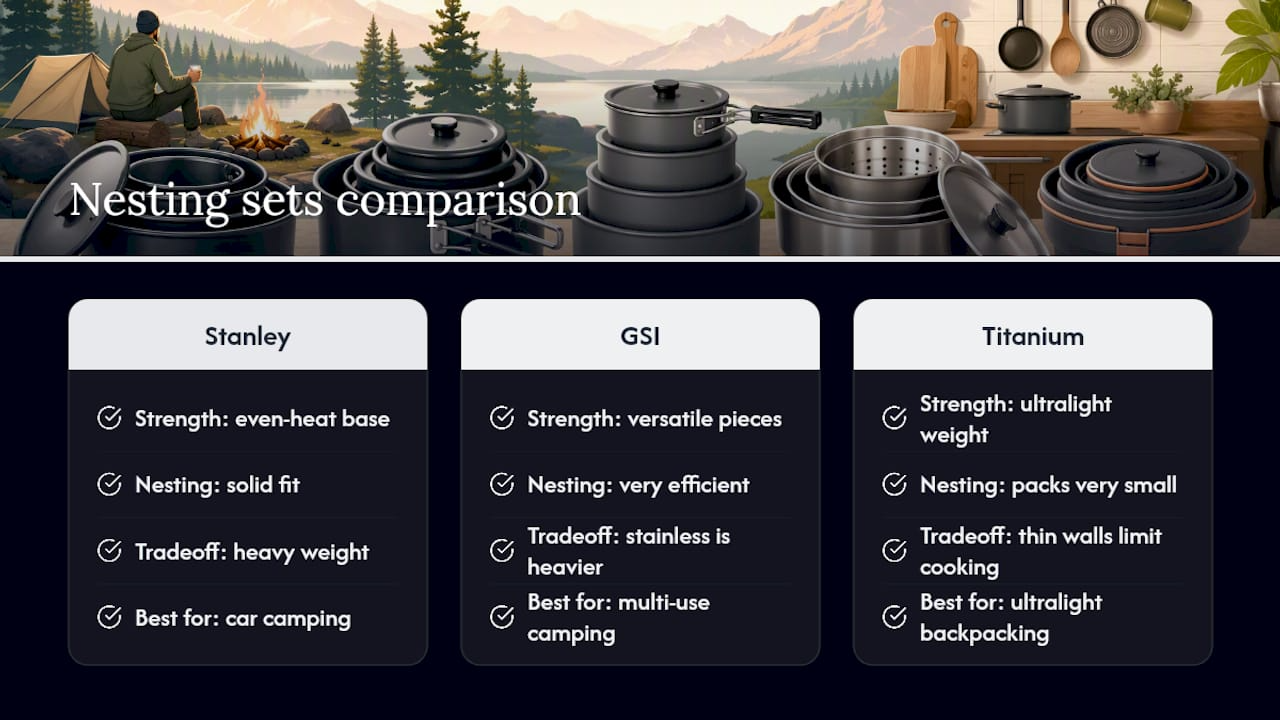
The Stanley Adventure Even-Heat series ranks as a top pick for car camping thanks to a durable base designed for even heat and solid nesting behavior across its pot and pan combination. The tradeoff is weight. It's not the set you want on a multi-day backpacking trip where every ounce counts.
GSI Outdoors Glacier Stainless sets earn consistent praise for versatility and nesting efficiency, with lids and pots designed to stack tightly and multi-use pieces that reduce how much gear you need to carry. The stainless construction adds durability but also adds pack weight compared to aluminum alternatives.
Ultralight two-piece titanium sets, the category that includes designs like the Snow Peak Ti-Mini and MSR Trail Mini, win on weight but lose on cooking versatility. They boil water fast and pack down to almost nothing, but sautéing or simmering anything beyond a simple meal exposes their thin-wall limitations.
None of these is universally "best." The right pick depends entirely on whether you're prioritizing pack weight, cooking performance, or long-term durability for frequent use, the same framework covered in the buying checklist above.
Gear That Makes Nesting Cookware Work Harder
A nesting set performs better with a few inexpensive additions that most first-time buyers skip. A padded cookware liner or a simple dish towel folded between pots prevents the scratching and coating wear that ruins nonstick surfaces within a season, especially on ceramic-coated pans nested against bare stainless.
A dedicated stuff sack, sized to match your nested stack rather than a generic oversized bag, compresses the set and keeps loose lids from rattling apart during transport. For boats and RVs, a tension strap or a cabinet with a raised lip keeps the stack from sliding during rough conditions.
Pairing your cookware with a compact stove sized to fit inside your largest pot saves additional space, a strategy covered in more depth in Life Camp Adventure's portable stove guide. For readers building a full camp kitchen rather than just a cookware set, Life Camp Adventure's essentials checklist rounds out the utensils, cutting boards, and cleaning supplies that pack alongside a nesting set without adding bulk. If you're organizing gear for minimalist travel more broadly, FS9 Tactical's guide to building a minimalist kit covers compact-packing principles that apply just as well to a camp kitchen as to a travel bag.
A Note From the Field
I've cycled through more nesting sets than I'd like to admit, from a titanium two-piece that lived in my backpack for years to a stainless set that's outlasted three apartments. What changed how I shop wasn't weight or price. It was watching handle joints loosen on cheap sets after a single season. Now I check the handle attachment before anything else.
— Billy
Key Takeaways
The right nesting cookware set matches your material, weight class, and true nested volume to your specific use-case rather than chasing the highest piece count or lowest price.
| Point | Details |
|---|---|
| Match set class to trip type | Ultralight titanium for solo backpacking, midweight tri-clad or stainless for car camping, full-size stainless for small kitchens or boats. |
| Measure nested volume, not pot volume | Confirm dimensions with lids on and handles attached before buying, using a tape measure against your actual storage space. |
| Ignore inflated piece counts | Count only core pots and pans; mesh bags and plastic extras don't add cooking capacity. |
| Check handles and coatings for durability | Loose handle joints and plastic fittings are the most common long-term failure points in reviews. |
| Life Camp Adventure curates by use-case | Life Camp Adventure's cookware review page tests nested volume, heat distribution, and handle durability across backpacking, car-camping, and small-kitchen picks. |
Get Cookware That Actually Fits Your Pack or Your Cabinet
Reading specs and comparing weight ranges only gets you so far when you're staring at ten different listings that all claim to be "compact." Life Camp Adventure built its cookware lineup around the exact problem this guide covers: sets that nest as tightly as advertised, hold their heat evenly, and survive years of handle stress without loosening up.
Every set in the cookware review collection is organized by use-case, so you're comparing ultralight backpacking options against other ultralight options rather than getting confused by a car-camping set with three times the weight. If you're building a full kitchen rather than just replacing a pot, the car camping packing list rounds out what pairs well with a new nesting set. Check current availability and compare specs directly on the product pages before your next trip.
Sources
- Best camping cookware | CleverHiker
- Best nesting pots and pans for small spaces | The Boat Galley
- Best camping cookware | OutdoorGearLab
- Best camping cookware | Outdoor Life
