
TL;DR:
- A packing checklist is a categorized, trip-specific list that helps you organize everything from clothing to essentials, preventing forgetfulness. Building a flexible, core set of categories like Clothing, Toiletries, Electronics, Documents, and Miscellaneous allows for easy customization depending on your destination and trip type. Using digital tools like Google Sheets and applying iterative improvements ensures your system becomes more efficient and tailored with each journey.
A packing checklist is a categorized, trip-specific list of every item you need to bring, organized to prevent forgetting anything from medications to rain gear. Whether you're building your first essential packing checklist for a weekend camping trip or refining a system you've used for years, the method matters as much as the list itself. Tools like Google Sheets, printable templates, and dedicated packing apps each serve different traveler types, and knowing which to use changes how efficiently you pack. The goal is a list that works for you specifically, not a generic catalog you copy from the internet.
How to create a packing checklist that actually works
The foundation of any effective packing list is category structure. Flexible, customizable templates built around categories like Clothing, Toiletries, Electronics, Documents, and Miscellaneous give you a repeatable framework that you can adapt for every trip without starting from scratch. The structure prevents the mental fatigue of trying to remember everything at once by breaking the problem into smaller, manageable groups.

Building your core categories
Start with five universal categories that apply to almost every trip:
- Clothing: Tops, bottoms, underwear, socks, outerwear, and shoes
- Toiletries: Toothbrush, toothpaste, deodorant, sunscreen, medications, and any personal care items
- Electronics: Phone, charger, power bank, headphones, camera, and adapters
- Documents: Passport or ID, travel insurance, reservations, credit cards, and emergency contacts
- Miscellaneous: Reusable bag, snacks, travel pillow, and any trip-specific extras
Once your core categories are set, add destination-specific sections. A beach trip needs a Beach Gear category covering sunscreen, a rash guard, and a dry bag. A winter camping trip needs a Winter Essentials section with thermal layers, hand warmers, and waterproof boots. This modular approach means you never bloat your main list with items that only apply to one type of trip.
Every checklist also benefits from a short notes section at the bottom. Use it to record things like "buy sunscreen at destination" or "borrow a sleeping bag from Jake." These small reminders prevent duplicate purchases and last-minute scrambles.
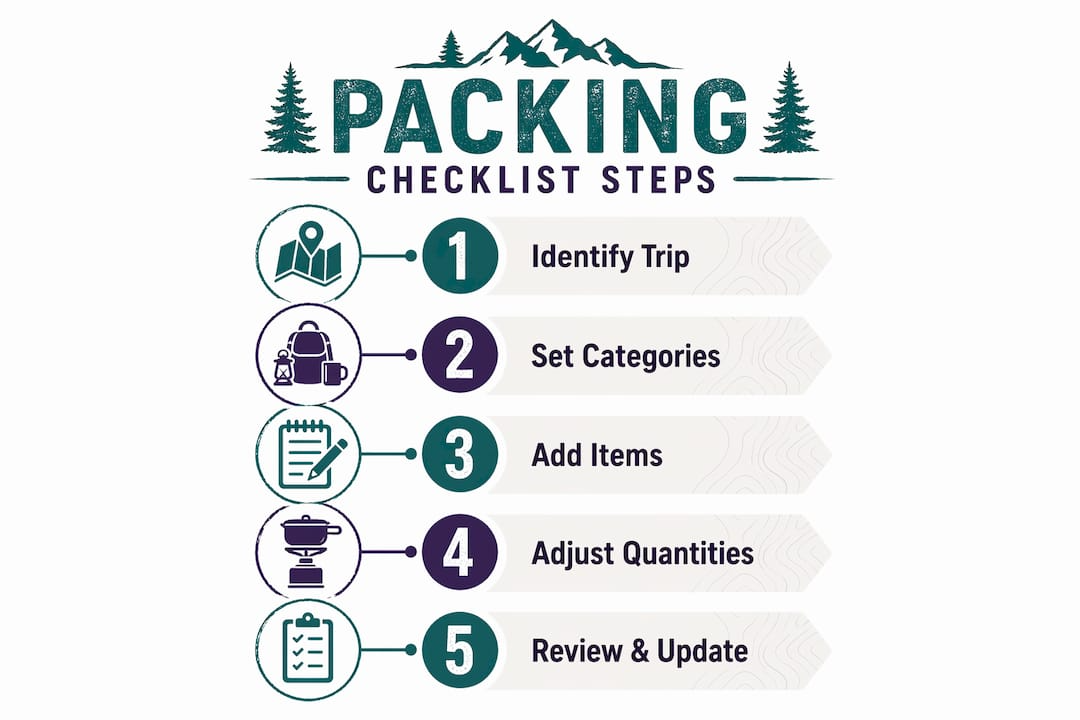
Pro Tip: After every trip, spend five minutes reviewing your list. Cross off anything you packed but never touched, and add anything you wished you had brought. This iterative process, recommended by Albritton Interiors, turns a generic template into a personalized system that gets sharper with every use.
How do you decide how much to pack?
Quantity decisions are where most travelers go wrong. Deciding whether to check a bag or carry on shapes your entire packing list before you write a single item down. A carry-on trip demands ruthless editing. A checked bag gives you more room but introduces the risk of delayed or lost luggage.
For clothing specifically, a structured framework removes the guesswork. The 5-4-3-2-1 packing method is one of the most practical tools available for carry-on travel. The goal of this framework is to simplify decision-making, not rigidly limit your choices.
Here is how the 5-4-3-2-1 method works for a one-week trip:
- 5 sets of socks and underwear (wash mid-trip if needed)
- 4 tops (mix of casual and one slightly dressier option)
- 3 bottoms (pants, shorts, or skirts that mix and match)
- 2 pairs of shoes (one comfortable walking shoe, one versatile option)
- 1 jacket or outerwear layer (weather-appropriate)
This framework keeps a week-long trip fitting in a carry-on, which is a real advantage when you want to move fast and avoid baggage fees.
Adjusting quantities for trip type and weather
| Trip Type | Clothing Strategy | Key Additions |
|---|---|---|
| Beach weekend (2-3 days) | 3 tops, 2 bottoms, 1 swimsuit | Sunscreen, sandals, dry bag |
| City break (4-5 days) | 4 tops, 3 bottoms, 2 shoes | Adapter, city map, light jacket |
| Camping week (7 days) | 5 tops, 3 bottoms, thermal layer | Headlamp, first aid kit, rain gear |
| Backpacking trip (7+ days) | 4 moisture-wicking tops, 2 bottoms | Water filter, trekking poles, repair kit |
Weather is the single biggest variable. A trip to a rainy destination requires waterproof layers even in summer. A desert trip in October may still need a warm layer for cold nights. Build weather into your quantity decisions before you finalize any category.
Pro Tip: For packing light on outdoor adventures, prioritize multi-use items. A merino wool base layer works as a hiking shirt, a sleep layer, and a light insulator. One item doing three jobs is always better than three single-purpose items.
What digital tools make packing lists easier to manage?
Google Sheets is the most practical free tool for building an interactive packing checklist. It handles checkboxes, conditional formatting, and real-time sharing with travel companions, all without requiring a paid subscription. Digital checklists with interactive checkboxes provide real-time feedback on packed items and are reusable across multiple trips without any reformatting.
Here is how to set one up in under ten minutes:
- Open a new Google Sheet and label the first row with column headers: Category, Item, Quantity, Packed.
- Fill in your categories and items using the five core categories as your starting point.
- Add checkboxes to the Packed column by selecting the cells and going to Insert > Checkbox.
- Apply conditional formatting so that checked rows turn gray or green. This gives you an instant visual read on your packing progress.
- Share the sheet with anyone traveling with you so responsibilities can be divided and tracked in real time.
The reusability factor is where digital checklists beat paper every time. Once your Google Sheet is built, you duplicate it for the next trip, adjust quantities and categories for the new destination, and you're ready in minutes rather than hours.
Comparing digital tools for packing list management
| Tool | Best For | Key Feature |
|---|---|---|
| Google Sheets | Group travel and repeat trips | Sharing, checkboxes, conditional formatting |
| Notion | Travelers who manage trip notes together | Database views, linked pages |
| PackPoint | First-time packers | Auto-generates lists based on destination and weather |
| Printable templates | Travelers without reliable device access | No battery required, tactile experience |
Collaborative digital checklists also reduce the classic travel problem of two people packing the same item twice. When you share a Google Sheet with your travel partner, you can assign items to each person and avoid carrying duplicate sunscreen, first aid kits, or chargers.
Pro Tip: Use conditional formatting in Google Sheets to automatically strike through or gray out any row where the Packed checkbox is checked. Visual packed-state indicators reduce packing errors significantly, especially when you're repacking under time pressure the morning of departure.
Common mistakes that make packing checklists useless
The most common mistake is building a list that is too detailed to use. Overly complex checklists with too many subcategories increase forgetfulness rather than reduce it. When a list becomes overwhelming, travelers skip it entirely and pack from memory, which defeats the purpose.
Here are the mistakes worth avoiding:
- Too many categories: Stick to five to seven maximum. Splitting "Toiletries" into "Skincare," "Dental," and "Hair Care" sounds organized but creates friction.
- No carry-on separation: Keep medications and key electronics in your carry-on bag at all times. Checked luggage gets delayed or lost. Your insulin, your laptop, and your passport should never be in a checked bag.
- Never updating the list: A list you built two years ago for a different trip type is not a system. It's a starting point that needs revision.
- Ignoring packing cubes: Color-coded packing cubes let you locate any category instantly without unpacking everything. Blue for clothing, red for toiletries, gray for electronics works as a simple system.
"A lean, modular list refined by experience is optimal. Static or overly complex packing lists increase forgetfulness and overpacking." — Albritton Interiors Expert Guide
Pro Tip: After your next trip, open your checklist and mark every item you never used. If an item goes unused on three consecutive trips, remove it permanently. Your list should reflect how you actually travel, not how you imagine you might travel.
Key takeaways
A well-built packing checklist combines five core categories, trip-specific quantity rules, and a digital tool like Google Sheets to create a system that gets more reliable with every trip you take.
| Point | Details |
|---|---|
| Start with five categories | Use Clothing, Toiletries, Electronics, Documents, and Miscellaneous as your base structure. |
| Decide bag type first | Choosing carry-on versus checked luggage shapes every quantity decision on your list. |
| Use the 5-4-3-2-1 method | This framework controls clothing quantities and prevents overpacking for week-long trips. |
| Build digitally in Google Sheets | Checkboxes and conditional formatting give you real-time packing progress and easy reuse. |
| Refine after every trip | Remove unused items and add forgotten ones to build a list that fits your actual travel style. |
What I've learned from years of packing checklists
The single biggest shift in my packing practice came when I stopped treating my checklist as a document and started treating it as a system. A document gets created once and reused without thought. A system gets tested, adjusted, and improved every time you use it.
I've found that digital lists work better for most people, but not because they're more convenient. They work better because they're harder to ignore. A printed list can sit on your desk while you pack from memory. A Google Sheet open on your phone while you're standing in front of your bag demands engagement.
The other thing I'd push back on is the instinct to pack for every possible scenario. Weather-driven packing decisions, where you build your list around the actual forecast rather than every hypothetical, consistently produce lighter, more functional bags. Minimalism in packing is not about sacrifice. It's about trusting your list enough to leave the "just in case" items at home. For anyone heading into the backcountry, pairing a sharp checklist with reliable adventure gear makes the difference between a stressful departure and a confident one.
— Billy
Gear worth adding to your packing checklist
A great checklist is only as good as the gear behind it. At Lifecampadventure, you'll find expert comparisons and reviews of the camping equipment that belongs on every outdoor packing list, from top-rated camping tents to essential camping gear tested for real-world conditions. Whether you're building a checklist for a weekend car camping trip or a multi-week backpacking expedition, Lifecampadventure's gear guides help you identify exactly what to pack and what to leave behind. Stop guessing and start packing with confidence.
FAQ
What is a packing checklist?
A packing checklist is a categorized list of items you need to bring on a trip, organized by type such as clothing, toiletries, and documents. It prevents forgotten items and reduces overpacking by giving you a structured, repeatable system.
How do I start making a packing list from scratch?
Start by identifying your trip type, destination, and bag type, then build five core categories: Clothing, Toiletries, Electronics, Documents, and Miscellaneous. Add destination-specific items and set quantities based on trip length and weather.
What should always be in a carry-on bag?
Medications, a phone charger, a power bank, your passport or ID, and any irreplaceable electronics should always travel in your carry-on. Checked luggage can be delayed or lost, and these items are too critical to risk.
How does the 5-4-3-2-1 packing method work?
The 5-4-3-2-1 method assigns specific quantities to clothing types: five socks and underwear, four tops, three bottoms, two pairs of shoes, and one jacket. It is designed for carry-on travel and reduces overpacking without limiting your outfit options.
How often should I update my packing checklist?
Update your checklist after every trip by removing items you did not use and adding anything you forgot. This iterative refinement process turns a generic template into a personalized system that improves with each trip.
