TL;DR:
- Insect repellents work by deterring biting insects, not by killing them, relying on active ingredients to scramble their host-finding cues. Protection duration varies with environmental conditions, application methods, and repellent formulation, requiring proactive reapplication in challenging outdoor settings. A layered approach, including clothing coverage, activity timing, and proper family usage, enhances outdoor safety against bugs effectively.
Most campers grab a bottle of insect repellent expecting it to drop bugs on contact. That's a natural assumption, but it's also the reason so many outdoor trips end with itchy bites and frustrated families. Insect repellents work by making you less attractive to biting insects, not by killing them. Understanding this distinction changes everything about how you choose, apply, and rely on repellents when you're out in the field. This guide covers the science behind repellent mechanics, how to compare active ingredients, what outdoor conditions do to your protection, and how to build a safe routine for every member of your group.
Key Takeaways
| Point | Details |
|---|---|
| Repellents deter, not kill | Insect repellents make you less attractive to bugs, so they avoid you instead of killing them. |
| EPA-registered for safety | Choose EPA-registered repellents for proven effectiveness and family-safe use. |
| Environment affects duration | Heat, humidity, rain, and sweat can shorten repellent protection—reapply as needed outdoors. |
| Follow application best practices | Properly applying repellents and avoiding common mistakes maximizes safety for everyone. |
| Combined prevention is key | Use repellents alongside clothing coverage and vigilance for total outdoor protection. |
How insect repellents actually work outdoors
Most people picture repellents as a kind of invisible bug-killing force field. In reality, the science is more interesting and more nuanced than that. When you apply a repellent to your skin or clothing, the active ingredient creates a chemical signal that disrupts a mosquito's or tick's ability to locate and land on you. Biting insects use cues like carbon dioxide, body heat, and skin chemicals to find a host. Repellents essentially scramble those signals, making you a far less appealing target.
The key word is "deterring." Repellents make you less attractive to biting insects so they avoid landing and feeding on treated skin or clothing. They don't kill the mosquito hovering around your campsite. They just convince it to go looking elsewhere. That's a crucial distinction because it means your repellent works only as long as the active ingredient stays effective on your skin.
Here's what the protection mechanism actually involves:
- Active ingredients (like DEET or picaridin) form a vapor barrier near the skin surface that insects detect and avoid
- Treated clothing adds a second layer because insects are also deterred from biting through fabric
- Coverage matters enormously since any untreated patch of skin is a potential landing zone
- Insects may still fly near you; they simply won't land and feed as readily
Repellents do not eliminate all bite risk in every real-world scenario. Complementary measures like clothing coverage, nets or screens, and regular tick checks are essential because no repellent offers 100% protection in every condition.
This is especially relevant for families who are new to outdoor camping. Knowing that repellents work through avoidance rather than elimination helps you plan more realistically and build better layered protection. You can learn more about outdoor safety for families as a foundation for any trip into the wilderness.
Choosing the right repellent: effectiveness and active ingredients
Once you understand that repellents work through deterrence, choosing the right product becomes a practical decision about ingredients, concentration, and duration. Not all repellents are created equal, and the label "natural" does not automatically mean effective.
The EPA registration system is your first filter. EPA-registered active ingredients for skin-applied repellents include DEET, picaridin, oil of lemon eucalyptus (OLE/PMD), and IR3535. These have all gone through safety and efficacy testing before reaching store shelves. Choosing an EPA-registered product is the baseline standard for any outdoor use.
Here's a quick breakdown of the four main options:
| Active ingredient | Protection duration | Best for | Notes |
|---|---|---|---|
| DEET (20-30%) | 4 to 8 hours | Heavy bug pressure, tick country | Strong, proven, slight odor |
| Picaridin (20%) | 8 to 12 hours | General use, sensitive skin | No plastics damage, nearly odorless |
| OLE/PMD | 4 to 6 hours | Moderate mosquito pressure | Not for children under 3 |
| IR3535 | 2 to 4 hours | Light conditions, children | Gentle formulation |
Independent human testing by Consumer Reports generally favors mid-to-higher DEET concentrations and confirms that DEET-free options like OLE and picaridin can perform effectively. The finding that stands out most? Most "natural" repellents score poorly. Citronella, essential oils, and unlabeled herbal sprays often fail to provide meaningful protection in real testing conditions. If a product isn't EPA-registered, it hasn't been through the same standards.
Concentration matters too, but there's a ceiling. A DEET concentration of 30% isn't dramatically better than 25% for most camping conditions. What it does offer is longer protection duration before you need to reapply. Going above 50% DEET adds little extra benefit for typical recreational outdoor use and may increase skin sensitivity for some users.
Some additional factors to weigh when picking a repellent:
- Formulation: Sprays cover large areas quickly; lotions offer more control; pump sprays reduce inhalation risk compared to aerosols
- Duration claims: Look for third-party verification, not just marketing
- Skin sensitivity: Picaridin is a strong choice for anyone who finds DEET irritating or greasy
- Clothing compatibility: DEET can damage synthetic fabrics; picaridin and IR3535 won't
Pro Tip: Match your repellent to the environment, not just the bug. Tick-heavy trails call for higher DEET or picaridin concentrations and treated clothing. A mild summer evening near a lake with light mosquito activity may be fine with a lower-concentration OLE product. Check out outdoor adventure gear reviews for side-by-side gear comparisons that help you prepare smarter.
Factors that impact repellent performance outdoors
Picking the right repellent is step one. Keeping it working through a full day of outdoor activity is step two, and this is where many people fall short. Environmental conditions can cut a repellent's effective window significantly.
Heat, humidity, rain, and sweating all reduce repellent effectiveness. When you're hiking hard on a hot day, perspiration can wash away active ingredients faster than the label's stated duration. A product rated for eight hours under calm, dry conditions may need reapplication after three to four hours of heavy exertion on a humid trail.

Here's a practical look at how conditions affect duration:
| Outdoor condition | Impact on repellent | Recommended action |
|---|---|---|
| High heat (90°F+) | Accelerates evaporation | Reapply after 2 to 3 hours |
| High humidity | Increases sweating, dilutes product | Reapply more frequently |
| Swimming or water contact | Washes product off skin | Reapply immediately after drying |
| Heavy rain | Similar to swimming | Reapply when rain stops |
| Light breeze | Minimal impact | Follow standard label guidance |
| High exertion (hiking) | Heavy perspiration speeds dilution | Carry repellent for on-trail reapplication |
The active ingredient, concentration, and formulation are what determine how long protection lasts, and whether you reapply correctly determines whether you stay protected. Many campers wait until they've already been bitten several times before reapplying. That's too late. The better habit is to reapply proactively based on conditions rather than bites.
Practical strategies that work in tough outdoor environments:
- Carry a small repellent in your daypack so you can reapply mid-hike without going back to camp
- Apply to clothing as well as skin for a more resilient barrier in rain or sweat-heavy conditions
- Set a phone reminder to prompt reapplication when you're deep in an activity and might forget
- After swimming, dry off and reapply before heading back into insect-heavy areas
Check our guide on weatherproof gear tips for more on preparing your kit for variable conditions, and review these camping safety tips for families to build a complete outdoor safety checklist.
Pro Tip: Pack at least 50% more repellent than you think you'll need on any multi-day trip. Conditions are rarely perfect, and running out mid-adventure in a bug-heavy area is a situation that's completely avoidable with a little extra preparation.
Safe repellent strategies for families and outdoor groups
Camping with children adds a layer of responsibility to repellent use that's easy to underestimate. Kids are often more active, sweat more, and are less likely to tell you when they're being bitten. A clear, practiced routine makes repellent application a normal part of your pre-adventure routine rather than an afterthought.
Using EPA-registered products and following label directions is the foundation of family repellent safety. The California Department of Public Health emphasizes correct technique and specifically warns against allowing children to apply repellents themselves. The risk isn't just missed spots. It's kids spraying near their eyes or mouths, which can cause serious irritation.Here's a step-by-step safe application routine for families:
- Choose an EPA-registered product appropriate for your children's ages. OLE is not recommended for children under 3. DEET at 10 to 30% is considered safe for children over 2 months old.
- Apply repellent to your own hands first, then spread it onto your child's exposed skin. Never let young children handle the bottle.
- Avoid face spraying. Spread repellent gently across the cheeks, forehead, and chin using your fingertips, keeping well clear of eyes, nose, and mouth.
- Cover clothing too. Spraying repellent on hats, shirts, and pants extends protection and reduces how much you need to apply directly to skin.
- Wash hands and treated skin when returning indoors, especially before meals.
- Store repellent out of reach of children when not in use.
EPA-registered insect repellents are proven effective at reducing biting by mosquitoes, ticks, sand flies, and mites when used as directed. That covers most of the arthropod-related risks your family will encounter across a range of outdoor environments.
Common mistakes to avoid:
- Applying under clothing: Repellent should go on exposed skin and over clothing, not under it
- Using combination sunscreen/repellent products: Sunscreen needs more frequent reapplication than repellent; combined products lead to over-applying repellent or under-applying sunscreen
- Spraying in enclosed spaces: Apply outdoors or in ventilated areas only
- Using too much: More product doesn't mean more protection; apply a thin, even layer
Pro Tip: Make repellent application a team event before every outdoor excursion. When kids watch parents apply it calmly and routinely, they're far more cooperative about their own application. Pair this with our family camping safety tips and sun protection for families advice to build a complete pre-adventure routine.
The real outdoor insect repellent mindset: What most guides miss
Most repellent guides stop at product recommendations. They tell you which brand scored highest and leave you to figure out the rest. What actually separates comfortable, safe adventurers from frustrated, bitten ones isn't brand loyalty. It's mindset.
The biggest mistake we see is treating repellent as a set-and-forget solution. Spray it on in the morning and forget about it until you're scratching at dinner. That approach fails in the real world, especially in the conditions most likely during peak outdoor season: heat, sweat, rain, stream crossings, and long hours of physical activity.
Think of repellent as one layer in a system, not the entire system. Clothing coverage is your first barrier. Long sleeves, pants tucked into socks, and a hat reduce exposed skin dramatically without requiring any chemistry at all. Repellent extends the protection of that physical barrier into areas you can't cover practically, like your face, neck, and hands. Add mosquito netting around your tent and sleeping area, and you've built a genuinely resilient defense.
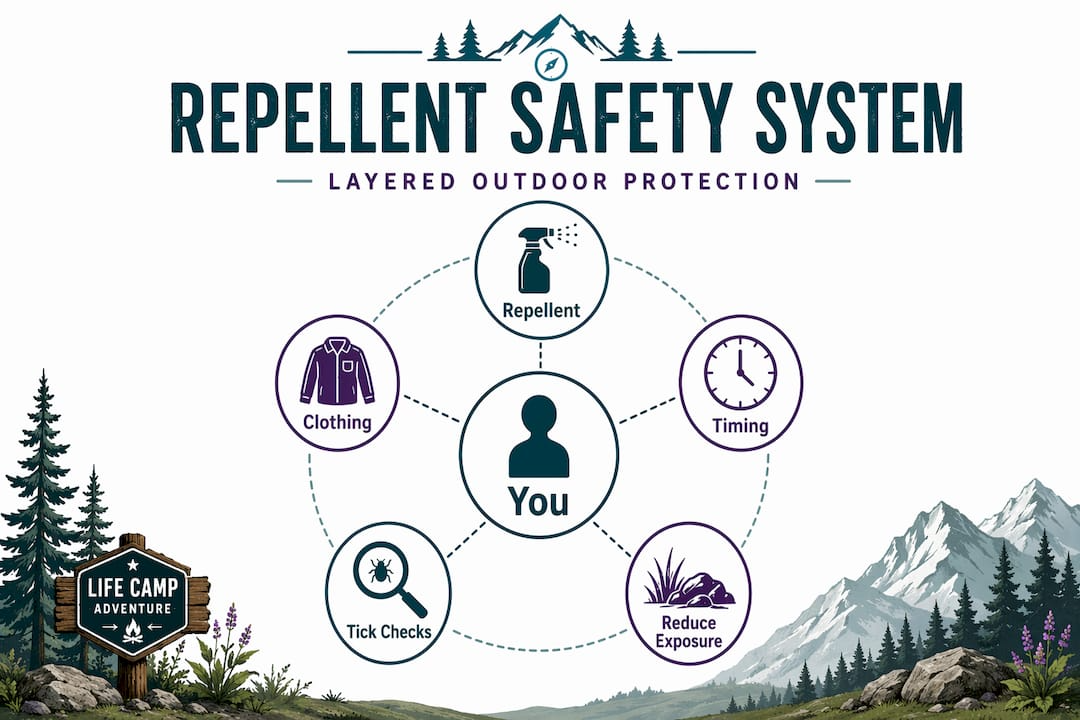
There's also a behavioral dimension most people overlook. Insects are most active at dawn and dusk. If your camp setup puts you outside during those windows without protection, you're relying entirely on chemistry to compensate for a timing mistake. Structuring your activities so you're inside netting or under cover during peak biting hours is a smarter move than applying extra product.
Another overlooked habit: tick checks. Ticks don't respond to repellents as reliably as mosquitoes. Reducing wildlife encounters through smart campsite placement and trail selection reduces tick contact before repellents even come into play. Then a full-body tick check after every trail session catches any hitchhikers before they embed.
The mindset shift we advocate is treating a bite not as a failure but as information. You got bitten because protection lapsed somewhere. Was the repellent past its duration? Did you skip a patch of skin? Were you in high-exposure conditions longer than the product was rated for? Use that signal to adjust and improve rather than to doubt repellents altogether. The same proactive approach works across other outdoor protection strategies, as cycling protection methods demonstrate in a completely different context: layering protection and using failure signals to adapt keeps you safer over time.
Gear up for adventure: Essential outdoor solutions
Understanding the science behind insect repellents gives you a real edge in the field. But repellents don't exist in isolation. They're part of a broader outdoor kit that keeps you comfortable, safe, and focused on the experience rather than the bugs.

At Life Camp Adventure, we build our product recommendations and gear guides around the same principle that runs through this article: layered protection works better than any single solution. That means pairing the right repellent with quality shelter gear, protective clothing, and well-stocked adventure kits. Whether you're preparing for a weekend family campout or a longer backcountry trip, our outdoor survival checklist gives you a complete framework for what to pack. And if you want step-by-step confidence for your first or your fiftieth wilderness trip, our essential survival steps guide walks you through everything from site selection to emergency preparedness.
Frequently asked questions
Do insect repellents kill mosquitoes and ticks?
No, most repellents work by deterring biting insects so they avoid landing and feeding rather than killing them. The insect survives; it simply has no interest in landing on you.
Can I use insect repellent on children and pregnant women?
EPA-registered products are considered safe for pregnant and breastfeeding women and children when used as directed, but children should not apply repellents themselves. Always have an adult handle application.
How often should I reapply insect repellent outdoors?
Reapply whenever biting increases, especially after swimming, heavy sweating, or rain, because heat, humidity, and moisture all reduce effectiveness faster than the label's stated duration. CDC recommends reapplication the moment you notice bites resuming.
Are "natural" insect repellents as effective as DEET or picaridin?
Most natural repellents score poorly in independent tests. Consumer Reports data shows that DEET, picaridin, and OLE perform reliably while most natural alternatives do not meet the same standard.
What is the best practice for applying repellent to the face?
Apply to hands first, then spread carefully across the face, avoiding eyes, nose, and mouth entirely. Never spray repellent directly toward the face.
