TL;DR:
- Packing light reduces physical fatigue, injury risk, and enhances outdoor mobility.
- Use multipurpose gear and minimal layers to effectively prepare for changing conditions.
- Follow a step-by-step process including layout, weighing, editing, and final checks for optimal minimalism.
Essential guide to packing light for outdoor adventures
You've been there: standing at the trailhead with a pack so heavy it throws off your balance before you've taken a single step. Your shoulders are already bracing for the hours ahead, and all that extra weight is eating into your energy before the real adventure begins. Packing light is one of the most powerful skills any hiker, camper, or traveling adventurer can build. In this guide, we'll walk through exactly why it matters, what to bring, how to actually do it step by step, common mistakes and how to fix them fast, and the final checks that confirm you've nailed your kit.
Key Takeaways
| Point | Details |
|---|---|
| Pack for versatility | Choose multipurpose clothing and gear that work for different weather and activities. |
| Capsule wardrobe method | Using the 3-3-3 or capsule approach creates maximum outfit combinations with minimal clothes. |
| Review and edit | Test your packed bag, weigh it, and remove anything you haven't used on similar trips. |
| Embrace minimalism | Packing light is a mindset that enhances outdoor mobility, comfort, and enjoyment. |
Why packing light matters for outdoor adventurers
Every extra pound in your pack costs you something real. Studies consistently show that carrying excess load increases oxygen consumption, accelerates muscle fatigue, and raises the risk of joint injury over long distances. For hikers covering 10 or more miles per day, the difference between a 20-pound pack and a 35-pound pack isn't just comfort. It can determine whether you reach your campsite before dark or struggle in the final mile.
Beyond the physical toll, a heavy pack changes how you experience the outdoors. You focus on the burden instead of the view. You skip that extra side trail because your knees are already hurting. You save energy and maximize outdoor adventures by keeping your load controlled and your body fresh throughout the day.
Packing light also gives you real mobility advantages. You can move faster, respond more easily to changing terrain, scramble over rocks without fighting your pack, and hop on public transportation or a shuttle without wrestling a giant bag overhead. For travelers who mix hiking and basecamp days in town, this flexibility is invaluable.
Minimalist packing also opens up smarter clothing strategies. Planning outfits capsule-style reduces items needed without losing utility or comfort, so you're not stuffing a bag full of single-use pieces that only work for one specific day.
Here's a quick look at what cutting pack weight actually delivers:
- Less fatigue over long days on trail
- Better balance on uneven or technical terrain
- Faster pace with fewer rest stops needed
- Greater flexibility to adapt your route spontaneously
- Reduced injury risk to knees, hips, and lower back
- More enjoyment because you're focused on the experience, not the load
"The goal of minimalist packing isn't to suffer with less. It's to carry exactly what serves you and nothing more. That's where real freedom in the outdoors begins."
The mindset shift is this: your gear should serve the adventure, not define it. When you stop thinking about what you might need and start asking what you actually need, everything gets lighter.
Essential gear: What you need and what to skip
The hardest part of packing light isn't finding ultralight gear. It's making honest decisions about what earns a place in your bag. Most adventurers pack for the worst-case scenario on every trip, which means they carry gear suited for disasters that never happen.
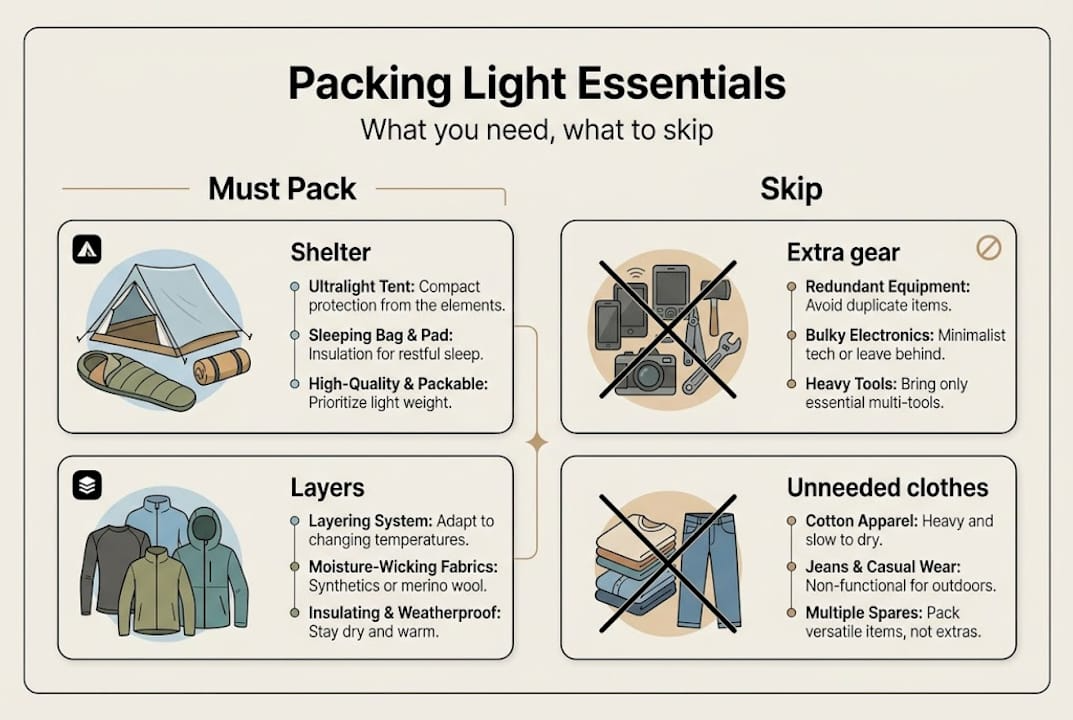
True outdoor essentials fall into five core categories: shelter and sleep, weather-appropriate layers, food and water systems, navigation and safety, and hygiene basics. Everything outside those categories is optional and should face scrutiny.
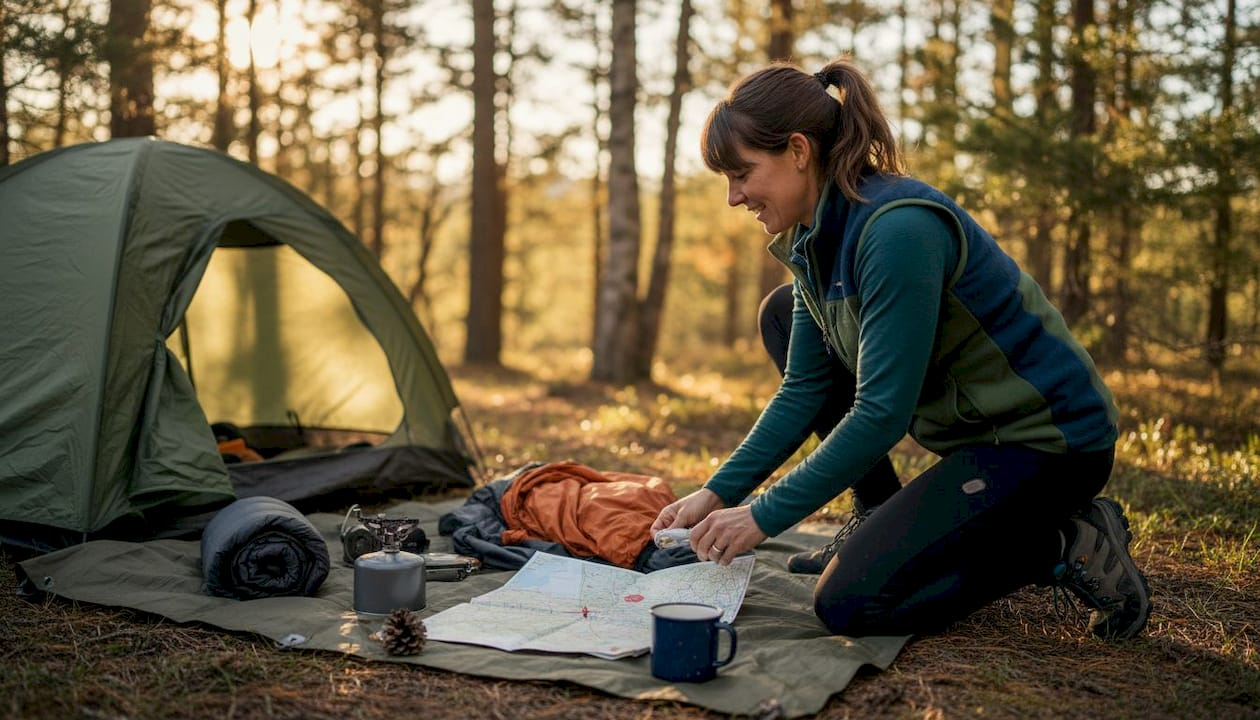
The layer system and capsule approach help you pack less while maintaining comfort across changing conditions. A base layer, an insulating mid-layer, and a waterproof shell cover nearly every weather scenario you'll encounter on most three-season trips.
Here's a comparison to help you cut the right items:
| Need | Nice to have |
|---|---|
| Lightweight shelter (tent or bivy) | Camp chair |
| Sleeping bag rated for conditions | Pillow (use a stuff sack) |
| Base layer, mid-layer, rain shell | Spare jeans or heavy pants |
| Moisture-wicking socks x3 pairs | Cotton t-shirts |
| Headlamp with extra batteries | Lantern |
| First aid kit | Duplicate toiletries |
| Water filter or purification tabs | Heavy water bottles (2+) |
| Trail snacks and planned meals | Full spice kit |
| Navigation (map, compass, or GPS) | Extra gadgets or chargers |
Multipurpose items are your best allies. A bandana works as a towel, sun protection, a pot holder, and a dust mask. A trekking pole doubles as a tent pole for many ultralight shelters. A merino wool base layer regulates temperature from 35°F nights to 70°F afternoons without smelling after repeated use. Check out these efficient packing tips before building your final list.
When building your kit, ask three questions for every item:
- Does it serve more than one purpose?
- Is there something already in my bag that does this job?
- What actually happens if I leave it behind?
Pro Tip: Before your trip, lay every item on the floor and assign it a category. If it doesn't fit into shelter, sleep, layers, food/water, or safety, it needs a strong reason to make the cut. Use your adventure packing checklist as your starting framework, then edit ruthlessly.
Step-by-step minimalist packing for outdoor adventure
Knowing what to pack is one thing. Actually doing it well requires a repeatable process. Follow these steps every time you prep for a trip, and you'll get faster and more precise with each outing.
Step 1: Define your core activities. List every activity you'll actually do on this trip. Hiking, swimming, cooking, sleeping in a tent, visiting town? Each activity generates a clothing and gear need. Stick to the list. Don't pack for activities you might add last minute.
Step 2: Choose multipurpose clothing. Reducing pack weight and increasing comfort starts with planning limited outfits using a repeatable capsule system. Pick neutral, coordinating colors. Every top should pair with every bottom. Merino wool and synthetic fabrics dry fast, resist odor, and layer well.
Step 3: Lay everything out before it goes in the bag. Physically spread every item on a flat surface. This step alone eliminates duplicates and forgotten items that sneak in through habit.
Step 4: Weigh your pack. Use a luggage scale or kitchen scale. For day hikes, aim for under 15 pounds. For multi-day backpacking, target 20 to 30 pounds including food and water, depending on distance and conditions.
Step 5: Edit again. After weighing, look for the three heaviest non-essential items and ask if you truly need them. Then learn how to pack a backpack efficiently by placing heavy items close to your back and lighter gear at the top and bottom.
Step 6: Do a test load. Put the full pack on and walk around for 10 minutes. Notice pressure points, imbalance, or items you're already second-guessing.
Here's a sample minimal packing list for a 3-day, 3-night hiking trip:
| Category | Item | Weight (approx.) |
|---|---|---|
| Shelter | Ultralight 2-person tent | 2.5 lbs |
| Sleep | 20°F sleeping bag | 2 lbs |
| Clothing | 2 merino tops, 1 shell, 1 mid-layer, 2 bottoms, 3 socks | 3 lbs |
| Footwear | Trail runners (worn) | 0 lbs in pack |
| Food | 3 days of meals and snacks | 3 lbs |
| Water | Filter + 1-liter soft flask | 0.5 lbs |
| Safety | First aid kit, map, headlamp | 0.75 lbs |
| Hygiene | Toothbrush, biodegradable soap, small towel | 0.4 lbs |
| Total | ~12.15 lbs |
Pro Tip: Roll your packable clothing instead of folding it. Rolling compresses items more evenly, prevents wrinkles, and lets you see everything at a glance without unpacking the whole bag.
Troubleshooting: Common packing mistakes and easy fixes
Even experienced adventurers slip into bad habits. Here's where most people go wrong and how to correct it before or during your trip.
Packing just-in-case items. This is the biggest culprit. A rain jacket for a forecast-clear desert trip, hiking boots when you're already bringing trail runners, a second tent footprint. These items add weight based on anxiety, not actual need. Fix it by making your gear decisions based on weather data, trip type, and trail conditions, not worst-case thinking.
Underestimating what your layers can do. Many people bring too many specialized pieces because they don't trust their layering system. Three well-chosen layers genuinely handle most three-season weather. Choosing clothing and gear that cross-function for multiple weather scenarios directly reduces the redundancy that makes packs heavy and uncomfortable.
Forgetting cross-functional gear. Your insulating layer should work as camp evening wear AND a sleep layer. Your rain shell should double as a wind layer. Your trekking poles should be compatible with your tent setup if you go ultralight. When items only serve one role, they earn their weight much harder.
Over-duplicating toiletries. Travel-size versions of everything. One bar of biodegradable soap replaces body wash, shampoo, and dish soap. A small tube of toothpaste, not a full one. Solid sunscreen and solid lip balm weigh less than liquid versions.
Not adjusting after a trip. One of the most useful habits you can build is noting what you never touched. On the trail and at camp, mentally flag everything you don't use. When you return, remove those items from your default list. Check out ultralight camping basics to refine your approach after each outing.
- Audit every item after each trip
- Remove anything untouched from your default kit
- Replace single-use items with multipurpose alternatives
- Trust your data from previous similar trips over instinct
"Reducing redundancy is the fastest path to a lighter, more functional pack. Every duplicate item is a hidden tax on your comfort and endurance."
How to know you've packed light enough: Final checks
You've planned, edited, and loaded your bag. Now use these final checks to make sure you've actually achieved the balance between minimal and prepared.
1. The lift test. Pick up the loaded pack with one hand. If you can't lift it comfortably off the ground, it's too heavy for most trip types. Adjust until it passes.
2. The shoulder test. Put the pack on and stand straight. Does it sit close to your back? Does weight distribute evenly between your shoulders and hips? If it pulls you backward or digs into one shoulder, redistribute or remove weight.
3. The category check. Ask yourself: do I have shelter, sleep, layers, food/water, and safety covered? If yes on all five, everything else is a bonus, not a necessity.
4. The repeat-trip test. Think back to your last similar trip. What did you not use? Leave those items out now. Cross-compatible capsule packing maintains comfort and preparedness without requiring you to carry specialized gear for every scenario.
5. The accessibility check. Can you reach your rain jacket, snacks, headlamp, and first aid kit without unpacking everything? These items need to be within reach, not buried at the bottom.
Pro Tip: If you haven't used something on two or more similar trips, it almost certainly doesn't belong in your pack. Past trips are your most reliable data set. Use your preparation process from this backpacking guide as your baseline and refine it trip by trip.
Here's a quick pre-departure checklist:
- All five essential categories are covered
- Pack weight is within your target range
- Items unused on past trips have been removed
- Rain gear, snacks, and headlamp are accessible
- You can walk comfortably with full load for 10 minutes
Why packing light is about mindset, not just gear
Here's something most packing guides won't say directly: the weight in your bag usually reflects the anxiety in your head. Overpacking is a control mechanism. If you bring everything, you feel prepared for anything. But that logic quietly costs you the very experience you came for.
Real freedom in the outdoors isn't found in having every option available. It comes from trusting yourself to handle whatever comes up with a well-chosen, lean kit. The philosophy of packing light isn't minimalism for its own sake. It's intentionality. You choose what earns a place in your pack, and that same focus sharpens how you move through the trail, the campsite, and the trip.
Every outing is a chance to test and refine. You'll come back knowing exactly what you used, what stayed buried, and what you wish you'd left behind. Over time, your pack gets lighter and your confidence grows. That's the real payoff.
Pro Tip: After each trip, write down three things you didn't use and three things you wished you'd brought. Two or three trips of that habit will produce your perfect personal kit.
Upgrade your gear for lighter, better adventures
Once you've locked in your minimalist packing mindset, the right gear makes it even easier to go lighter without giving up performance or comfort.
At Life Camp Adventure, we've put together expert-reviewed resources to help you choose gear that does more with less. Whether you're comparing shelter options in our camping tents guide or building out your kit with help from our breakdown of essential camping gear, we make it easy to find what actually belongs in your pack. You can also sharpen your preparation with our tested packing list tips. Lighter gear, smarter choices, and better adventures start here.
Frequently asked questions
What is the 3-3-3 method for minimalist packing?
The 3-3-3 method creates up to 27 outfits from just three tops, three bottoms, and three pairs of shoes, all selected in coordinating colors for maximum mix-and-match flexibility.
How do I avoid packing unnecessary items for a camping trip?
Focus on multipurpose gear and clothing, stick to a prepared list based on your actual activities, and remove just-in-case items that have gone unused on past similar trips.
Is packing light practical for colder climates?
Yes. The layer system within a capsule wardrobe lets you adjust to variable or cold weather using three well-chosen layers instead of carrying bulky single-purpose pieces.
Does minimalist packing mean compromising comfort?
Not at all. Cross-compatible capsule packing maintains comfort and full preparedness without requiring you to carry specialized gear or duplicate items for each scenario.
