TL;DR:
- True emergency preparedness involves structured planning, proper gear, and practicing skills before venturing outdoors. It is a continuous cycle of planning, equipping, training, and reassessing to ensure safety when help is distant or delayed. Building collective readiness and regularly reviewing procedures significantly enhance safety in remote wilderness environments.
Most people assume emergency preparedness means throwing a first aid kit into their backpack before hitting the trail. That assumption gets people hurt. True preparedness is a structured, multi-layered approach that anticipates hazards, reduces their impact, and guides both response and recovery when things go sideways. For campers, hikers, and families venturing into remote areas, the stakes are much higher than they are at home. You can't call for help and expect someone to show up in five minutes. This article breaks down what emergency preparedness actually means, how it works as a cycle, and how to build real readiness for outdoor adventures.
Key Takeaways
| Point | Details |
|---|---|
| Preparedness is a cycle | Effective emergency readiness means continuously planning, equipping, practicing, and reviewing your approach. |
| Tailor for outdoor needs | Your plan and kit should address communication gaps, weather, navigation, and medical challenges unique to remote adventures. |
| Include everyone | Assign clear roles and make sure each member understands the plan before you leave. |
| Skills matter most | Training and scenario practice often make the biggest difference in true emergencies, not just gear. |
| Preparedness is shared | Your personal readiness contributes to group safety and connects with wider community and national efforts. |
What is emergency preparedness?
Now that we've recognized that true preparedness goes beyond just packing a kit, let's unpack what emergency preparedness really means, especially for outdoor enthusiasts.
At its core, emergency preparedness is the structured planning and readiness to anticipate hazards, reduce their impact, and manage response and recovery when emergencies occur. That definition sounds simple, but there's a lot packed into it. Anticipating hazards means thinking ahead about what could go wrong before you leave the trailhead. Reducing impact means taking action now so that if something does go wrong, it's less catastrophic. Managing response and recovery means knowing what to do in the moment and how to get back to safety afterward.
Emergency preparedness is not a single action. It's a mindset and a system that you build before, during, and after every outdoor experience.
There's also an important distinction between personal preparedness and collective preparedness. Personal preparedness is what you do for yourself: the gear you carry, the skills you learn, the plan you make. Collective preparedness involves your family, your group, and even your community. As FEMA emphasizes, preparedness is a shared responsibility that spans prevention, protection, mitigation, response, and recovery. That framework applies at every scale, from a family camping trip to a national disaster response.
For outdoor adventurers specifically, the stakes are elevated because of factors you simply don't face at home:
- Limited resources: You only have what you carry. There's no hardware store down the road.
- Group separation: Trail emergencies can split up your party quickly, especially in poor visibility or fast-moving water.
- Delayed help: In backcountry areas, emergency responders may be hours or even a full day away.
- Changing conditions: Weather, terrain, and daylight can shift rapidly and without warning.
Understanding emergency preparedness steps in the outdoor context means recognizing that your margin for error is smaller, and your need for planning is greater.
Core components: The emergency preparedness cycle
Understanding the definition is only the start. The real value comes from seeing how preparedness works as a continuous cycle.
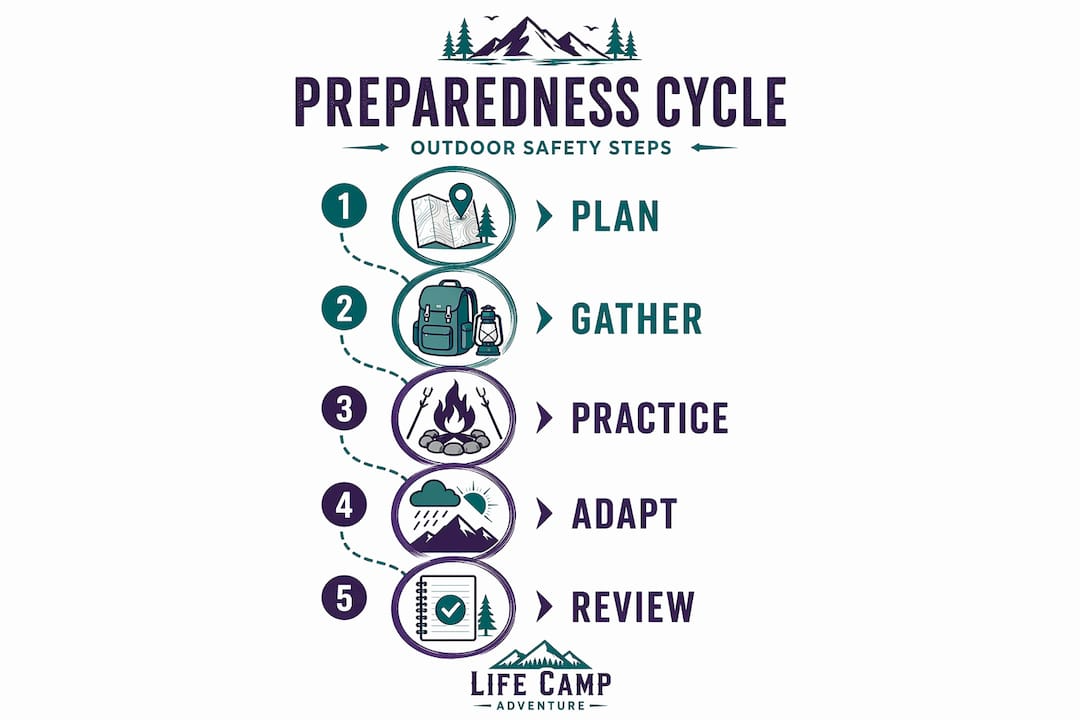
Emergency preparedness is not something you do once and forget. FEMA's national preparedness framework describes it as a cyclical process: plan, equip, train, and reassess. Each phase feeds into the next, and skipping any one of them creates gaps that show up at the worst possible time.
Here's how that cycle plays out in a practical outdoor context:
- Plan: Identify where you're going, what hazards exist, and what your emergency protocols are. Assign roles to each group member.
- Equip: Gather and maintain the gear needed to execute your plan. Check expiration dates, test equipment, and replace anything worn or outdated.
- Train: Practice your skills before you need them. Run through scenarios at home. Take a wilderness first aid course. Know how to use your signaling devices.
- Reassess: After each trip, review what worked and what didn't. Update your plan and kit before the next adventure.
| Phase | What it means | Outdoor-specific example |
|---|---|---|
| Plan | Define roles, routes, and protocols | Assign one person as navigator, one as first aid lead |
| Equip | Gather appropriate gear | Pack a satellite communicator and a trauma kit |
| Train | Practice skills before emergencies | Take a wilderness first aid weekend course |
| Reassess | Review and update after each trip | Swap out expired medications, update emergency contacts |
Pro Tip: Don't treat kit-packing as the finish line. Real readiness means every person in your group knows the plan, knows their role, and has practiced the basics before you ever leave the parking lot.
For a deeper look at how these phases play out step by step, the essential survival steps guide and a solid hiking essentials list are great starting points for building your cycle out.
Building your outdoor emergency plan and kit
With the cycle in mind, let's dive into building your customized emergency plan and kit for real-world outdoor needs.
A solid emergency plan starts long before you reach the trailhead. Here's a step-by-step approach that works for families, couples, and larger groups:
- Set your communication protocol: Decide how your group will communicate if separated. This includes check-in times, rally points, and what to do if someone doesn't show up.
- Identify meeting points: Choose two or three specific, recognizable locations on your route where the group will meet if separated.
- Plan your evacuation routes: Know at least two ways out of your destination. Weather, wildfire, and trail damage can close your primary exit.
- Share your itinerary: Leave a detailed plan with a trusted contact at home, including your start point, destination, expected return, and what to do if they don't hear from you.
- Account for group needs: Note any medical conditions, allergies, or physical limitations in your plan. This matters for both your group and any rescuers who may need to help.
Ready.gov recommends that families practice their plan so that everyone knows what to do without having to think about it under stress. That same logic applies equally on the trail.
When it comes to your kit, the contents need to be tailored to the environment. A home emergency kit and a backcountry kit are very different animals:
| Category | Home emergency kit | Outdoor/backcountry kit |
|---|---|---|
| Water | Stored jugs or bottles | Filter, purification tablets, collapsible container |
| Food | Non-perishable pantry items | Lightweight high-calorie rations, emergency bars |
| First aid | Basic bandages and medications | Trauma kit, blister care, splints, SAM splints |
| Communication | Phone, battery backup | Satellite communicator, whistle, signal mirror |
| Navigation | Local maps | Topographic map, compass, GPS device |
| Shelter | Staying in place | Emergency bivy, tarp, fire-starting tools |
| Lighting | Flashlight, candles | Headlamp with extra batteries, glow sticks |
As the National Park Service notes, outdoor adventurers should prepare for reduced access to services, including limited or no cell coverage, and carry essentials that support navigation, signaling, hydration, and first aid. That's not a suggestion; it's a baseline for safe backcountry travel.
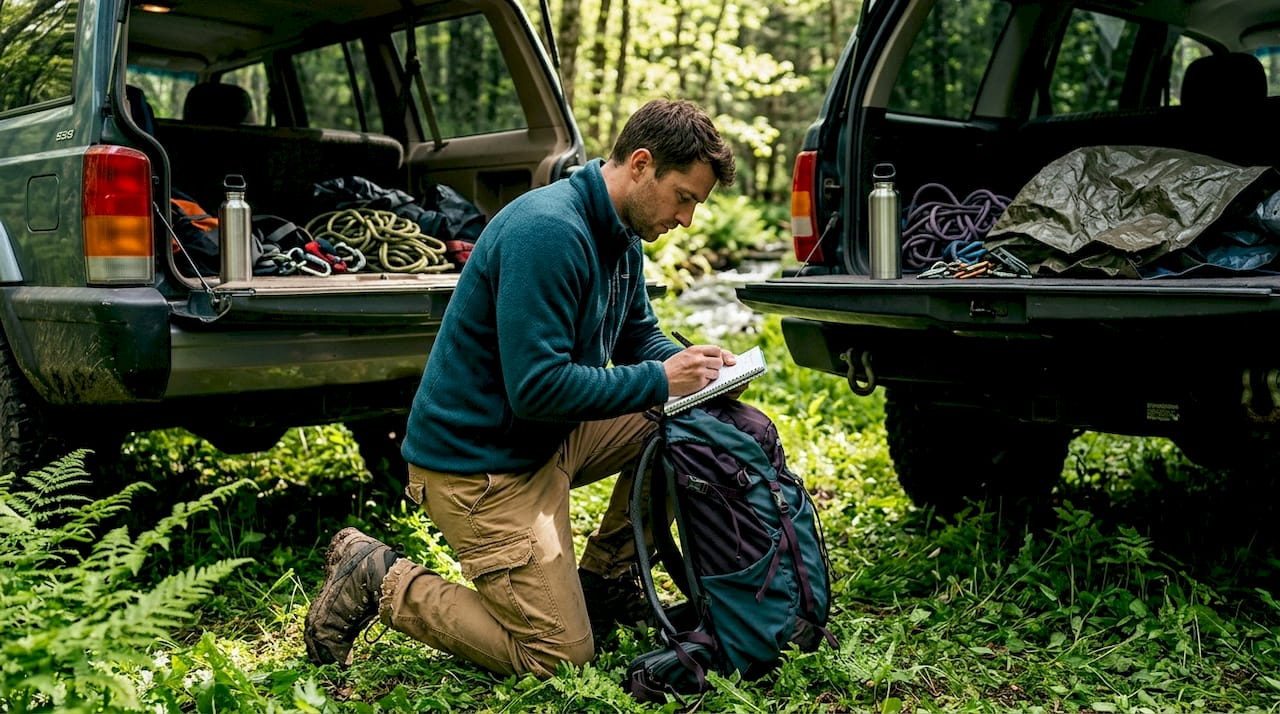
Pro Tip: Share your trip itinerary with at least one trusted person who will actually follow through if you don't check in. Telling someone you're "going camping" is not enough. Give them specifics: trailhead name, campsite, car description, and a clear deadline for when to call for help.
For a full breakdown of what your kit should include, check out our guide to outdoor first aid kits and the complete outdoor survival checklist. If you're planning a bikepacking trip, this bikepacking safety gear checklist is also worth a look.
Wilderness and remote readiness: Skills and scenarios
Once your plan and kit are set, special attention is needed for truly remote locations, where traditional rules change.
When you're more than a few miles from a road, the rules shift dramatically. Professional emergency services may be hours away. Helicopter evacuation may be delayed due to weather. Cell service is likely nonexistent. In these situations, your group's skills are your most important survival asset.
NOLS describes Wilderness First Aid as remote-area first aid training specifically designed for scenarios where professional help is delayed. This training focuses on patient assessment, evacuation decision-making, and the ability to manage injuries or illness for extended periods in the field. It's not the same as a basic CPR course, and for anyone spending significant time in the backcountry, it's worth completing.Here's a practical breakdown of what Wilderness First Aid (WFA) versus Wilderness First Responder (WFR) training covers:
- WFA (16-20 hours): Designed for outdoor educators, guides, and active families. Covers patient assessment, wound care, fractures, altitude sickness, hypothermia, and evacuation basics.
- WFR (70-80 hours): Designed for professionals leading extended expeditions. Covers everything in WFA plus advanced patient management, pharmacology, and complex evacuation scenarios.
For most families and recreational groups, WFA is the right level. For guides, group leaders, or anyone planning multi-week wilderness expeditions, WFR is the better fit.
Beyond formal training, here are the skills every outdoor group should build before heading into remote territory:
- Navigation with map and compass, not just GPS
- Shelter construction using a tarp or emergency bivy
- Fire starting in wet or cold conditions
- Water purification using filters and chemical treatment
- Signaling using a whistle, mirror, or personal locator beacon (PLB)
- Basic patient assessment: checking responsiveness, airway, breathing, and circulation
- Recognizing and responding to hypothermia and heat exhaustion
In a wilderness emergency, the first 30 minutes are yours to manage alone. What you do in that window often determines the outcome.
Building these skills is not about being paranoid. It's about being confident. Visit our resource on wilderness first aid skills and outdoor first aid steps for practical guides on getting started.
Beyond the individual: Emergency preparedness as a shared responsibility
Personal and family actions are powerful, but it's worth understanding how your efforts fit into the larger safety web.
Individual preparedness doesn't exist in a vacuum. FEMA's national preparedness mission identifies five core areas that work together at every level of society: prevention, protection, mitigation, response, and recovery. When you create a trip plan and file it with a contact, you're contributing to the response and recovery capabilities of the broader system. When you take a wilderness first aid course, you're building the kind of community resilience that FEMA points to as a national priority.
Here's how those roles align across different scales:
| Level | Role | Example |
|---|---|---|
| Individual | Self-rescue, first aid, communication | Carrying a PLB, knowing how to use it |
| Family/Group | Role assignment, shared resources, group evacuation | One person navigates, one manages first aid |
| Community | Search and rescue teams, local emergency management | Volunteer SAR teams, local ranger stations |
| National | Policy, funding, coordination | FEMA, National Park Service emergency protocols |
One sobering statistic: surveys consistently show that fewer than half of American adults have a documented emergency plan for their household, let alone for outdoor activities. That gap is exactly where accidents turn into tragedies. When outdoor-minded families take preparedness seriously, they're not just protecting themselves. They're reducing the burden on search and rescue teams, keeping rescuers safer, and modeling the kind of readiness culture that makes everyone's adventures more sustainable.
Why most people get emergency preparedness wrong outdoors
Let's step back and look at why true preparedness isn't what most people think it is when heading into the wild.
Here's the uncomfortable truth: the majority of wilderness emergencies don't happen because someone forgot to pack a bandage. They happen because someone skipped the walkthrough. Roles were never assigned. The evacuation plan was vague. Nobody actually practiced using the emergency whistle or the satellite communicator. The gear was there. The readiness wasn't.
We've seen this pattern repeat itself countless times. A family packs a beautiful kit, drives four hours to a trailhead, and then nobody in the group knows how to read the topographic map inside it. The kit becomes a false sense of security, which is actually more dangerous than no kit at all because it removes the urgency to stay alert and think critically.
Real preparedness is cultural. It requires honest self-assessment: "Do I actually know how to do this, or do I just own the tool?" It requires leadership, meaning someone in your group needs to be willing to say "we're not ready for this route" or "we need to turn back." It requires practice, which means doing a dry run at home before your life depends on it in the field.
Schedule a seasonal preparedness tune-up with your family or group before each camping season. Pull out your kit. Check everything. Review the plan. Make sure every person, including kids, knows what to do if something goes wrong. This doesn't have to be a solemn event. Make it part of the adventure culture. Frame it as a skill session, not a chore.
Pro Tip: Set a recurring calendar reminder each season to review your emergency tools list and run a 30-minute group walkthrough. The investment is small. The payoff is enormous.
The shift we need is simple: stop treating preparedness as a box to check and start treating it as a shared skill that your group builds together over time. That mindset is what separates confident adventurers from people who get lucky.
Get equipped for outdoor emergency preparedness
Making the move from planning to action is where everything clicks. At Life Camp Adventure, we've built a library of practical resources to help you do exactly that.

Whether you're gearing up for your first overnight hike or planning a multi-week backcountry expedition, our guides are designed to meet you where you are. Start with the essential survival steps guide for a clear, actionable breakdown of what to do and when. Use the complete survival checklist to audit your current kit and fill the gaps. And if you're still figuring out why a well-built kit matters, the survival kit benefits resource makes the case clearly. Great gear, paired with real knowledge, is how you head into the wild with genuine confidence.
Frequently asked questions
What does emergency preparedness mean for hiking and camping?
Emergency preparedness for hikers and campers means anticipating hazards, forming a plan, packing essential gear, and being ready to respond when things go wrong in areas where help may be far away.
What should a basic outdoor emergency kit include?
A basic outdoor kit should include water filtration, food rations, a first aid kit, navigation tools, a signaling device, and weather protection, since you may need to survive on your own for several days before help arrives.
How often should you update your emergency plan and kit?
Update your emergency plan and kit at least once per season or before each new adventure to ensure contents are fresh, gear is functional, and everyone in your group knows their assigned role.
Why is emergency preparedness more important outdoors than at home?
In outdoor settings, reduced access to services and limited cell coverage mean your group must rely entirely on its own skills and equipment to stay safe until help can reach you.
What training is recommended for remote wilderness settings?
Wilderness First Aid training is the starting point for recreational groups, while Wilderness First Responder certification is recommended for expedition leaders and guides who manage extended backcountry trips.
