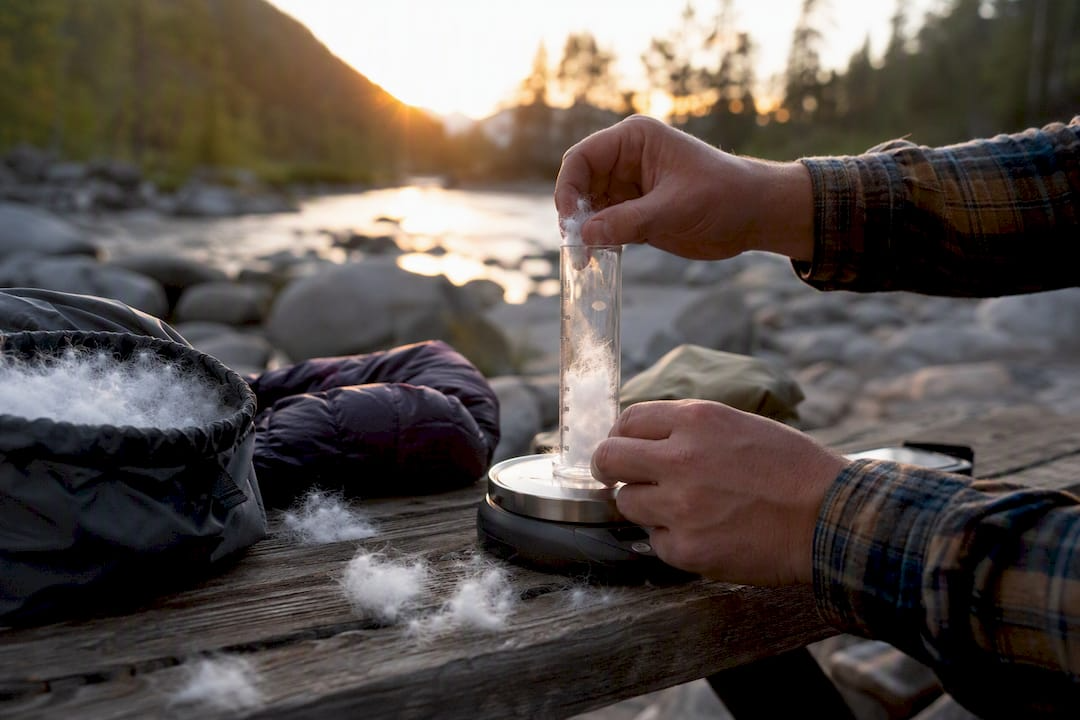
Fill power is the number of cubic inches one ounce of down fills when it lofts to its full fluff. An 800-fill jacket uses down that expands to 800 cubic inches per ounce; a 550-fill jacket only reaches 550. Higher numbers generally indicate the down traps more air per ounce, which can translate to better warmth-to-weight and packability, but fill power alone does not tell you how warm a jacket or sleeping bag actually is. That depends just as much on fill weight, the total amount of down stuffed inside.
Two shopping rules follow directly from this:
- Always check fill power and fill weight together. A tag that only lists one number is telling half the story.
- Pick higher fill power when you're optimizing for pack size and ounces saved. Pick more fill weight when you need raw warmth and don't mind extra bulk.
Key Takeaways
Total warmth in down gear comes from fill power and fill weight working together, not from the fill-power number alone.
| Point | Details |
|---|---|
| Fill power measures loft | It's the cubic inches one ounce of down fills in a controlled lab test, not a warmth guarantee. |
| Fill weight completes the picture | More ounces of lower-fill down can outperform fewer ounces of higher-fill down. |
| 700 to 800 is the sweet spot | This range balances packability, warmth, and cost for most backpackers and campers. |
| Construction shapes real warmth | Baffle design, down-to-feather ratio, and shell treatments change performance as much as the fill-power tag. |
| Lifecampadventure lists both specs | Its product pages pair fill power with fill weight so you can compare gear accurately before buying. |
How Is Down Fill Power Measured?
Fill power comes from a standardized lab test, not a marketing guess. Technicians take a one-ounce sample of cleaned, conditioned down, drop it into a graduated cylinder, and place a weighted piston on top. After the down settles under that fixed pressure, the cylinder reading in cubic inches becomes the fill power number on the label.
The test only works because the conditions are tightly controlled:
- Down is conditioned at a specific temperature and humidity before testing, since damp down compresses differently than dry down.
- Sample preparation follows a fixed protocol so labs get repeatable results across batches.
- The piston applies a consistent, standardized weight so no lab can inflate numbers with a lighter load.
That precision is exactly why two products with identical fill-power ratings can still feel different in the field. Baffle construction, how tightly the down is packed, and ordinary manufacturing variation all affect real-world loft even when the lab number matches.
Pro Tip: Don't treat fill power as a warranty on warmth. Treat it as a quality grade, similar to how thread count hints at sheet quality without guaranteeing comfort.
Fill Power vs Fill Weight: Which One Determines Warmth?
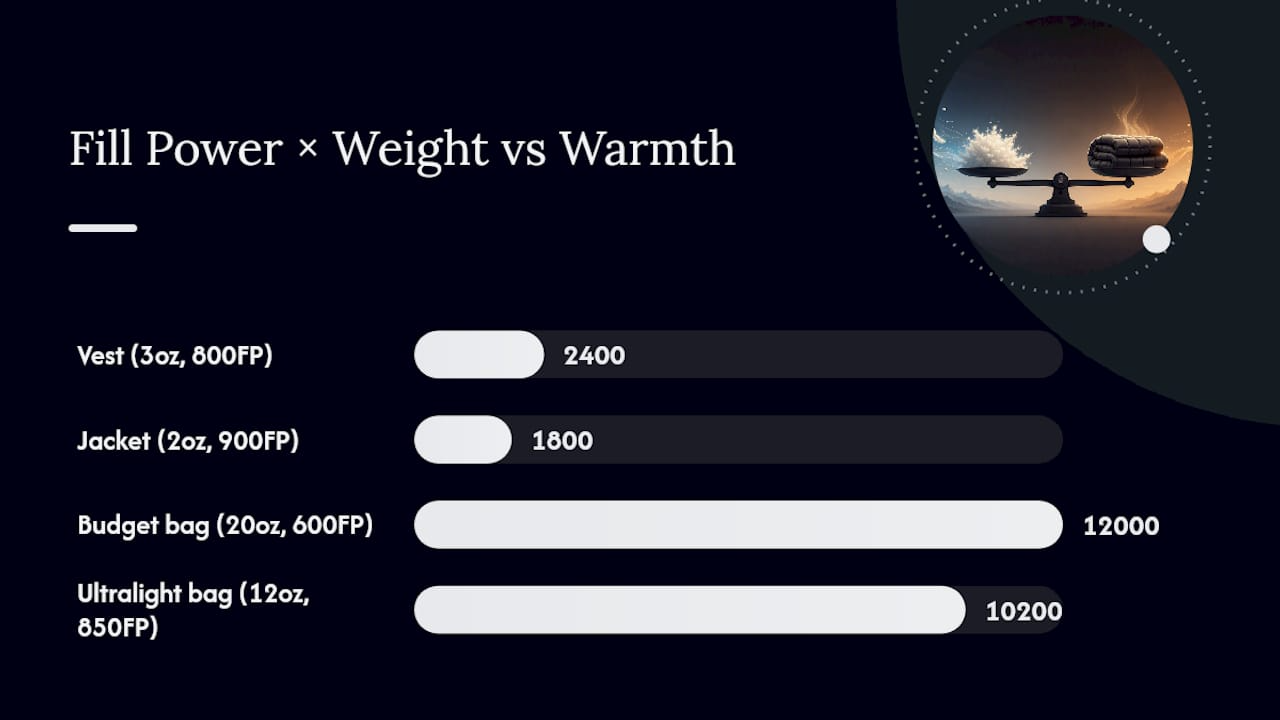
Think of fill power as efficiency and fill weight as quantity. Fill weight is simply how many ounces or grams of down are stuffed into the product, and it's the companion spec that fill power can't replace. A rough mental model: total warmth tracks with fill power multiplied by fill weight, though real performance also depends on construction and baffle design.
Here's where this gets counterintuitive:
- A vest with 3 ounces of 800-fill down can outperform a jacket with only 2 ounces of 900-fill down, despite the lower fill-power number.
- A budget sleeping bag with a generous 20 ounces of 600-fill down might sleep warmer than an ultralight bag with 12 ounces of 850-fill down.
Manufacturers routinely lean on this trade-off to hit price points without sacrificing much real-world warmth, which is exactly why fill weight matters as much as fill power when you're comparing two products side by side.
What Do Different Fill-Power Ratings Mean for Outdoor Gear?
Fill-power ratings cluster into a few practical bands, and knowing which one fits your activity saves you from overpaying or underpacking.
- 450 to 550 (entry-level): Common in budget jackets and kids' gear. Fine for mild weather and short trips where weight isn't a concern.
- 600 to 650 (mid-range): A solid, affordable choice for car camping, everyday winter wear, and casual hikers who don't need to shave ounces.
- 700 to 800 (performance sweet spot): The range most outdoor brands target because it balances compressibility, warmth, and cost without the steep price jump of top-tier down.
- 900+ (premium/ultralight): Reserved for backpackers and mountaineers counting grams, where every bit of packed volume matters on a multi-day carry.
If you're doing weekend car camping or casual day hikes, 600 to 650 fill will keep you warm without draining your budget. If you're backpacking multiple days and every cubic inch in your pack counts, stepping up to 700 to 800, or even 900+ for serious ultralight setups, pays for itself in comfort on the trail. Beyond that point, though, the returns get thin. Industry data suggests 900+ fill delivers only marginal real-world gains over 800 for anyone who isn't shaving grams professionally, while the price tends to increase significantly with very high fill powers.
Do Baffles and Materials Matter More Than the Fill-Power Number?
Fill power sets the ceiling on performance, but construction decides whether a product actually reaches it. A few factors quietly do as much work as the number on the tag:
- Baffle design. Poorly sewn baffles let down shift and clump, creating cold spots even in a high-fill-power garment.
- Down-to-feather ratio. A "90/10" blend (90% down, 10% feather) lofts better than an "80/20" mix at the same fill-power rating, since feathers add weight without adding much loft.
- Shell fabric and treatments. A tightly woven, wind-resistant shell holds warm air in better than a loose weave, regardless of what's stuffed inside.
- Dirt, compression, and moisture. Grime coats individual down clusters and prevents them from fully expanding, which quietly lowers effective fill power over time.
Pro Tip: When comparing two jackets with the same fill power, check the down-to-feather ratio next. It's often the tiebreaker that explains why one feels noticeably puffier.
Should You Choose Down or Synthetic Insulation?
Down wins on warmth-to-weight and packability, which is why it dominates high-end sleeping bags and backpacking jackets. Synthetic insulation costs less and keeps insulating even when soaked, since synthetic fibers don't clump and collapse the way untreated down does.
- Choose down for backpacking, expedition layers, and anywhere pack weight is the priority.
- Choose synthetic for wet-climate commuting, budget-conscious purchases, or gear that will see regular rain exposure.
- Hydrophobic-treated down closes much of that wet-weather gap, but it doesn't fully match synthetic performance in prolonged downpours or river crossings.
For most three-season backpacking trips in the US, treated down hits the sweet spot between weight savings and weather resistance.
What Should You Check Before Buying a Down Product?
Reading a down product spec sheet gets easier once you know the checklist. Run through these before you check out:
- Fill power number – tells you loft quality and packability potential.
- Fill weight (grams or ounces) – tells you the actual quantity of insulation, which drives total warmth.
- Down-to-feather ratio – higher down percentage means better loft consistency.
- RDS certification – the Responsible Down Standard confirms ethical sourcing and traceability, a detail more brands now list prominently.
- Shell fabric and hydrophobic treatment – affects wind resistance and wet-weather performance.
- Temperature rating, if listed – gives you a real-world warmth estimate instead of relying on fill power alone.
Pro Tip: If a listing skips fill weight entirely, treat that as a red flag. It's often a sign the brand is leaning on a flashy fill-power number to distract from a thin, underfilled product.
For weight-obsessed backpackers, prioritize fill power first and fill weight second. For budget shoppers or casual campers, flip that order and let fill weight and price lead the decision, then use our guide to down sleeping bags to match your trip style to the right pick.
How Do You Wash and Store Down to Keep Its Loft?
Loft loss is usually reversible if you treat down gear right. A few habits keep fill power performing closer to its rated number for years instead of seasons.
- Use a mild, down-specific detergent and a front-loading washer, since agitators can shred baffles.
- Spot-clean small stains instead of running a full wash cycle when possible.
- Dry on low heat with a few clean tennis balls or dryer balls to break up clumps and restore loft as the down dries.
- Confirm the down is completely dry before storage. Trapped moisture breeds mildew and kills loft permanently.
- Store loose in a breathable cotton sack. Never leave down compressed in a stuff sack long term.
A Packer's Take on Fill Power
On multi-day trips, I'd rather pay more for higher fill power than carry extra ounces I'll feel on every incline. That preference shows up in how we build out our down sleeping bag recommendations and our advice on trimming overall pack weight.
Ready to Compare Packable Down Gear?
Everything above boils down to one habit: read fill power and fill weight side by side before you buy, then match that pair to what your trip actually demands. Lifecampadventure's product pages list both specs plainly, so you're not stuck guessing from a single flashy number on a hangtag.

If you're outfitting for a multi-day backpacking trip, browse our packable gear picks built for weight-conscious adventurers or check the full spec breakdowns on our camping gear comparison page. For jackets and layering pieces, the Bug Away apparel guide is a useful companion resource if you're also weighing bug protection for warm-weather trips. Start by comparing two or three items with your new checklist in hand, then order the one that actually matches your trip, not just the biggest number on the tag.
Sources
- Fill power — Wikipedia
- Down Fill and Insulation Explained | Switchback Travel
- Responsible Down Standard — Textile Exchange
- What is down fill power? — Wired
