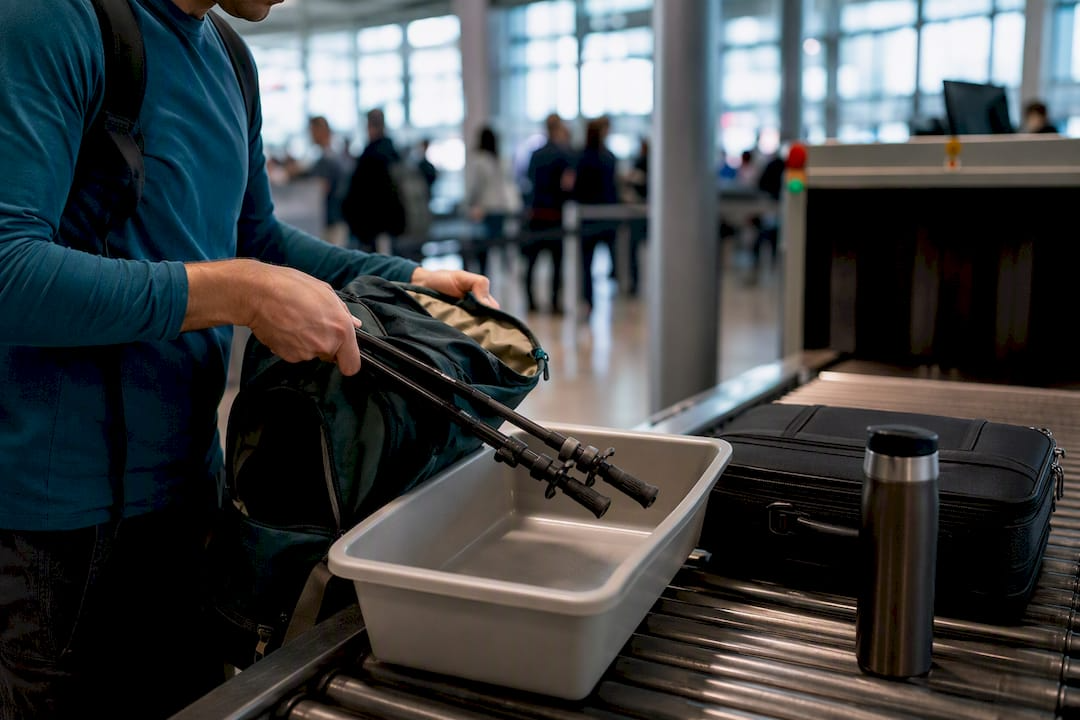
Blunt-tipped trekking poles are allowed in carry-on bags at U.S. airports, as long as they clear screening. Sharp-tipped poles, the kind with exposed carbide spikes, are not allowed in your carry-on and need to go in checked luggage.
That's the short version. Here's the part travelers miss:
- The TSA officer at the checkpoint makes the final call, regardless of what the tip looks like.
- Even a pole TSA clears can still get bumped to checked baggage if it doesn't meet your airline's carry-on size limits.
Know your tip type and your airline's dimensions before you get to the gate, and you'll avoid most surprises.
Key Takeaways
Blunt-tipped trekking poles can travel in U.S. carry-on bags if they pass TSA screening and fit your airline's carry-on size limits.
| Point | Details |
|---|---|
| Tip type decides carry-on status | Rubber or rounded tips are allowed in carry-on; exposed carbide spikes must be checked. |
| Officer has final say | A TSA officer's judgment at the checkpoint overrides general guidance, tip type included. |
| Airline rules are separate from TSA | Even TSA-approved poles can be gate-checked or refused if they exceed your airline's carry-on dimensions. |
| Pack smart before you fly | Measure collapsed length, secure sections, cover tips, and place poles inside your bag rather than strapped outside. |
| Have a backup plan | Gate-check, counter-check, ship home, or rent locally if security denies carry-on. |
| Choose travel-ready gear | Life Camp Adventure carries collapsible, rubber-tipped trekking poles and protective sleeves built for carry-on travel. |
The Official TSA Rule On Carry On Trekking Poles
TSA's own guidance is specific: blunt-tipped hiking poles are allowed in both carry-on and checked bags, provided they pass through the X-ray screening like any other item. Sharp-tipped poles are a different story. Those are restricted to checked bags only.
What counts as "blunt" versus "sharp"? A blunt tip usually means a rubber foot, a rounded rubber ferrule, or a walking-foot style cap that covers the metal underneath. A sharp tip is an exposed carbide or steel spike with no covering, the kind designed to bite into ice or hard-packed trail. If your poles came with rubber tip protectors, keep them on. That single piece of rubber often decides whether your poles fly with you or ride in the cargo hold.
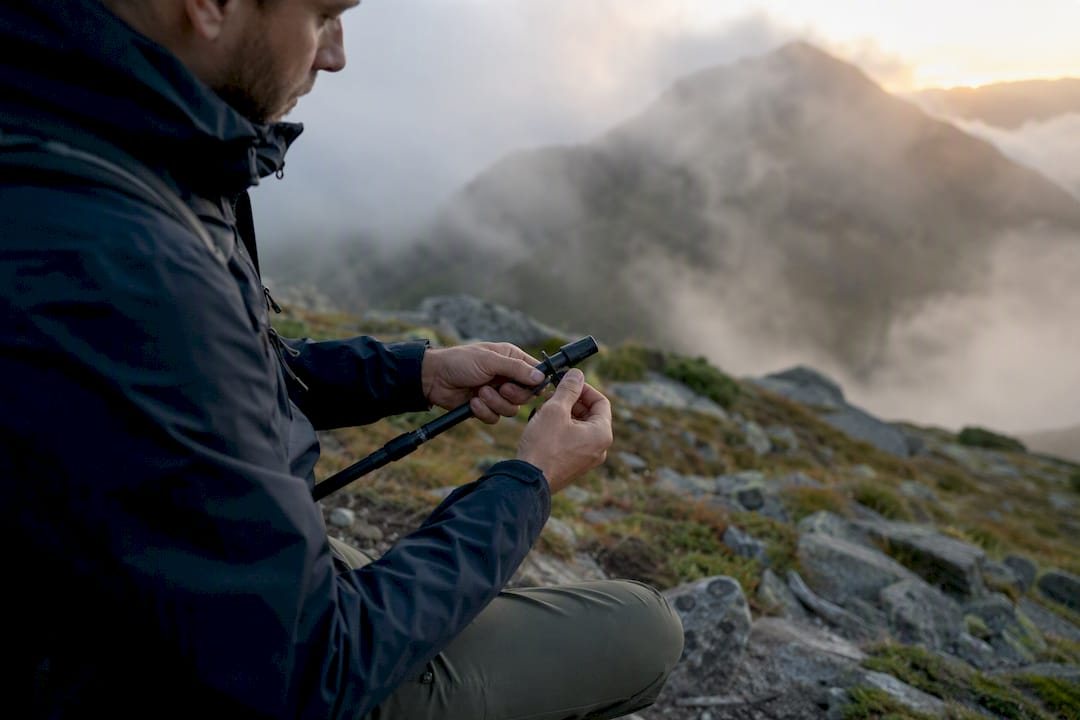
One TSA officer's judgment call at the checkpoint overrides everything else, including what you read online, including this article. TSA officers make the final decision on every item that passes through screening, tip type or not.
Pro Tip: Check the TSA "What Can I Bring?" tool or the MyTSA app the night before your flight. Rules get updated, and a two-minute check beats an argument at security.
Why Airline Rules Matter As Much As TSA Rules
TSA decides what's allowed through security. Your airline decides what fits in the cabin, and those are two completely different sets of rules. A pair of poles that sails through screening can still get gate-checked if they're too long for your carrier's overhead bin or personal-item allowance.
Airlines generally respond to trekking poles one of three ways:
- They allow the poles in the cabin if collapsed length fits inside your carry-on bag or the overhead bin.
- They require a gate-check for long, bulky, or oddly-shaped items that won't stow properly.
- They require full check-in at the ticket counter, particularly on smaller regional aircraft with limited overhead space.
Even fully TSA-compliant poles get rejected by an airline over size alone, so measure your poles collapsed, compare that number against your airline's published carry-on dimensions, and build in extra time at check-in in case you need to reroute them to the hold.
Which Pole Designs Pass Carry On Screening
Not every trekking pole is built the same way, and design details decide a lot at the checkpoint.
- Collapsible poles (telescoping or folding) pack down small enough to slide into most carry-on bags, which makes them the more travel-friendly option. They still have to meet the same tip rule as fixed-length poles.
- Fixed-length poles are harder to fit inside standard luggage and more likely to need checking regardless of tip type, purely on size.
- Rubber ferrules and rounded walking feet generally read as blunt and clear screening.
- Exposed carbide or steel spikes read as sharp, no matter how the rest of the pole is designed.
- Partial disassembly doesn't change tip status. Breaking a folding pole into sections doesn't turn a sharp tip blunt. If the spike is exposed when reassembled, it's still restricted from carry-on.
If your poles ship with interchangeable baskets or tip caps, pack the rubber ones and leave the snow baskets and bare spikes at home.
How To Pack Trekking Poles For A Smooth Screening
A little prep at home saves a lot of back-and-forth at the checkpoint.
- Measure your poles collapsed. Confirm the folded length fits your carry-on bag's dimensions, not just the airline's general carry-on allowance.
- Check the tip. Confirm rubber or rounded caps are attached and secure before you leave for the airport.
- Clean off trail debris. Dirt, mud, or plant matter can trigger a secondary inspection for agricultural reasons, separate from the TSA screening itself.
- Secure the sections. Use the pole's own locking mechanism or a strap so it doesn't telescope open inside your bag.
- Use a protective sleeve. A padded pole sleeve or dedicated pole bag keeps tips covered and prevents them from poking through your carry-on's fabric.
- Pack inside your bag, not strapped outside. Poles lashed to the outside of a pack are harder to screen and more likely to draw extra attention.
- Present them clearly at the X-ray belt. Pull them out separately if asked, and be ready to answer basic questions about tip type.
Pro Tip: Snap a photo of your poles' tip and collapsed length before travel. If a checkpoint officer questions the tip type, a clear photo speeds up the conversation more than trying to describe rubber versus carbide on the spot.
What To Do If TSA Denies Your Poles
Getting turned away at the checkpoint isn't a dead end, it just means the poles fly a different way. Traveler reports collected after recent TSA guidance updates show officer discretion still varies checkpoint to checkpoint, so have a backup plan ready.
- Gate-check them at the boarding door, often free and fast, though not every gate agent offers it for trekking poles specifically.
- Return to the ticket counter and check a bag, which usually costs a standard checked-bag fee.
- Ship them home if you're departing from your own airport and don't want to deal with the return trip.
- Buy or rent poles at your destination if you're already past security and out of easy options.
If an officer checks the poles on your behalf at the checkpoint, note their condition and get a claim receipt in case anything turns up damaged at baggage claim.
Do You Need To Declare Trekking Poles At Security?
Trekking poles don't require a formal declaration the way currency over a certain amount or firearms do. There's no special form and no separate line for hiking gear. What matters is presentation, not paperwork.
Pull your poles out of your bag and place them directly on the X-ray belt rather than leaving them buried inside your pack. A pole tucked inside a backpack often triggers a secondary bag check anyway, since the shape reads unclearly on the scanner. Presenting it openly usually moves things along faster.
If a TSA officer asks about the tip type, answer plainly: tell them whether the tips are rubber or exposed carbide, and show them if asked. Officers deal with hiking gear regularly at airports near trailheads and national parks, so a straightforward answer usually resolves questions fast. Volunteering information upfront, "these have rubber tip covers," tends to work better than waiting for the officer to ask.
If you're flying internationally out of a U.S. airport, check the destination country's rules too. The United Kingdom, for example, prohibits walking and hiking poles in hand luggage entirely, regardless of tip type. A pole cleared for carry-on out of a U.S. airport could still need checking on the return leg if you're flying through a country with stricter rules. When in doubt on an international itinerary, check in the poles for the whole trip and skip the guesswork.
Renting Poles At Your Destination Instead
Sometimes the simplest solution is not bringing poles through security at all. Many gateway towns near major trailheads, national parks, and ski destinations have outfitters that rent trekking poles by the day or week. This sidesteps the tip question, the airline size limit, and the risk of a checkpoint denial completely.
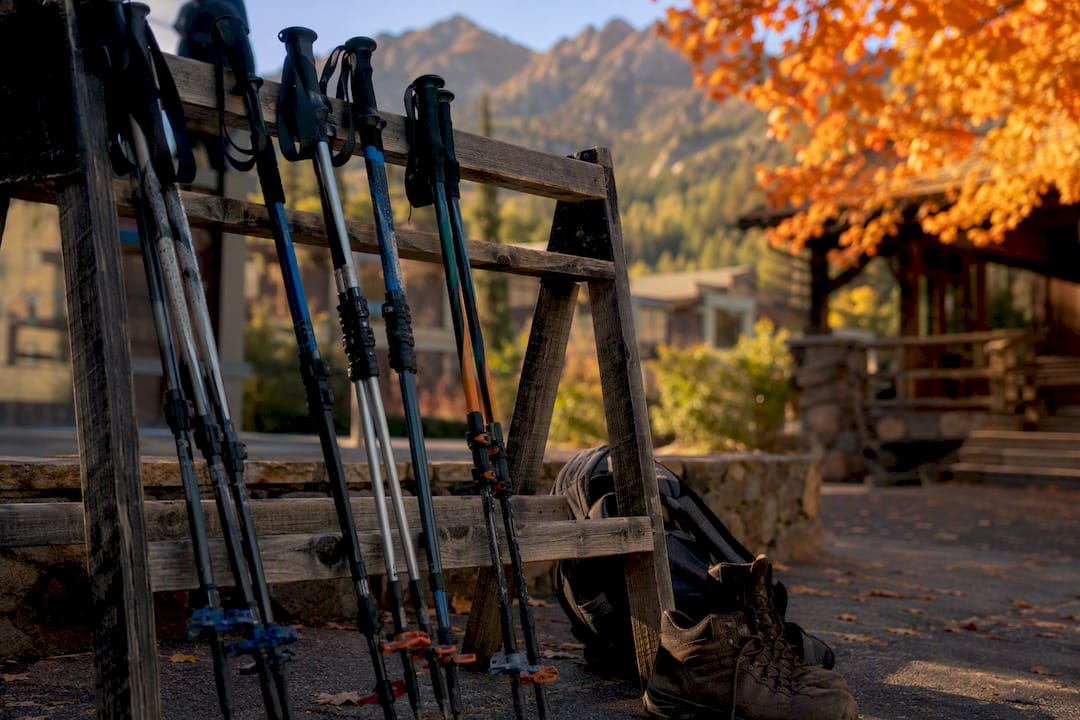
Renting makes the most sense on trips where poles are a nice-to-have rather than a requirement, like a single day hike bolted onto a longer trip, or a first attempt at trekking poles before committing to buying a pair. It also helps if you're flying with an airline known for tight overhead bin space on regional routes, where checking gear adds real hassle.
The trade-off is availability and fit. Rental poles are rarely adjustable to the exact height range you're used to, and popular trailhead towns can run low on rental stock during peak season weekends. If you already know your ideal pole length and grip style, or you're headed somewhere remote without easy access to gear shops, bringing your own collapsible poles checked or carried on still beats hoping a rental counter has what you need.
For most travelers doing more than one or two trips a year, owning a pair that packs into your hiking backpack ends up cheaper and more reliable than repeat rental fees.
What Actually Works When You Fly With Trekking Poles
Most of the confusion around flying with trekking poles comes from people treating TSA rules and airline rules as the same thing. They're not. TSA cares about the tip. Your airline cares about the inches. Solve for both separately and you'll rarely get stuck.
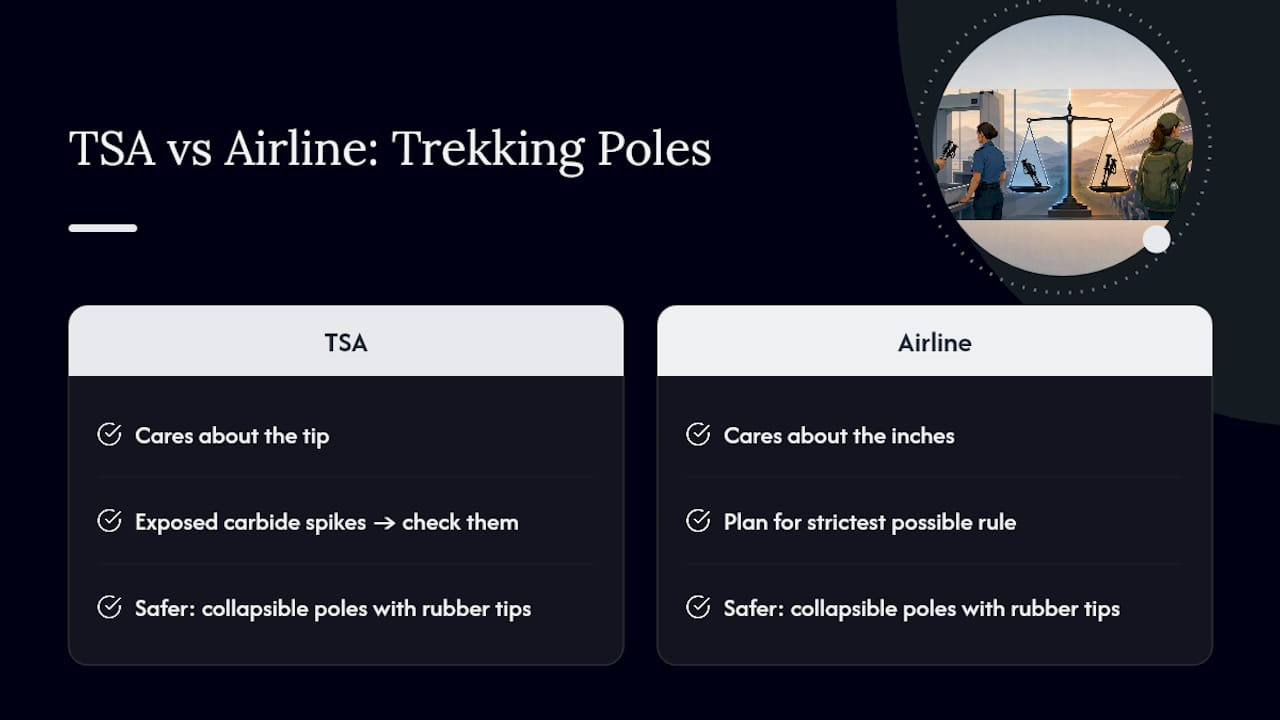
The safer bet, in our view, is always collapsible poles with rubber tips if you're set on carrying them on. If your poles have exposed carbide spikes, don't gamble on convincing an officer otherwise. Check them from the start and save yourself the checkpoint conversation. Life Camp Adventure has spent years helping hikers gear up for trips where every ounce and every inch of pack space counts, and the pattern holds: travelers who plan for the strictest possible rule, not the most convenient one, have the smoothest airport experience.
Travel-Ready Trekking Poles Worth Packing
The right pole makes this whole checkpoint conversation moot. Look for a collapsible design that folds down to fit inside your carry-on, rubber or rounded tip covers rather than exposed spikes, and a padded sleeve that keeps everything contained and protected in transit.

Life Camp Adventure stocks travel-friendly gear built with exactly this kind of trip in mind, poles that pack small, tips that clear screening, and accessories that keep your kit organized whether it's riding in the cabin or the hold. Browse outdoor gear built for travel to see what fits your next trip, or check the adventure travel packing list if you're trying to keep your whole kit carry-on only. Before you fly, measure your collapsed pole against your carry-on's dimensions and grab a protective sleeve if you don't already have one.
Frequently Asked Questions
Can you bring trekking poles on a plane in your carry-on? Yes, if the tips are blunt or rubber covered. TSA allows blunt-tipped hiking poles in carry-on bags, subject to screening and airline size limits.
Are trekking poles allowed on planes if they have carbide tips? Not in carry-on. Sharp, exposed carbide or metal tips need to go in a checked bag. Rubber tip covers, if your poles came with them, can resolve this before you even reach security.
Do collapsible trekking poles get treated differently than fixed-length poles? Collapsible poles are easier to fit inside carry-on luggage, but the tip rule applies the same way to both. A collapsible pole with an exposed spike still needs to be checked.
What happens if a TSA officer won't let my poles through? You can gate-check them, check a bag at the counter, ship them home, or rent replacements at your destination. The officer's decision at the checkpoint is final for that flight.
Do trekking poles need to be declared at TSA security? There's no formal declaration process. Just place your poles on the X-ray belt separately from your bag and answer honestly if an officer asks about the tip type.
Sources
- Hiking Poles | Transportation Security Administration - TSA
- Easy Hiking Poles On Planes Guide 2026 Rules
- Gov
