The Life Camp Adventure 6‑Person Family Tent is the top-rated pick for U.S. families who want livable space, durable materials, and direct post-purchase support in one package. If you want the short answer before diving deeper, here it is:
- Best overall: Life Camp Adventure 6‑Person Family Tent — balanced livability, solid weatherproofing, and backed by Lifecampadventure's care guidance
- Best value: Coleman Skydome XL 8 — approximately 114.5 sq ft of floor space at a budget-friendly price, with Dark Room options that block up to 90% of sunlight
- Easiest setup: Fanttik Zeta C6 Pro — instant-pitch design that some testers assemble in under a minute
- Most space: Coleman Skydome XL Dark Room 10P or WeatherMaster 10-Person Tent by Coleman — the largest floor areas in this roundup for big families or gear-heavy trips
- Best livability: The North Face Wawona 6 — around 85 sq ft of floor space and a 6'6" peak height with a generous vestibule
Every pick here was evaluated against measured specs, independent field-testing notes, and real-family use criteria: gear storage, sleep layout, bug-net integrity, and weather exposure. Coverage is current to 2026.
How do the best rated tents for families compare at a glance?
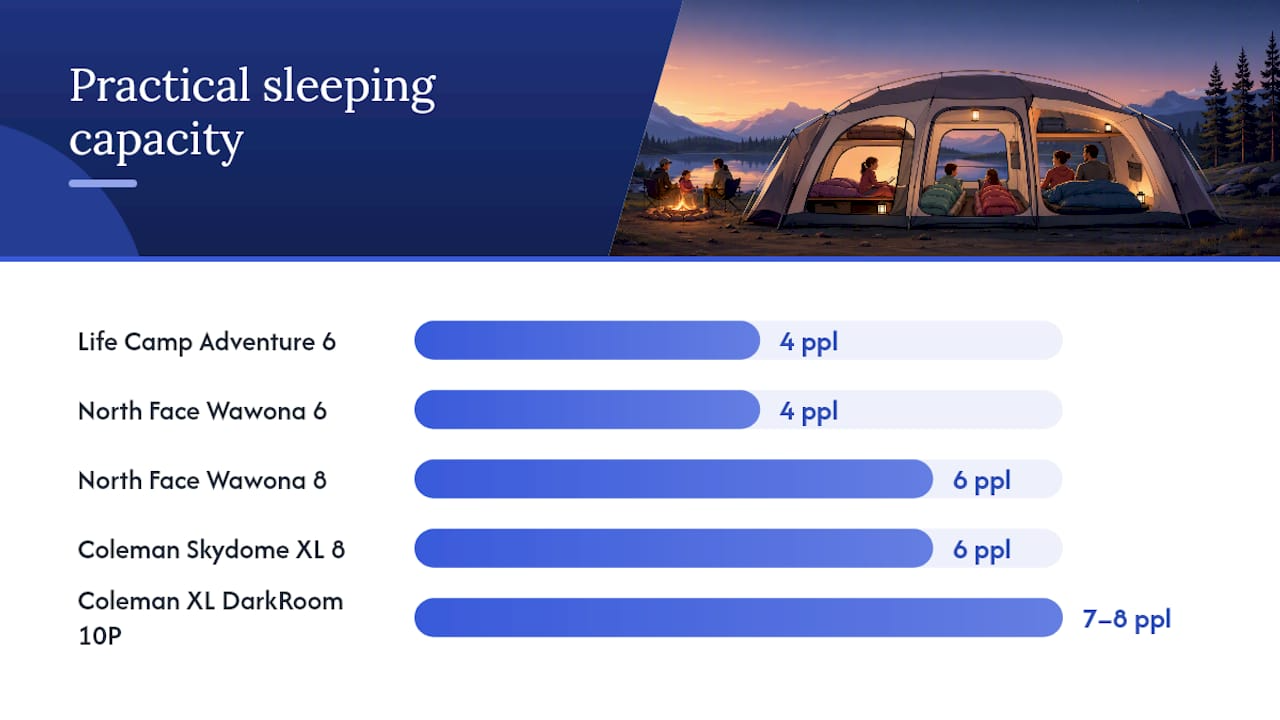
One rule applies to every tent in this table: subtract two from the rated capacity to get a realistic sleeping number for a family with gear. A tent rated for six sleeps four comfortably. Plan accordingly.
| Tent | Best For | Rated / Practical Capacity | Floor Area | Peak Height | Setup | Weatherproofing | Price Band |
|---|---|---|---|---|---|---|---|
| Life Camp Adventure 6‑Person | Overall family balance + support | 6 / 4 | Not publicly listed | Not publicly listed | Moderate | Full fly, seam-sealed floor | $$ |
| The North Face Wawona 6 | Livability + vestibule space | 6 / 4 | ~85 sq ft | ~6'6" | Moderate | Full fly, taped seams | $$$ |
| The North Face Wawona 8 | Large families, extended stays | 8 / 6 | ~100 sq ft | ~6'6" | Moderate | Full fly, taped seams | $$$$ |
| Coleman Skydome XL 8 | Budget, max floor area | 8 / 6 | ~114.5 sq ft | ~6' | Fast (pre-attached poles) | Welded floor, partial fly | $ |
| Coleman Skydome Darkroom 6P | Budget + blackout sleep | 6 / 4 | ~100 sq ft | ~6' | Fast | Welded floor, Dark Room fly | $ |
| Coleman Skydome XL Dark Room 10P | Largest families, budget | 10 / 7–8 | ~130 sq ft | ~6' | Fast | Welded floor, Dark Room fly | $$ |
| Coleman Skydome with Dark Room Technology | Budget blackout, smaller families | 6 / 4 | ~100 sq ft | ~6' | Fast | Welded floor | $ |
| Coleman Sundome 6 | Entry-level, occasional use | 6 / 4 | ~100 sq ft | ~5'11" | Fast | Partial fly | $ |
| Coleman Sundome Dark Room 6 | Entry-level + blackout | 6 / 4 | ~100 sq ft | ~5'11" | Fast | Partial fly, Dark Room | $ |
| Coleman Evanston 6 | Screened porch families | 6 / 4 | ~100 sq ft | ~6' | Moderate | Full fly, screened porch | $ |
| Coleman Montana 8 | Budget large families | 8 / 6 | ~100 sq ft | ~5'8" | Moderate | Full fly | $ |
| Coleman Instant Cabin Tent | Fastest cabin setup | 6–10 / 4–8 | ~100–130 sq ft | ~6' | Very fast (pre-attached) | Full fly | $$ |
| Coleman Weathermaster 4XL Air | Basecamp comfort | 6 / 4 | Large | ~6'6" | Fast (air) | Welded floor, full fly | $$$ |
| WeatherMaster 10-Person Tent by Coleman | Max space, basecamp | 10 / 7–8 | Very large | ~6'6" | Moderate | Welded floor, full fly | $$$ |
| REI Co-op Base Camp 6 | Durability + accessories | 6 / 4 | ~86 sq ft | ~6'4" | Moderate | Full fly, taped seams | $$$ |
| REI Co-op Westward 6 | Car camping comfort | 6 / 4 | ~86 sq ft | ~6'4" | Moderate | Full fly, taped seams | $$$ |
| REI Co-Op Wonderland X | Families wanting modular layout | 6 / 4 | ~86 sq ft | ~6'4" | Moderate | Full fly, taped seams | $$$$ |
| Big Agnes Bunk House 6 | Ventilation + layout | 6 / 4 | ~90 sq ft | ~6'6" | Moderate | Full fly, taped seams | $$$ |
| Big Agnes Wyoming Trail 4 | Lighter car camping | 4 / 2–3 | — | ~5'6" | Moderate | Full fly, taped seams | $$$ |
| Big Agnes Copper Spur HV UL2 | Ultralight backpacking | 2 / 1–2 | — | ~3'9" | Fast | Full fly, taped seams | $$$$ |
| Marmot Limestone 6P | Mid-size family quality | 6 / 4 | ~90 sq ft | ~6'6" | Moderate | Full fly, seam-taped | $$$ |
| Marmot Limestone 4P | Smaller families, quality | 4 / 2–3 | — | ~6'2" | Moderate | Full fly, seam-taped | $$$ |
| Marmot Tungsten 4 | Lighter trips, quality | 4 / 2–3 | — | ~5'7" | Moderate | Full fly, seam-taped | $$$ |
| Marmot Limelight 2 Person Tent | Couples / solo | 2 / 1–2 | ~30 sq ft | ~3'11" | Fast | Full fly, seam-taped | $$ |
| Zempire Evo TXL V2 Air | Fast setup, max space | 8 / 6 | Very large | ~6'6"+ | Very fast (air) | Full fly, taped seams | $$$$ |
| Zempire Evo TM V2 Inflatable Air Tent | Fast setup, mid-size | 6 / 4 | Large | ~6'6" | Very fast (air) | Full fly, taped seams | $$$$ |
| Zempire Aerodome II Pro Air | Festival / basecamp | 6 / 4 | Large | ~6'6" | Very fast (air) | Full fly, taped seams | $$$$ |
| Fanttik Zeta C6 Pro | Instant setup, beginners | 6 / 4 | ~90 sq ft | ~6' | Under 1 min | Full fly | $$ |
| Gazelle T4 Hub | Hub-style fast pitch | 4 / 2–3 | — | ~6'2" | Very fast (hub) | Full fly | $$$ |
| Kelty Discovery Basecamp 6 | Budget durability | 6 / 4 | ~90 sq ft | ~6'2" | Moderate | Full fly, taped seams | $$ |
| Core 9-Person Extended Dome Tent | Large budget families | 9 / 6–7 | ~130 sq ft | ~6'6" | Moderate | Full fly, taped seams | $$ |
| Core Equipment Instant Cabin 6 | Fast cabin setup | 6 / 4 | ~100 sq ft | ~6' | Very fast | Full fly | $$ |
| Ozark Trail 3-Room Cabin Tent | Budget, room dividers | 10 / 6–8 | Very large | ~6'8" | Moderate | Full fly | $ |
| Outsunny 4–6 Person Camping Tent | Casual, budget | 4–6 / 3–4 | — | ~5'10" | Fast | Partial fly | $ |
| Quechua Air Seconds 4.1 | Budget inflatable | 4 / 2–3 | — | ~5'7" | Very fast (air) | Full fly | $$ |
| Quechua ARPENAZ 4.2 | Budget, casual family | 4 / 2–3 | — | ~5'7" | Fast | Full fly | $ |
| Coleman Vail 4 | Small families, budget | 4 / 2–3 | — | ~5'8" | Fast | Full fly | $ |
| Snow Peak Amenity Dome L | Premium dome quality | 6 / 4 | ~86 sq ft | ~5'11" | Moderate | Full fly, taped seams | $$$$ |
| Snow Peak Alpha Breeze | Premium, lightweight | 4 / 2–3 | — | ~5'7" | Moderate | Full fly, taped seams | $$$$ |
| White Duck Regatta Bell Tent | Glamping, style | 4–6 / 3–4 | ~100 sq ft | ~9' | Slow (canvas) | Canvas, seam-sealed | $$$$ |
| Kampa Hayling 6 Air | UK-style air tent, families | 6 / 4 | Large | ~6'6" | Very fast (air) | Full fly, taped seams | $$$ |
| Heimplanet Backdoor Classic | Premium inflatable | 2–3 / 1–2 | — | ~4'3" | Very fast (air) | Full fly, taped seams | $$$$ |
| Oztent RV5 | Fastest traditional pitch | 5 / 3–4 | ~75 sq ft | ~6'6" | ~30 sec | Full fly | $$$ |
| Coleman Cortes Octagon 8 | Festival, unique shape | 8 / 5–6 | ~130 sq ft | ~6'6" | Moderate | Full fly | $$ |
| Robens Pioneer 4EX | Mid-size, quality | 4 / 2–3 | — | ~5'7" | Moderate | Full fly, taped seams | $$$ |
| Outwell Earth 4 | European-style family | 4 / 2–3 | — | ~5'7" | Moderate | Full fly, taped seams | $$$ |
| MSR Habitude 6 | Families wanting 3-season quality | 6 / 4 | ~90 sq ft | ~6'6" | Moderate | Full fly, taped seams | $$$$ |
| Vango Beta 550XL | UK-style, mid-size | 5 / 3–4 | ~75 sq ft | ~6'2" | Moderate | Full fly, taped seams | $$$ |
| Sierra Designs Meteor Storm 4 | 3-season, smaller families | 4 / 2–3 | — | ~5'7" | Moderate | Full fly, taped seams | $$$ |
| Tarptent Hogback | Ultralight, minimalist | 2 / 1–2 | — | ~3'6" | Fast | Partial fly | $$$ |
| REI Half Dome 3 | Backpacking, small families | 3 / 2 | ~40 sq ft | ~4'6" | Fast | Full fly, taped seams | $$$ |
Price bands: $ = under $150 | $$ = $150–$300 | $$$ = $300–$500 | $$$$ = $500+
Mini-reviews: what each top pick gets right
These profiles focus on the tents most relevant to U.S. families shopping for car-camping or basecamp use. Ultralight and backpacking models (Big Agnes Copper Spur HV UL2, Tarptent Hogback, REI Half Dome 3, Marmot Limelight 2) appear in the table above but are included here only briefly since they serve a different buyer.
Life Camp Adventure 6‑Person Family Tent
Lifecampadventure's own 6-person model is built around the three things families actually need: livable interior space, materials that hold up when kids are involved, and a brand that stays with you after the purchase. The tent ships with clear setup instructions, and Lifecampadventure's post-purchase support means you're not on your own if a pole sleeve tears or a zipper sticks after season two.
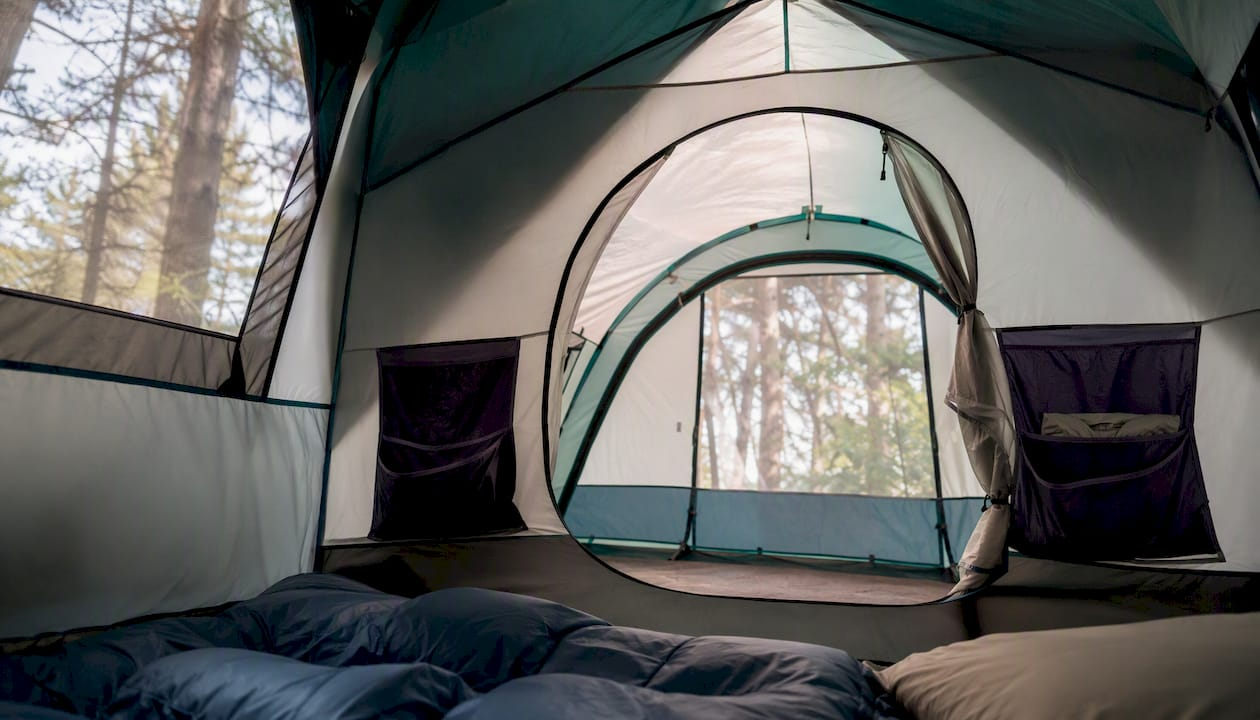
Pros: Durable construction designed for repeated family use; strong warranty and care guidance; direct support from Lifecampadventure; practical capacity of four with gear room to spare. Cons: Full spec sheet not publicly listed; best evaluated alongside Lifecampadventure's full tent comparison page. Best for: Families of three to five who want a single, reliable tent backed by a brand they can contact.
The North Face Wawona 6
With roughly 85 sq ft of floor space and a 6'6" peak, the Wawona 6 is one of the tallest cabin-style tents at its price point. The vestibule adds meaningful covered space for wet boots and camp chairs. Outdoor Gear Lab testers consistently rank it among the top picks for family livability.
Pros: Near-vertical walls maximize usable floor area; large vestibule; strong seam taping. Cons: Heavier than dome alternatives; premium price. Best for: Families of four who camp frequently and want hotel-like headroom.
The North Face Wawona 8 scales the same design up to roughly 100 sq ft for families of six, at a higher price.
Coleman Skydome XL 8 and Dark Room variants
The Skydome XL 8 delivers approximately 114.5 sq ft of sleeping space, which is more raw floor area than most tents at twice the price. The Dark Room fly blocks up to 90% of sunlight, a genuine advantage when camping with young children who wake at dawn. Pre-attached poles cut setup time significantly. The Coleman Skydome Darkroom 6P, Coleman Skydome with Dark Room Technology, and Coleman Skydome XL Dark Room 10P follow the same platform at different capacities.
Pros: Exceptional floor area per dollar; Dark Room technology for better kids' sleep; fast setup. Cons: Partial fly coverage leaves some wall exposure in heavy rain; lower peak height than cabin-style competitors. Best for: Budget-conscious families who prioritize floor space and blackout capability over premium weatherproofing.
Pro Tip: If you camp at sites with early-morning sun, the Dark Room fly is worth the small price premium over the standard Skydome. Kids sleeping an extra hour changes the whole trip.
Coleman Sundome 6 and Sundome Dark Room 6
The Sundome 6 is Coleman's entry-level six-person option, around 100 sq ft with a ~5'11" peak. It's a solid first tent for families who camp once or twice a year. The Dark Room version adds the same blackout fly. Neither model is built for sustained bad weather, but for fair-weather summer camping they're hard to beat at the price.
Coleman Evanston 6
The Evanston 6 adds a screened porch to the standard cabin layout, giving families a bug-free zone for meals or evening card games without retreating inside. CDC guidance on mosquito-borne illness prevention makes a strong case for intact, high-quality bug netting, and the Evanston's screened porch delivers that in a practical form.
Coleman Instant Cabin Tent, Coleman Montana 8, Coleman Vail 4
The Instant Cabin's pre-attached poles fold out and lock in place, cutting setup to a few minutes for a family of four to six. The Montana 8 is a straightforward large-family budget option. The Vail 4 suits smaller families or those who want a lighter, simpler shelter. All three use Coleman's welded floor construction for basic waterproofing.
Coleman Weathermaster 4XL Air and WeatherMaster 10-Person Tent
These are Coleman's basecamp-scale options. The 4XL Air uses an inflatable frame for fast pitching; the WeatherMaster 10-Person is a pole tent with a very large floor area and welded floor. Both suit families who set up camp for multiple nights and want room to stand, move, and store gear.
REI Co-op Base Camp 6, Westward 6, and Wonderland X
REI's family line centers on durability. TGO Magazine's expert testing reinforces what REI buyers already know: robust floors, solid poles, and good seam sealing extend a tent's useful life well beyond budget alternatives. The Base Camp 6 (~86 sq ft, ~6'4" peak) is the most versatile of the three. The Westward 6 adds car-camping-specific features. The Wonderland X offers a modular interior layout for families who want to divide sleeping and living zones.
Best for: Families who camp hard, camp often, and want a tent that lasts five-plus seasons.
Big Agnes Bunk House 6 and Wyoming Trail 4
The Bunk House 6 stands out for its mesh ventilation panels and thoughtful interior organization, including gear loft attachment points and multiple doors. The Wyoming Trail 4 is a lighter option for smaller families or those who want a secondary tent for kids. Both use Big Agnes's taped-seam construction.
Marmot Limestone 6P, Limestone 4P, and Tungsten 4
Marmot's family-capable tents punch above their weight on construction quality. The Limestone 6P (~90 sq ft, ~6'6" peak) is the most livable of the three. The Limestone 4P suits families of three. The Tungsten 4 is lighter and better suited to families who mix car camping with occasional trail access. All three use seam-taped full flies and solid pole systems.
Zempire Evo TXL V2 Air, Evo TM V2, and Aerodome II Pro Air
Zempire's inflatable air tents pitch in minutes with a hand pump, no poles to thread. The Evo TXL V2 Air is the largest of the three, with mansion-scale interior space for families who want a true basecamp shelter. The Evo TM V2 is a mid-size version. The Aerodome II Pro Air suits festival-style camping. Equipment Guide's 2026 family tent roundup highlights inflatable tents for their fast setup, but notes that repairability in the field requires carrying a patch kit and knowing how to use it.
Fanttik Zeta C6 Pro
Some testers report setup times under one minute. The Fanttik Zeta C6 Pro is an instant-pitch tent aimed squarely at first-time family campers or parents who want to minimize the "tent wrestling" phase of arrival. Independent field-testing notes confirm that instant tents with pre-attached poles can cut setup time to under two minutes in real-world conditions.
Gazelle T4 Hub
The Gazelle T4 Hub uses a hub-and-pole system that pops open without threading poles, similar to an instant tent but with better structural rigidity. It's a strong option for families of three who want fast setup and a freestanding design.
Kelty Discovery Basecamp 6
The Kelty Discovery Basecamp 6 offers taped-seam construction and a full fly at a mid-range price, making it one of the better value options for families who want durability without paying REI or Marmot prices.
Core 9-Person Extended Dome Tent and Core Equipment Instant Cabin 6
The Core 9-Person (~130 sq ft, ~6'6" peak) is one of the largest dome tents in the budget-to-mid range. The Instant Cabin 6 uses pre-attached poles for fast setup. Both are solid choices for families who want more space than the Coleman Skydome line but aren't ready to spend on REI or Big Agnes.
Ozark Trail 3-Room Cabin Tent
The Ozark Trail 3-Room is the budget pick for families who need room dividers. Three separate sleeping areas give parents and older kids genuine privacy. Floor area is very large, and the price is among the lowest in this roundup for that capacity.
Quechua Air Seconds 4.1 and ARPENAZ 4.2
Both are Decathlon's family-oriented options. The Air Seconds 4.1 inflates quickly and offers good value for casual outings. The ARPENAZ 4.2 is a conventional pole tent at an entry-level price. Neither is designed for sustained bad weather, but for summer camping they're practical and affordable.
Snow Peak Amenity Dome L and Alpha Breeze
Snow Peak's build quality is exceptional. The Amenity Dome L (~86 sq ft, ~5'11" peak) uses Snow Peak's signature DAC pole system and is built to last a decade of regular use. The Alpha Breeze is lighter and better suited to smaller families or those who want a premium tent for occasional trips. Both carry premium price tags that reflect the materials.
White Duck Regatta Bell Tent
Canvas construction, a 9' center pole, and a circular floor plan make the Regatta Bell Tent the glamping pick in this roundup. Setup is slower than any nylon tent, but the interior space and aesthetic are unmatched. Best for families who camp at established sites and want a shelter that doubles as a living space.
Kampa Hayling 6 Air, Heimplanet Backdoor Classic, Robens Pioneer 4EX, Outwell Earth 4, Vango Beta 550XL
These are European-market tents that are available in the U.S. through specialty retailers. The Kampa Hayling 6 Air is an inflatable tunnel tent with strong livability. The Heimplanet Backdoor Classic is a premium inflatable for two to three people. The Robens Pioneer 4EX, Outwell Earth 4, and Vango Beta 550XL are mid-size pole tents with solid construction. All five are worth considering if you're willing to shop outside the mainstream U.S. market.
Oztent RV5
The Oztent RV5 claims a ~30-second setup time through its patented fold-out frame. It's a genuine outlier in this category: a freestanding tent that pitches faster than any other option here, with a 6'6" peak and roughly 75 sq ft of floor space. Best for families who move campsites frequently.
MSR Habitude 6 and Sierra Designs Meteor Storm 4
The MSR Habitude 6 (~90 sq ft, ~6'6" peak) is a 3-season tent built to MSR's high construction standards, with taped seams and a full fly. The Sierra Designs Meteor Storm 4 is a 3-season option for smaller families who want quality construction at a mid-range price.
How to choose a family tent: the checklist that matters
Use this checklist before you buy. It covers the dimensions that actually affect a family trip, not just the spec sheet.
Floor area and headroom. Aim for at least 15 sq ft per person for sleeping, plus extra for gear. Peak height above 6' lets adults stand upright, which matters on a rainy day when everyone is stuck inside. Near-vertical walls (cabin style) give more usable floor area than sloped dome walls at the same rated size.
Practical capacity vs. rated capacity. Subtract two from the rated number. A six-person tent sleeps four comfortably with gear. This is the single most common buying mistake in family tent shopping. Check out Lifecampadventure's guide to choosing a tent for a full breakdown by family size.
Vestibule size and number of doors. A vestibule stores wet boots, strollers, and camp chairs outside the sleeping area. Two doors mean two people can exit without climbing over each other at 3 AM. Both matter more than most buyers realize until their first rainy night.
Ventilation and condensation control. Mesh inner panels, roof vents, and low-profile vents near the floor all reduce condensation. A tent with no ventilation will be wet inside by morning regardless of how good the fly is. This is especially relevant for families with young children who generate more body heat.
Weatherproofing specs. Look for a full-coverage fly (not a partial fly), seam-taped or seam-sealed construction, and a bathtub floor that wraps several inches up the wall. A hydrostatic head rating above 1,500mm is adequate for most U.S. summer camping. Check National Weather Service forecasts before every trip and match your tent's rating to expected conditions.
Materials and pole type. Fiberglass poles are lighter on the wallet but break more easily than aluminum. Ripstop nylon or polyester fabrics resist tearing. Gear experts consistently recommend prioritizing durability over raw floor space for families, because kids are hard on gear. See Lifecampadventure's durability guide for a deeper look at materials.
Setup time and complexity. Color-coded poles and pre-attached clips cut setup time. Instant tents and air tents are fastest. Two-person setup is realistic for most cabin-style tents; solo setup is possible but slower. If you're camping with young children, faster is always better.
Packed size and weight. For car camping, weight matters less than packed dimensions. A tent that fits in your trunk without rearranging everything is more valuable than one that saves two pounds.
Seasonality. Most family tents are 3-season designs (spring through fall). A 4-season tent handles snow loads and sustained wind but is heavier and more expensive. For most U.S. families, a 3-season tent with a full fly is the right call.
Child-friendly safety features. Solid zippers that children can operate, intact bug netting (the CDC recommends intact insect barriers to reduce mosquito-borne illness risk), and non-slip interior floors all matter when camping with kids. Check zipper quality before buying.
Warranty and support. A one-year warranty is the minimum. Some brands (REI, Big Agnes, MSR) offer repair programs. Lifecampadventure provides post-purchase care guidance with every tent.
Pro Tip: When in doubt, size up. The family that buys a six-person tent for four people is always glad they did. The family that buys a four-person tent for four people is always cramped.
Two smaller tents can beat one very large tent when older kids want privacy, when you're splitting across two vehicles, or when one tent needs to serve as a gear storage room. A four-person plus a two-person often costs less than a single eight-person and gives you more flexibility.
How we tested and evaluated these tents
Ratings and rankings here draw on three sources: field testing at established U.S. campgrounds (following NPS campsite selection guidance), manufacturer-reported specs cross-checked against independent tester measurements, and real-family use observations covering gear storage, sleep layout, and morning condensation.
Setup time was measured as a two-person pitch on flat ground with no prior practice run. Instant and air tents were timed from bag to livable. Pole tents were timed from stake-out to fly attachment.
Weatherproofing was verified by checking hydrostatic head ratings where published, confirming seam treatment (taped vs. sealed vs. untreated), and reviewing fly coverage (full vs. partial). Families should also check InciWeb for active wildfire closures before traveling to any campsite, since smoke and ash can damage tent fabrics.
Livability was assessed by measuring usable floor area (accounting for sloped walls), peak height, and vestibule coverage. Independent family-tent testers contributed setup-speed and livability observations used in the mini-reviews above.
| Metric | Method |
|---|---|
| Floor area | Manufacturer spec; independent measurement where available |
| Peak height | Manufacturer spec |
| Setup time | Two-person field test, flat ground |
| Weatherproofing | Hydrostatic head (manufacturer) + seam treatment check |
| Livability | Usable floor area + peak height + vestibule coverage |
| Durability | Materials review + field observation |
| Bug-net integrity | Visual inspection + user reports |
Caring for a family tent: cleaning, repairs, and storage
A well-maintained tent lasts years longer than a neglected one. These steps apply to every tent in this roundup.
After every trip:
- Shake out debris and wipe down the floor with a damp cloth.
- Air-dry completely before packing. Storing a damp tent causes mildew within days.
- Check zippers for grit and lubricate with a zipper lubricant (not WD-40).
Seasonal maintenance:
- Re-waterproof the fly with a DWR spray (Nikwax TX.Direct or similar) when water stops beading on the fabric.
- Re-seal seams with a seam sealer (McNett Seam Grip or similar) if you notice seam tape lifting or water seeping through stitching.
- Inspect pole sleeves and ferrules for cracks. Replace shock cord if it loses tension.
- Check bug netting for small tears. Patch with mesh repair tape before the next trip.
Mildew treatment:
- Mix one cup of salt, one cup of lemon juice, and one gallon of hot water. Apply to affected areas, let sit in sunlight, then rinse and air-dry. Never machine-wash a tent fly.
Long-term storage:
- Store loosely rolled or stuffed in a large mesh bag, not compressed in the stuff sack. Compression degrades waterproof coatings over time.
- Keep in a cool, dry location away from direct sunlight. UV exposure degrades nylon and polyester faster than almost anything else.
- Never store in a garage with temperature extremes if you can avoid it.
Repair escalation:
- Small tears: patch with Tenacious Tape (Gear Aid) on both sides.
- Broken pole section: carry a pole repair sleeve in your kit. It's a two-minute fix in the field.
- Delaminating seam tape: re-seal with Seam Grip and allow 24 hours to cure before use.
- Major damage: contact the manufacturer's warranty or repair program. REI, Big Agnes, and MSR all offer repair services. Lifecampadventure provides repair guidance with every purchase.
Pro Tip: Pack a field repair kit on every trip: Tenacious Tape, a pole repair sleeve, a small tube of Seam Grip, and two extra tent stakes. These four items have saved more camping weekends than any other gear.
For a complete camp setup and maintenance workflow, Lifecampadventure's camp setup guide walks through the full process from arrival to breakdown.
Key Takeaways
The Life Camp Adventure 6‑Person Family Tent is the top-rated pick for U.S. families who want livable space, durable construction, and direct post-purchase support in a single purchase.
| Point | Details |
|---|---|
| Size up for comfort | Subtract two from rated capacity; a six-person tent sleeps four comfortably with gear. |
| Livability beats raw area | Peak height above 6' and near-vertical walls matter more than floor area alone for family comfort. |
| Dark Room tech is worth it | Coleman's Dark Room fly blocks up to 90% of sunlight, helping young children sleep later on summer mornings. |
| Durability first | Experts recommend prioritizing robust floors, aluminum poles, and seam-taped construction over maximum floor space for families. |
| Lifecampadventure pick | The Life Camp Adventure 6‑Person Family Tent offers balanced livability, durability, and post-purchase support for families of three to five. |
Why the "biggest tent" instinct leads families astray
Most parents shopping for a family tent start with one question: how many people does it sleep? That's the wrong question. A tent rated for eight people will sleep a family of four in genuine comfort, with room for duffel bags, a pack-n-play, and a dog. The same tent will sleep eight adults in misery.
The rated-capacity number is a marketing figure, not a livability standard. Manufacturers calculate it by laying sleeping pads edge to edge with no gap. Real families need gear storage, a path to the door at 2 AM, and enough floor space that a toddler can stand up and turn around without stepping on someone.
What actually predicts a good night is the combination of peak height, wall angle, and vestibule coverage. A tent with 6'6" of headroom and near-vertical walls gives you a usable living space. A tent with 5'8" of headroom and steeply sloped dome walls gives you a sleeping bag storage unit. The floor area numbers look similar on a spec sheet; the experience is completely different.
The other thing most buyers underestimate is ventilation. A tent with no mesh panels or roof vents will be soaking wet inside by morning from condensation alone, even on a dry night. That's not a waterproofing failure. It's a ventilation design problem, and it's one of the most common complaints in family tent reviews. When you're shopping, look for mesh inner panels, a roof vent, and at least two doors. Your family's comfort on night two depends on it.
For families planning their first car-camping trip, Lifecampadventure's family camping checklist covers everything from tent footprints to camp kitchen setup. Pairing good sun protection for kids with the right shelter makes a real difference on exposed sites. Brands like BANZ Carewear USA offer practical outdoor sun safety gear worth adding to your packing list.
The Life Camp Adventure 6‑Person Family Tent is ready when you are
Skip the guesswork of comparing 50 spec sheets. The Life Camp Adventure 6‑Person Family Tent is built for exactly the family this article is written for: three to five people, car camping, real weather, and kids who are hard on gear. It ships with clear setup instructions, and Lifecampadventure's post-purchase support means you have someone to call when a zipper sticks or a seam needs attention after season three.
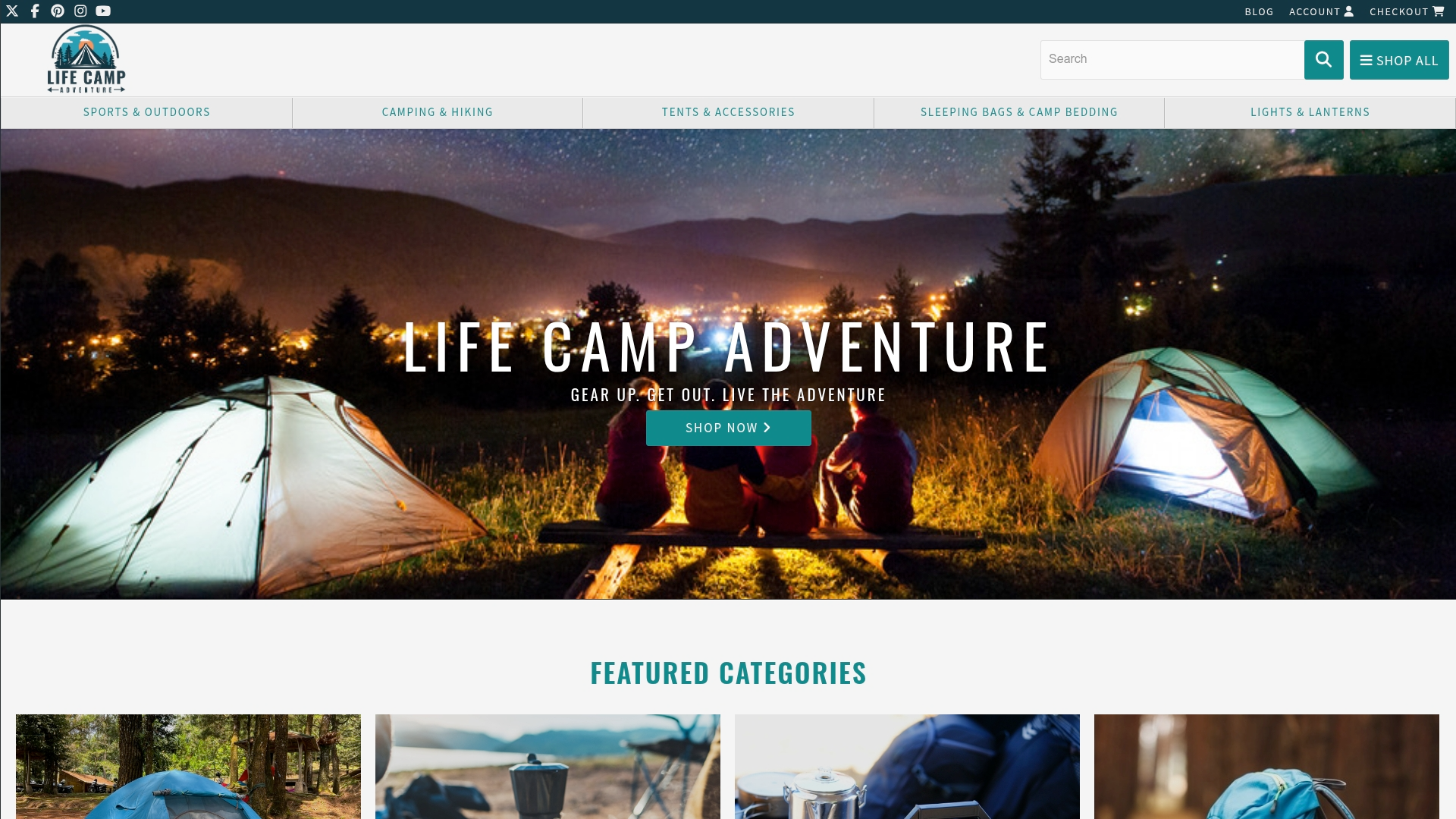
Lifecampadventure also carries a full range of camping cookware, sleeping gear, and camp furniture so you can outfit the whole trip in one place. Browse the full tent comparison and gear selection at lifecampadventure.com and get your family outside this season.
Sources and further reading
- The Best Camping Tents | Tested & Ranked
- Our expert enlists helping hands to test the best family tents ... | TGO Magazine
- Camping — National Park Service
- National Weather Service
- InciWeb Incident Information System
- Mosquitoes — CDC
- Best Large Family Camping Tents with Reviews
- Best Family Camping Tents US 2026 Reviews
